
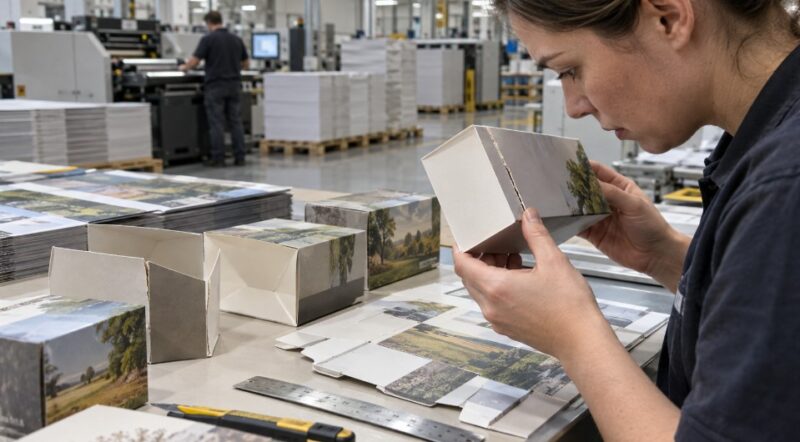
Mechanical damage to film at fold points is a common problem in the printing industry, reducing both the appearance and the seal integrity of the finished product. This phenomenon is most often caused by improper material selection or technological errors at the creasing stage.
Correct identification of the parameters of the paperboard and the protective film itself makes it possible to eliminate this defect at an early stage, even before mass production begins.
The Most Common Causes of Cracking at the Folds of Laminated Packaging
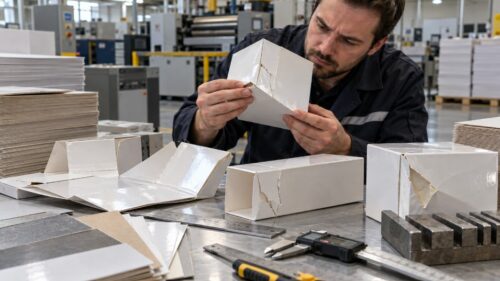
Cracks in the top layer occur when the tensile stresses on the outer edge of the fold exceed the elastic limit of the material used.
This situation becomes particularly severe in winter, when humidity levels drop in warehouse and production halls. Over-dried cellulose fibers become brittle, directly transferring stress to the delicate laminate coating.
The Impact of Laminate Quality and the Production Process on Packaging Durability
The durability of the finishing layer depends on the parameters of the materials used and the precision of the bindery machinery. Paper with too low a grammage or improperly applied adhesive causes laminated packaging to lose its integrity during 3D forming.
The key technological factors that intensify this process are:
- The type of film used polyester materials (PET) are significantly less flexible than polypropylene ones (BOPP),
- Creasing force and depth a crease that is too shallow does not properly break the paperboard fibers, forcing unnatural stretching of the laminate,
- The level of adhesive application an insufficient or uneven layer of adhesive makes it easier for the film to delaminate at sharp edges.
High-performance gluing lines require the application of a polyurethane adhesive layer weighing at least 1.8-2.2 g/m², which guarantees full bond cohesion even when the material is bent repeatedly.
The use of BOPP polypropylene film with a thickness of 12-15 µm provides elongation at break of up to 140-180%, allowing the coating to absorb the stresses generated at the crease line.
By contrast, a lack of correlation between the direction of the paperboard fibers and the fold axis reduces the laminate’s mechanical resistance by as much as 30%, making precise sheet alignment necessary already at the die-cutting stage.
How Can the Risk of Cracking Be Identified Before Production?
Verifying material behavior during prepress preparation and prototype development allows companies to save significant amounts on rejected defective runs.
Professional contractors always carry out technological tests on white, unprinted sheets, checking their flexibility at the maximum folding angle.
Testing and Evaluation of Laminated Materials for Bending Resistance
The most important test for checking raw material behavior is the bending test, which simulates the actual operation of folder-gluer machines. The verification covers bending resistance and a visual assessment of the edges under magnification.
Detailed microscopic analysis makes it possible to determine whether it is the film itself, the printing ink layer, or the base paperboard that is cracking or delaminating.
Effective Methods for Preventing Cracking at the Folds of Laminated Packaging
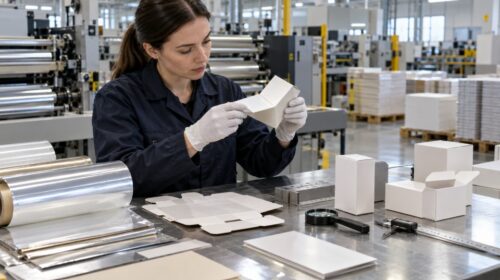
To avoid damage, climatic conditions in the print shop must be strictly controlled, maintaining relative humidity at 50-55%. Properly conditioned paperboard exhibits much greater flexibility.
The trusted paperboard packaging manufacturer BoxPro matches the width and profile of the creasing rules precisely to the thickness of the specific substrate, ensuring proper fiber breakage without excessively stressing the applied film.
In addition, for projects requiring deep embossing and folding boxes to 180 degrees, the use of BOPP film with enhanced stretchability is recommended.
Key Rules for Preventing Packaging Cracks
- Maintain warehouse humidity at a minimum of 50% to prevent cellulose fibers from drying out.
- Use flexible polypropylene films (BOPP) instead of rigid polyester variants for demanding folds.
- Adjust creasing force and width to the thickness of the substrate to ensure proper breaking of the base material.
- Carry out bending tests on sample sheets before starting mass production.
FAQ
Why does the film on laminated packaging crack at the edges?
The film cracks when the stresses at the fold exceed its elasticity. This is most often caused by over-dried paperboard or creasing that is too shallow in the base material.
Which laminating film is most resistant to cracking?
Flexible polypropylene films (BOPP) offer the highest resistance to cracking during folding. They are much more stretchable than standard polyester films (PET).
How does air humidity affect the quality of folds in paperboard packaging?
Low humidity dries out cellulose fibers, making the paperboard brittle and prone to breaking. Optimal humidity at 50-55% helps preserve the material’s flexibility.
What is creasing, and how does it prevent laminate damage?
Creasing is the industrial process of pressing grooves into paperboard at planned fold points. Properly executed creasing breaks the fibers, relieving stress from the outer film layer.
Does the type of adhesive matter when laminating packaging?
Yes, an uneven or overly thin adhesive layer weakens the bond between the film and the substrate. As a result, the laminate may delaminate and crack during box forming.