

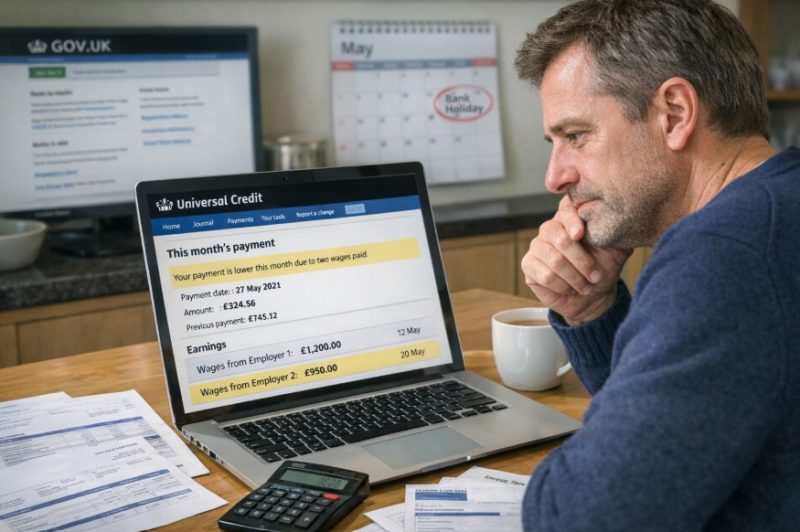
If your Universal Credit payment has suddenly dropped, increased or disappeared for a month, the reason may not be a mistake in your benefit claim.
The Department for Work and Pensions (DWP) has clarified that many cases are linked to the “double pay day” issue, where two wages are counted within the same Universal Credit assessment period. The good news is that most of these cases are now corrected automatically.
Key highlights:
- The issue usually happens when your wages are paid early because of a weekend or bank holiday.
- Two wage payments can be recorded in one assessment period, reducing your Universal Credit.
- The DWP can move one wage payment into the following month under rules introduced in 2020.
- Most cases are now automatically identified and corrected.
- You should still check your Universal Credit statement if your payment looks wrong.
What Is the Universal Credit Double Pay Day Issue?
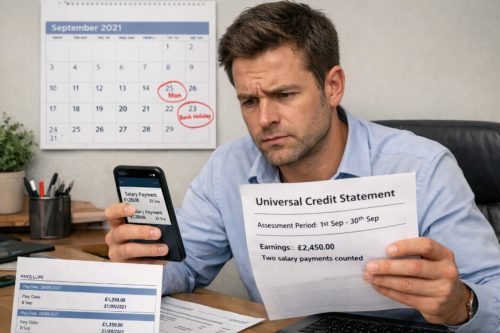
The Universal Credit “double pay day” issue occurs when you receive two wages from the same employer within one monthly assessment period.
This does not mean you were paid twice by Department for Work and Pensions. Instead, the system temporarily treats it as higher income for that month.
Because Universal Credit is calculated monthly, two wage payments in one period can reduce or stop your benefit for that month, followed by a higher payment the next month when no wages are recorded. This often happens when payday shifts earlier due to weekends or bank holidays.
“The Department recognises that receiving two sets of earnings from the same employer within a single Universal Credit assessment period can create unexpected fluctuations in a claimant’s award.” — Sir Stephen Timms, Minister of State for Social Security and Disability
Key Terms Explained:
| Term | Meaning |
| Double pay day | Two wage payments counted in one assessment period |
| Assessment period | Monthly period used to calculate Universal Credit |
| Automatic correction | One wage payment moved to another month |
| Work Allowance | Amount you can earn before benefits reduce |
In short, this issue is usually temporary and often corrected automatically, helping keep your payments accurate over time.
Why Does the Double Pay Day Problem Happen?
The “double pay day” problem occurs because Universal Credit relies on wage information sent to HMRC through its Real Time Information (RTI) system.
Every time your employer pays you, that payment is reported to HMRC and then used by the DWP to calculate your Universal Credit for that assessment period.
If two wage payments are reported within the same monthly assessment period, the system may assume that you earned twice as much as usual. As a result, your Universal Credit payment can fall sharply or even stop for that month.
Common Reasons Two Wages Appear in One Month
- Your normal payday falls very close to the end of your assessment period.
- Your employer pays you early because of a bank holiday.
- Your salary is paid earlier because your payday falls on a weekend.
- Payroll changes mean two wage entries are sent to HMRC in the same month.
Why the Timing Matters?
Imagine your assessment period runs from 2 July to 1 August. Normally, you are paid on the last working day of each month. If your July salary arrives on 31 July and your August salary is brought forward to 30 August because of a bank holiday, both wages could appear in the same assessment period.
The Universal Credit system may then assume you earned nearly double your usual monthly wage. That can reduce your payment significantly, even though your actual income has not changed.
| Cause | Effect on Universal Credit |
| Two wages in one assessment period | Universal Credit may reduce or stop temporarily |
| Early payment due to bank holiday | Income appears higher than normal |
| No wage in the next month | Universal Credit may rise sharply again |
Understanding how the double pay day issue happens can help you spot problems early and check whether the DWP has corrected your Universal Credit payment automatically.
How Does Universal Credit Calculate Your Payment Each Month?
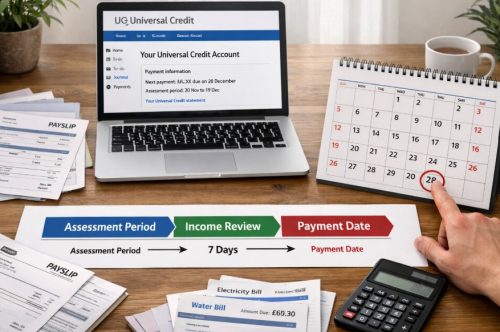
Universal Credit works on fixed monthly cycles called assessment periods. Your circumstances and income are reviewed over that month, and the DWP then calculates how much you should receive.
For most people, payment arrives seven days after the end of the assessment period. This system works well when wages arrive on the same date each month. However, small changes in pay dates can create problems.
The following table shows the standard process:
| Stage | Typical Timeline |
| Assessment period begins | Day 1 of your claim month |
| Assessment period ends | One month later |
| DWP reviews income and circumstances | Immediately after period ends |
| Universal Credit payment arrives | Around 7 days later |
The DWP has confirmed that the “double pay day” issue mainly affects people who are paid calendar monthly. Weekly or fortnightly workers are not usually covered by the same correction rules.
What Has the DWP Said About the Universal Credit Double Pay Issue?
The issue was raised in Parliament by Labour MP Mohammad Yasin, who asked the DWP what it was doing to reduce the impact on claimants and department resources.
In response, Sir Stephen Timms explained that the Universal Credit (Earned Income) Amendment Regulations 2020 already allow the DWP to move one of the wage payments into a different assessment period.
“To address this, the Universal Credit (Earned Income) Amendment Regulations 2020 were introduced, allowing one set of monthly paid earnings to be reallocated to a different assessment period to ensure awards are calculated fairly.” — Sir Stephen Timms
The DWP says this rule has had a positive effect because it smooths income across months and prevents claimants from losing money unfairly.
Importantly, the department also confirmed that most affected cases are now identified and corrected automatically. This means fewer people need to contact Universal Credit manually, although errors can still happen.
How Does the Automatic Correction Process Work?
Under the 2020 regulations, the DWP can reallocate one of the two wage payments into the following assessment period. This means your Universal Credit is based on what you actually earn each month, rather than on the timing of payroll.
The automatic correction process usually works in the following way:
- The system identifies that two wages from the same employer have been reported.
- It checks whether you are paid monthly.
- One wage is moved into the next assessment period.
- Your Universal Credit award is recalculated.
This is designed to reduce financial volatility and keep your payment pattern more consistent.
“Most cases affected by double earnings are now identified and corrected automatically, minimising any burden on customers and administrative pressure on the Department.” — Sir Stephen Timms
When Automatic Corrections May Not Happen?
The system does not always correct every case immediately. Problems can still occur if:
- You have changed jobs recently.
- You are paid by more than one employer.
- Your earnings pattern is irregular.
- Your employer reports your wages incorrectly to HMRC.
If any of these situations apply, you may need to raise the issue in your Universal Credit journal.
Who Is Most Likely to Be Affected by the Double Earnings Issue?

The people most likely to experience this problem are working Universal Credit claimants who are paid once a month.
Those at greatest risk include:
- Employees whose payday is at the end of the month.
- Workers whose wages are often brought forward before bank holidays.
- NHS staff, retail workers and office employees on monthly payroll.
- Claimants whose assessment period ends around the same time as payday.
The Royal College of Nursing has warned that some claimants may lose work allowances worth up to £344 per month if the correction is not applied properly. In some cases, people could also be incorrectly affected by the benefit cap.
Real Example from a Claimant
While researching this issue, I came across a claimant who explained how confusing the system can be. She worked in healthcare and normally received her wages on the last Friday of the month. One month, her August wage was paid early because of the bank holiday weekend.
She said:
“I logged into my Universal Credit account and saw my payment had dropped by more than £300. The statement showed two wages in the same month. I panicked because I thought I had done something wrong.”
A few days later, the DWP corrected the figures automatically and her next statement returned to normal. Her experience highlights why it is important to check your account rather than assume your claim has been stopped permanently.
Could the Double Pay Day Issue Reduce Your Universal Credit?
Yes, if the issue is not corrected, your Universal Credit can be reduced temporarily. The amount depends on your earnings and whether you receive a Work Allowance.
You may notice:
- A much lower payment for one month.
- No Universal Credit payment at all.
- A larger-than-normal payment in the following month.
- A temporary loss of your Work Allowance.
For some households, this can create budgeting problems, especially if rent or childcare costs are due at the same time.
Potential Issues and Impact on Payments:
| Potential Problem | What Could Happen |
| Two wages counted together | Universal Credit falls sharply |
| Work Allowance not applied | You lose up to £344 |
| Incorrect income assessment | You may appear subject to the benefit cap |
A sudden change in your Universal Credit does not always mean your claim has been closed. In many cases, it is simply the result of the timing of your wages being recorded incorrectly within the assessment period.
What Should You Do If Your Universal Credit Payment Looks Wrong?
If your payment changes unexpectedly, do not ignore it. The DWP says most cases are corrected automatically, but you should still check your records.
Start by reviewing the earnings shown in your online Universal Credit statement. Compare the dates and amounts with your payslips.
If you can see two wages listed in one assessment period, the system may have triggered the double pay day issue.
You should then:
- Add a note to your Universal Credit journal.
- Explain that two wages have been counted in the same period.
- Upload copies of your payslips if requested.
- Contact the Universal Credit helpline if the issue is not corrected.
Most claimants find that the correction is applied without needing a formal complaint, but it is still important to act quickly if the figures remain wrong.
Is This a New DWP Rule or an Existing Universal Credit Fix?
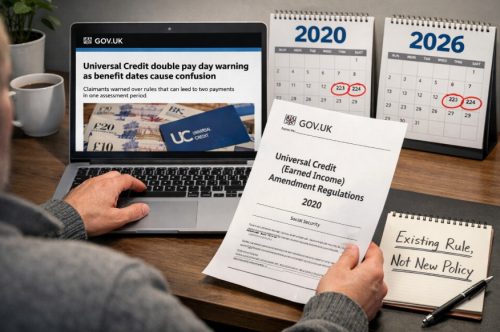
This is not a new rule or recent change to Universal Credit. The legal fix has existed since the Universal Credit (Earned Income) Amendment Regulations 2020 were introduced.
These rules allow the Department for Work and Pensions to move one wage payment into a different assessment period if two salaries from the same employer are reported in the same month. The goal is to reflect normal monthly earnings rather than payday timing.
Recent updates simply confirm most cases are now corrected automatically. The issue resurfaced after Mohammad Yasin raised concerns in Parliament. Overall, this fix has been in place for years and mainly applies to people paid monthly.
What Does This Mean for Universal Credit Claimants Going Forward?
The Department for Work and Pensions clarification reassures claimants that the double pay day issue is recognised and usually corrected automatically. Most people will not need to contact the department, as adjustments are made within the system.
However, it is still important to understand how Universal Credit works, especially your assessment period and pay dates.
If you are paid monthly and your payday falls near the end of your assessment period, you are more likely to experience this issue, particularly around bank holidays or weekends.
Going forward, it’s best to:
- Check your Universal Credit statement regularly
- Keep copies of payslips and payment dates
- Watch for sudden changes in payments
- Report issues quickly if something looks wrong
By staying aware and monitoring your account, you can spot issues early and ensure your payments are corrected quickly.
Conclusion
The DWP has confirmed that most Universal Credit double pay day issues are now corrected automatically, helping to prevent unfair reductions in support.
However, if two wages are recorded in one assessment period, your payment could still change temporarily. Understanding how assessment periods and early paydays work can help you avoid confusion.
If your Universal Credit looks wrong, check your statement, compare it with your payslips and contact the DWP promptly to ensure any correction is applied.
Frequently Asked Questions
Does a double pay day mean the DWP paid me Universal Credit twice?
No. It usually means that two wage payments from your employer were counted in one assessment period, which changed your Universal Credit amount.
Why were two wages counted in one Universal Credit assessment period?
This often happens when your employer pays you early due to a bank holiday or weekend, causing two salaries to fall within the same monthly period.
Will the DWP fix every double pay day case automatically?
The DWP says most cases are corrected automatically, but some claimants may still need to raise the issue in their journal.
Can the double pay day issue affect my Work Allowance?
Yes. If two wages are counted together, you could temporarily lose your Work Allowance and receive less Universal Credit.
Who is most likely to experience this issue?
Working Universal Credit claimants who are paid monthly and whose payday falls close to the end of their assessment period are most at risk.
What should I check in my Universal Credit statement?
Look for two wage entries from the same employer within the same assessment period and compare them with your payslips.
Is the double pay day issue linked to bank holidays?
Yes. Bank holidays and weekends are among the most common reasons why wages are paid early and recorded twice in one month.