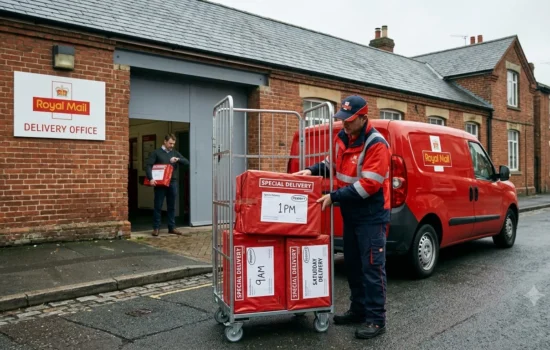


We’ve got used to getting what we want, when we want it. Whether it’s food, shopping, or entertainment, waiting’s no longer part of the plan.
One-click orders, same-day delivery, tap-to-watch streaming; it’s all become normal. And it’s not just about speed. It’s changed the way that we live day to day.
This need for instant everything didn’t happen overnight, but now it’s built into the way we think. The real question is what we are gaining, what we are losing, and whether we have gone too far to slow down.
The latest shopping data illustrates how firmly convenience has become embedded in British behaviour.
Online purchases accounted for 29.4% of total retail sales in Great Britain during June 2026, the highest proportion recorded since April 2021. Digital convenience is therefore no longer confined to younger or highly technical consumers; it is part of the mainstream retail economy.
However, convenience is not experienced equally. Older people, customers with disabilities and households without reliable devices, connectivity or digital skills may struggle when businesses remove telephone support, cash payments or face-to-face services.
A genuinely convenient system should make digital access easier without leaving people who need alternative channels behind.
Updated on 29.07.2026
Is the UK’s Obsession With Convenience Changing How We Live Every Day?
We’re Used to Getting Everything Now

Fast has become normal. Whether it’s food, streaming, or sorting your bills, we expect things to happen the second we tap a screen. It’s how the UK runs now. Better tech made it possible, but our routines made it happen. People don’t have time to wait, and businesses know it.
Look at food delivery. Just Eat took something that used to be slow, and they’ve made it instant. No more calling the local takeaway and guessing the delivery. Now, you decide on what you want, you track the driver, and eat within half an hour. It is effective because it saves on hassle. That’s it.
Entertainment has followed the same path. Casino players, for example, are turning to UK casino sites not on Gamstop. These sites are faster, offer more options, and don’t come with the delays of a physical venue. People want quick access, and these platforms provide it.
Speed and ease of access should not be confused with regulatory protection. Any online gambling company providing services to consumers in Great Britain requires an appropriate Gambling Commission licence, regardless of where the operator is based.
All online operators licensed in Great Britain must also participate in GamStop. Platforms outside that system may not provide the same self-exclusion measures, complaints processes or regulatory recourse.
The wider lesson applies beyond gambling: a smooth app can make a service feel trustworthy, but interface quality does not prove that a company is properly licensed, financially stable or handling personal information responsibly. Consumers still need to check who operates the platform, what protections apply and how problems will be resolved.
Streaming does the same. Open Netflix, press play, done. No waiting, no planning, no digging around. It fits in short breaks or quiet evenings, whenever there’s a moment to fill. Everything’s on demand now, and we’ve come to expect it that way.
Messaging Is Instant, as Well
Messages fly around 24/7. One tap and it’s done; text, photo, video, whatever. Apps such as WhatsApp range from family chats to last-minute work changes. Over 50 million businesses use it, and most don’t even think twice about it. It’s just part of life now.
Work tools were on the same path. Zoom calls replaced boardrooms. No travel, no wasted time. Thousands of workers are now dependent on these tools every day.
But there’s a downside. You’re never really off. People expect a reply within an hour. That constant buzz gets tiring. Tech is fast, but people still need space.
The scale of instant communication is considerable. WhatsApp was used by 92% of UK adult smartphone users in May 2025, making it the country’s most widely reached smartphone app. This helps explain why customers and colleagues increasingly expect messages, updates and support to arrive almost immediately.
Yet availability should not become an expectation of permanent responsiveness. Businesses can reduce pressure by setting realistic response times, limiting unnecessary notifications and allowing staff to separate working accounts from personal devices. Convenience works best when it saves time rather than making every person feel continuously on call.
Healthcare Has Also Been Affected

You don’t need a gym or a diary to keep track of your health. Scan your lunch, check your calories, track your workouts, and apps such as MyFitnessPal do it all in seconds. It’s fast and fits around your day, which is why so many use it.
Need a doctor? You don’t always have to go in. More appointments are now online: video appointments, digital forms, and instant bookings. For people outside cities, or anyone juggling too much already, it saves time and hassle.
Still, not everything should be rushed. Quick workouts are good, but they are missing the bigger picture. The same goes for meal boxes that show up within 30 minutes; they’re fast but not always great in the long term.
Digital healthcare has expanded significantly. NHS England recorded 6.5 million online consultation requests to GP practices in September 2025, around half as many again as in September 2024.
The NHS also arranged 376 million GP appointments during 2025, with patients increasingly encouraged to use the NHS App to book, cancel and manage routine services.
These tools can reduce administrative effort and make routine tasks more convenient, but they should complement rather than automatically replace clinical judgement or in-person care. Some symptoms require physical examination, while patients with limited digital access may need telephone or face-to-face support.
Fast Spending, Fast Growth, Real Problems
Quick, everything means quick money. Deliveries arrive quickly, films play immediately, and shopping is done in seconds.
That speed is what drives the economy nowadays, and many industries are built around it. It’s made things easier for buyers and opened new doors in the business world for businesses that don’t need a shop front to sell.
Plenty of small brands depend on this system. They collaborate with delivery platforms, have online storefronts, and target individuals who would never walk past a store. But while the tech pushes things forward, the reality underneath isn’t always great.
Gig workers do the heavy lifting, often without sick-day pay, with no stable income, and with little say in how things run. And while one side of the economy grows, another side shrinks, with thousands of high street shops closing and struggling to keep up with the pace and prices.
The growth of rapid delivery and platform-based services also changes who carries the cost of convenience. Gig work can offer flexibility, but the Health and Safety Executive notes that it is often characterised by short-term, unpredictable or irregular working arrangements.
Digital platforms may also exercise considerable control over how jobs are allocated and completed, even where workers are formally treated as self-employed.
For businesses, a responsible convenience model should consider more than delivery speed. Fair pay, safe workloads, transparent algorithms and realistic customer promises all affect whether a service can grow sustainably. An order arriving several minutes earlier is not necessarily an improvement when the speed depends on unsafe pressure or unstable working conditions.
Convenient purchasing can also make spending less noticeable. Stored card details, one-click checkouts and automatic renewals remove useful moments of reflection between wanting something and paying for it.
Customers can protect themselves by reviewing subscriptions regularly, disabling unnecessary notifications and setting personal limits for food delivery, shopping and entertainment.
Keeping Convenience on Track
Things are only going to get quicker. More apps, more automation, fewer steps in between wanting something and getting it. That’s where we’re at now, and that’s really gaining momentum.
Still, somebody’s got to keep it in check. Constant tracking, constant notifications, no space to slow down; that’s the risk. If we’re building a world where everything happens instantly, we need to make sure it still works for people, not just systems. The pace can remain high, but the focus has to stay human.
Some people are already trying to regain control over their digital routines. Ofcom found that 27% of UK adults deliberately set aside offline time, while 26% used “do not disturb” settings or disabled notifications.
One in five also avoided taking a phone to bed. These habits show that convenience and boundaries do not have to be opposites.
The next stage of innovation should therefore focus on meaningful convenience rather than maximum immediacy. Services can remain quick while offering clear notification controls, simple cancellation, transparent prices and alternatives for people who do not want to use an app.
Convenience has improved everyday life in many practical ways, but faster is not automatically better. The strongest services will be those that remove unnecessary effort without encouraging excessive spending, constant availability or dependence on systems that people cannot easily understand or leave.