

Setting up a PO Box in the UK allows individuals, freelancers and businesses to receive letters without sharing their home or workplace address with everyone who contacts them.
It can be particularly useful for home-based entrepreneurs, online sellers and organisations that want to separate business correspondence from personal post.
Royal Mail offers two main options: collecting mail from a designated Customer Service Point or having it delivered to the address registered with the service.
However, opening a PO Box involves more than choosing an address and paying a subscription.
Applicants need to understand identity requirements, payment conditions, collection arrangements and the limitations of using a PO Box for business purposes.
This guide explains how to set up a PO Box, what to prepare before applying, how much it costs in 2026 and how to manage the service once it becomes active.
What Do You Need Before Setting Up a PO Box?
Before starting an application, applicants should establish why they need a PO Box and how they intend to receive their correspondence.
A Royal Mail PO Box is a paid postal service that provides a dedicated address for receiving eligible mail. It does not normally mean renting a physical, individually accessible locker inside a local Post Office branch.
The first decision is whether the applicant wants to collect incoming correspondence or have it delivered to an existing address.
Information to Prepare
Applicants should have the following information ready:
- Full legal name and contact details.
- Current residential or business address in the UK.
- Correct postcode.
- Business or organisation name, where applicable.
- A debit or credit card registered to the application address for online applications.
- Proof of identity where required, particularly for postal applications.
- Preferred subscription duration.
- Details of the intended mail collection or delivery arrangement.
Businesses should also check which trading names and authorised recipients need to be covered by the service.
For example, someone running an online retail business under a trading name should confirm that the PO Box can receive letters addressed to that name before publishing the address.
Preparing this information beforehand can reduce the likelihood of errors or delays during application processing.
How to Set Up a PO Box Online in the UK?
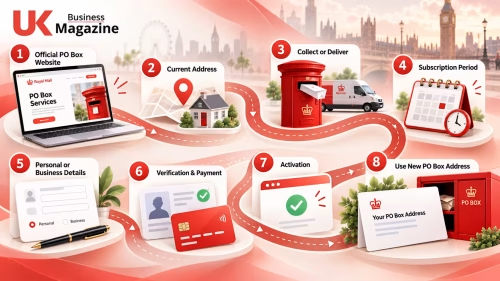
The simplest application route is through Royal Mail’s official website. Royal Mail states that an online PO Box can take up to seven working days to set up.
The following steps explain how to approach the application.
Step 1: Visit the Official Royal Mail PO Box Website
Open the Royal Mail PO Box application page.
Review the current service descriptions, pricing and application requirements before proceeding.
Select the online application option to begin.
Applicants should use the official Royal Mail service rather than assuming that any website advertising a UK mailing address provides the same product.
Private mailbox providers may offer different facilities, pricing structures and verification requirements.
Step 2: Enter Your Current Address
Provide the residential or business address requested during the application.
Royal Mail uses this information to establish the service and determine the relevant postal arrangements.
The applicant’s underlying address remains necessary even when the main reason for opening a PO Box is privacy.
This means the service can keep a home address off routine correspondence, but it does not eliminate the need to disclose that address to Royal Mail.
Important: The payment card used for an online application must be registered to the address entered on the application.
Applicants using a different billing address should resolve this before proceeding.
Step 3: Choose Between PO Box Collect and PO Box Deliver
Royal Mail offers two principal services.
| Feature | PO Box Collect | PO Box Deliver |
| Postal address | Dedicated PO Box address | Dedicated PO Box address |
| How mail is received | Collected from a Customer Service Point | Delivered to the application address |
| Travel required | Yes | Normally no collection journey |
| Suitable for | People wanting to collect correspondence separately | People wanting mail delivered conveniently |
| Annual cost in 2026 | £416.40 | £499.80 |
PO Box Collect may suit individuals who want their personal and business correspondence kept separate until collection.
PO Box Deliver is more convenient for those who work from home or cannot regularly visit a collection location.
Before selecting Collect, applicants should check the location and opening hours of the Customer Service Point they would use.
Step 4: Select the Subscription Period
Royal Mail offers monthly, six-month and twelve-month pricing arrangements.
Monthly subscriptions are available through Direct Debit and have a minimum three-month commitment.
Longer subscriptions can reduce the effective monthly cost, although they require a greater financial commitment.
A freelancer testing a new service might prefer a shorter arrangement, while an established business expecting a consistent volume of correspondence could benefit from an annual subscription.
The total subscription cost should be considered alongside any collection expenses.
Step 5: Complete the Required Personal or Business Details
Enter the information requested for the relevant application.
For businesses, the name used for receiving correspondence should be consistent with the intended recipient details.
A business operating under several names should confirm how those names are handled rather than assuming that all related organisations or trading identities are automatically covered.
Applicants should carefully review names, contact information and addresses before submission.
Even a minor error in an important field could require correction during processing.
Step 6: Complete Verification and Payment
Follow the payment and verification instructions provided by Royal Mail.
The online application route requires a debit or credit card registered to the application address. Monthly Direct Debit arrangements are subject to the service’s separate payment requirements.
Applicants should retain their confirmation and any reference details supplied during the process.
If Royal Mail requests additional information, provide it through the official application or support channel.
Step 7: Wait for Your PO Box to Become Active
Submitting an application does not mean the PO Box is immediately available.
Royal Mail states that online setup can take up to seven working days.
The new postal address should not be published or given to customers until the service has been confirmed as active.
This distinction matters for businesses preparing new invoices, website contact pages, advertising materials or product packaging.
Publishing an address prematurely could result in correspondence being sent before the service is ready to receive it.
Step 8: Begin Using Your New PO Box Address
Once Royal Mail confirms activation, use the full address exactly as provided.
A typical format looks like this:
Recipient or Business Name
PO Box [Assigned Number]
[Town or City]
[Assigned Postcode]
The details shown above are placeholders. Customers must use the number and postcode actually assigned by Royal Mail.
At this stage, it is sensible to send a test letter from a trusted sender and confirm that it reaches the intended collection point or delivery address.
This is a practical operational check rather than a separate Royal Mail activation requirement.
Can You Set Up a PO Box Without Applying Online?
Yes. Royal Mail also accepts postal applications.
Applicants can download the application form from the official PO Box page, complete the requested details and submit it with the required proof of identity and payment.
Royal Mail lists the following postal application address:
Royal Mail PO Box Team
Dearne House
Cortonwood Drive
Brampton
Barnsley
S73 0UF
Royal Mail states that postal applications take at least ten working days to process.
The postal route may be suitable for applicants who cannot complete the online application, but it requires additional preparation.
Applicants should use the current form, follow its identification requirements and avoid sending original documents unless specifically instructed.
How Much Does It Cost to Set Up a PO Box in 2026?
The cost depends on the service selected and the subscription period.
As of 17 October 2026, Royal Mail publishes the following personal PO Box prices, including VAT.
| Subscription | PO Box Collect | PO Box Deliver |
| Monthly | £50.40 | £50.40 |
| Six months | £243.00 | £276.60 |
| Twelve months | £416.40 | £499.80 |
| Effective monthly cost on annual plan | £34.70 | £41.65 |
Monthly subscriptions have a minimum three-month commitment.
Business-facing Royal Mail prices may be shown excluding VAT, which explains why the same service can appear cheaper on one price page than another.
The subscription is not necessarily the only expense associated with operating a PO Box.
Someone collecting correspondence may also incur travel costs, parking charges or time away from work.
A complete comparison of post office box prices and subscription costs can help businesses assess the different payment arrangements.
Example: Is Collection Actually Cheaper Than Delivery?
Consider a home-based business owner choosing between the annual plans.
PO Box Collect costs £416.40 per year, while PO Box Deliver costs £499.80.
The difference is £83.40 annually, equivalent to £6.95 per month.
If the business owner makes one dedicated collection journey each week, that saving works out at approximately £1.60 per trip across 52 weeks.
If each journey costs more than £1.60 in additional travel expenses, the apparent subscription saving disappears even before considering the owner’s time.
On the other hand, a business owner who regularly passes the collection point might incur almost no additional travel cost.
The practical decision is therefore not simply which subscription has the lowest price, but which arrangement offers the lowest overall cost and inconvenience.
How Long Does It Take to Open a PO Box?
Royal Mail provides different processing estimates depending on the application method.
| Application method | Published setup time |
| Online | Up to 7 working days |
| By post | At least 10 working days |
These are processing estimates rather than guarantees of a specific activation date.
An application may require extra attention if payment details do not match, required documentation is incomplete or Royal Mail requests clarification.
For businesses, it is better to incorporate this processing period into launch planning instead of assuming that the PO Box will be ready the day the application is submitted.
For further background on eligibility and application requirements, see the guide to obtaining a PO Box in the UK.
What Should You Do Immediately After Your PO Box Is Activated?
Obtaining the address is only the first part of establishing a reliable postal arrangement.
The next step is making sure that correspondence reaches the right person and is processed without unnecessary delay.
Confirm the Address and Delivery Arrangement
Check that the assigned PO Box number, postcode, recipient name and chosen service match the confirmation received.
For PO Box Deliver, confirm the address to which incoming mail will be delivered.
For PO Box Collect, establish where collections will take place and what identification or authorisation may be required.
Update the Right Contact Channels
Once the address is active, businesses can consider adding it to appropriate customer-facing materials, such as their website contact page, customer correspondence, marketing literature and business stationery.
However, it should only replace an existing address where its use is suitable and legally permitted.
A PO Box should not automatically replace a trading address, registered office or physical returns location.
Establish a Mail-Handling Routine
Businesses should decide who is responsible for monitoring incoming correspondence.
For a small company, a straightforward process might involve checking incoming mail regularly, recording important documents and forwarding time-sensitive correspondence to the appropriate person.
This becomes particularly important when receiving supplier notices, financial documents or customer complaints.
Test the Service Before Relying on It
A test letter can help confirm that the new arrangement is functioning as expected.
Once the first successful delivery has been verified, the business can begin using the address more widely.
For organisations receiving important physical correspondence, maintaining a backup contact method is also sensible.
Can You Use a PO Box as Your Business Address?
A PO Box can be useful as a public-facing correspondence address, but it cannot replace every address that a business is legally required to maintain.
For example, a sole trader working from home may want a separate postal address for general customer enquiries.
A limited company may use a PO Box for suitable customer communications while maintaining its registered office elsewhere.
The key difference lies in what each address is intended to do.
| Address type | Primary purpose | Can a Royal Mail PO Box fulfil it? |
| General mailing address | Receiving eligible business letters | Yes |
| Customer correspondence address | Receiving customer enquiries | Generally yes |
| Limited company registered office | Official statutory company address | No |
| Physical trading address | Identifying where a business operates | Not as a substitute for an actual location |
| Courier returns address | Receiving returned products | Not suitable for all carriers or products |
The rules for limited companies are especially important.
Companies House requires an appropriate physical registered office address in the relevant UK jurisdiction. A Royal Mail PO Box does not meet this requirement.
Businesses can review the official Companies House registered office address requirements before deciding which address to use.
An accountant, solicitor or suitable registered office service may be an alternative where the business does not want to publish a director’s home address.
However, any third-party address must meet the legal requirements.
Can a PO Box Receive Parcels and Courier Deliveries?
A common misunderstanding is that a PO Box can be used exactly like a normal home or commercial delivery address.
In practice, delivery acceptance depends on the carrier, the item and the relevant service conditions.
Royal Mail PO Boxes are primarily designed for receiving eligible mail through the postal network.
Private courier companies may require a street address rather than a PO Box, particularly when deliveries involve oversized items, specific handover procedures or recipient verification.
Online retailers may also refuse to accept a PO Box during checkout.
This is particularly relevant for online businesses handling frequent product returns.
An online seller might use a PO Box for customer letters while retaining a separate warehouse, collection point or courier-compatible address for returned merchandise.
Before publishing a PO Box as a returns address, the business should check which delivery services will accept it.
What Are the Most Common Mistakes When Setting Up a PO Box?
Several avoidable errors can make the service less effective.
Using a Payment Card Registered to a Different Address
Royal Mail requires the payment card used for online applications to be registered to the application address.
Applicants should verify this requirement before submitting their details rather than assuming that any valid card will work.
Choosing Collection Without Checking Travel Arrangements
Collection may be cheaper at the subscription level, but inconvenient opening hours or long journeys can make it a poor operational choice.
Check the practical collection arrangements before committing to the service.
Publishing the Address Before Activation
A PO Box is not necessarily active when an application is submitted.
Businesses should wait for confirmation before printing the address on materials or instructing customers to send correspondence.
Treating a PO Box as a Registered Office
This can create compliance problems for limited companies because Companies House does not accept Royal Mail PO Boxes as registered office addresses.
The correct address arrangement should be established before incorporating or updating company records.
Assuming Every Delivery Company Accepts PO Boxes
A PO Box is not a universal replacement for a physical delivery address.
Businesses dealing with courier parcels should maintain an appropriate alternative.
Forgetting About Renewals or Address Changes
An expired service or outdated address information can disrupt correspondence.
Customers should track their subscription period, review renewal requirements and contact Royal Mail when relevant account details change.
Is a PO Box Better Than a Virtual Office?
The better option depends on what the applicant needs from the address.
A PO Box is primarily a postal service.
A virtual office may provide a conventional business street address and additional facilities, depending on the provider.
| Requirement | Royal Mail PO Box | Virtual office |
| Dedicated correspondence address | Yes | Usually |
| Mail collection or delivery services | Yes | Depends on plan |
| Conventional street address | No | Often |
| Mail scanning | Not a standard PO Box feature | May be included or charged separately |
| Meeting facilities | No | Sometimes |
| Potential registered office service | No | Only where the address and service meet legal requirements |
| Personal address privacy | Helps protect privacy in correspondence | Can offer similar benefits |
A sole trader who mainly needs to receive letters privately might find a PO Box sufficient.
A limited company requiring an appropriate registered office address, professional administrative services or occasional meeting space might prefer a broader solution.
The practical differences are explained further in this overview of how virtual offices support growing businesses.
Neither service should be selected solely because an address appears professional. Its legal suitability and day-to-day usefulness matter more.
What Happens If You Move or Stop Using Your PO Box?
Moving home, relocating a business or closing a service requires advance planning.
Customers should contact Royal Mail about changes to the underlying address or the PO Box arrangement, because the original service details may affect how incoming mail is handled.
Businesses should also consider where outstanding correspondence will be delivered during the transition.
Before closing or replacing a PO Box, review the organisations that still use it.
These may include customers, suppliers, professional advisers and other parties who communicate by post.
Where appropriate, notify those contacts of the replacement address and investigate the relevant redirection options.
An address change should be treated as a controlled communication process, especially when the business receives important financial or legal documents.
Who Should Consider Setting Up a PO Box?
A PO Box is most useful when an applicant has a clear reason to separate their correspondence address from their residential or operational premises.
Home-Based Business Owners
A home business may need to publish a postal contact address without making the owner’s residential address available in routine customer communications.
A PO Box can provide this separation, although mandatory legal address disclosures still need to be satisfied.
Freelancers and Consultants
Independent professionals may want a consistent address for general correspondence without using a client’s office or a personal residential address.
This can also help maintain continuity when working arrangements change.
Online Sellers
Online retailers can use a PO Box for appropriate letters and customer communications.
However, it should not automatically be treated as an address for every product return or courier shipment.
Charities and Community Groups
An organisation may benefit from a dedicated address that is not tied to one volunteer’s home.
It should nevertheless establish who is authorised to receive correspondence and how frequently incoming mail will be checked.
Individuals Seeking Greater Address Privacy
People living in shared accommodation or those who prefer not to circulate their residential address widely may find a PO Box useful.
The service improves privacy in the contexts where the PO Box is used, but does not guarantee anonymity or override identity and address-verification requirements.
Frequently Asked Questions
Can I Set Up a PO Box for Free in the UK?
No. Royal Mail’s standard PO Box service is paid. Applicants can choose from the available subscription periods, with prices depending on collection or delivery.
Do I Need to Visit a Post Office to Open a PO Box?
No. Royal Mail allows online applications and postal applications. PO Box Collect customers normally collect mail from a designated Royal Mail Customer Service Point rather than an ordinary Post Office counter.
Can I Get a PO Box Without a Home Address?
Royal Mail requires an underlying address as part of its application process. A PO Box is intended to provide an alternative correspondence address, not to remove the need for address verification.
Can I Set Up a PO Box for Three Months?
Royal Mail’s monthly payment option has a minimum three-month commitment. Applicants should follow the current Direct Debit arrangements and check the applicable payment conditions.
Can Someone Else Collect My PO Box Mail?
Another person may be able to collect correspondence where Royal Mail’s authority and identification requirements are satisfied. Customers should confirm the procedure before arranging collection on someone else’s behalf.
Does a PO Box Hide My Address From Everyone?
No. It helps avoid publishing a residential address in routine correspondence, but Royal Mail requires the applicant’s underlying address. Banks, regulators and other organisations may also require physical address details.