


For years, company car benefits have been settled quietly after the fact. A P11D in July, a tax code adjustment, a Class 1A bill, and the cycle starts again. Few business owners looked closely at what each vehicle really cost.
That changes on 6 April 2027. Company cars, vans and fuel will be among the first benefits required to be taxed directly through payroll in real time. Every pay run will show the cost of your fleet choices, both to the business and to the employee.
This makes the next six months a natural moment to step back and ask a bigger question. Not just “how do we comply?”, but “are we offering the right vehicle benefits at all?”
What Mandatory Payrolling Means for Your Fleet?

HMRC is phasing in mandatory payrolling over two years. From 6 April 2027, the rules will apply to company cars, car fuel, vans, van fuel and employer-provided medical cover, with most other benefits following in April 2028.
For fleet benefits, three things shift at once:
- Tax moves onto the pay slip: The taxable value of each car is added to pay every period and taxed through PAYE, instead of through a tax code adjustment.
- Class 1A National Insurance is paid as you go: The employer’s 15% charge on the benefit is reported and paid through payroll, not in one annual payment.
- Every change counts in the month it happens: A new car, a returned car or a change in private fuel must be reflected in that pay period.
The rules themselves are not new. Voluntary payrolling has been available since 2016. What is changing is that every employer providing a company car will need to payroll the benefit accurately each month.
Reviewing Your Options, One Benefit at a Time
| Fleet benefit | 2027/28 tax position | Verdict |
| Electric company car | 5% BiK | Still the most tax-efficient car benefit |
| EV via salary sacrifice | 5% BiK, outside OpRA rules | Strong value at low cost to the employer |
| Plug-in hybrid | 5%–17% now, 18% from April 2028 | Review lease lengths carefully |
| Petrol or diesel car | Up to 37% BiK | Hard to justify for most new orders |
| Free private fuel | Car fuel benefit charge | Often poor value for drivers |
| Zero-emission van | No van benefit charge | Worth considering for van users |
- Electric company cars remain the standout choice. The BiK rate increases from 4% to 5% in 2027/28, while a similarly priced petrol car could attract a rate of 30% or more. Lower BiK also means lower Class 1A for the employer, which now lands every month.
- EV salary sacrifice deserves a serious look if you do not run a traditional fleet. Cars emitting 75g/km or less are excluded from the optional remuneration (OpRA) rules, so the employee is taxed only on the low BiK, not on the salary given up. The employer saves Class 1 National Insurance on the sacrificed pay. HMRC’s guidance on salary sacrifice explains the conditions, including the rule that pay cannot fall below the National Minimum Wage.
- Plug-in hybrids look cheap in 2027/28 but carry a cliff edge in 2028 (see below).
- Free private fuel is worth questioning. The charge is based on a fixed multiplier (£29,200 for 2026/27), not on fuel actually used. Low-mileage private drivers often pay more tax than the fuel is worth. Once it appears on every pay slip, staff will notice.
- Cash allowances are simple to run and sit outside BiK rules, since they are taxed as ordinary pay. They suit staff who prefer their own car, but they offer none of the EV tax advantages.
- Vans are often overlooked. A zero-emission van with private use carries no benefit charge at all, against a £4,170 flat charge for a diesel van in 2026/27.
Look Beyond 2027: Two Changes Arriving in April 2028
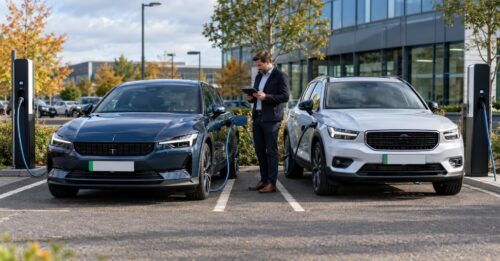
Any vehicle you order this winter will probably still be on the road in 2029. So fleet decisions made now need to price in what comes next.
- The PHEV cliff edge: A temporary easement currently keeps many newer plug-in hybrids in low BiK bands. It ends on 5 April 2028. From 2028/29, every car emitting 1–50g/km moves to a flat 18%, whatever its electric range. A PHEV taxed at 6% or 8% today could more than double for the driver, and Class 1A rises with it.
- Pay-per-mile for electric cars: From 1 April 2028, the government plans to charge Electric Vehicle Excise Duty (eVED). The GOV.UK policy paper on eVED sets the rate at 3p per mile for fully electric cars and 1.5p for plug-in hybrids. Vans are outside the scheme at launch. For a car covering 10,000 miles a year, that is around £300 for an EV.
eVED does not change the case for electric cars. It is still roughly half the fuel duty a petrol driver pays per mile. But it is a new running cost that someone, employer or employee, will need to cover. Your car policy should say who.
A Six-Month Plan to Get Your Fleet Ready
- Now to November: take stock: Create a complete list of every car and van, including its list price, CO2 emissions, fuel type, lease end date and assigned driver. Note who receives free private fuel.
- November to December: run the numbers: Work out each vehicle’s BiK and Class 1A for 2027/28 and 2028/29. Flag PHEVs whose leases run past April 2028.
- December: decide your policy: Choose whether to move new orders to EVs, launch a salary sacrifice scheme, withdraw fuel benefit or offer a cash alternative. Decide who pays eVED from 2028.
- January to February: prepare payroll: Confirm your payroll system can report car and van benefits each period and handle mid-year changes. Set up a clear process for fleet updates to reach payroll on time.
- February to March: tell your people: Explain what will change on pay slips from April, and why. Share any new scheme options at the same time.
Step four is where many small businesses get stuck. Linking fleet records to monthly payroll is fiddly, and errors now show up on pay slips straight away. Working with a specialist provider such as Tunedin Payroll can take that burden off your team, from setting up benefit payrolling to keeping each pay run accurate.
The Bottom Line
Mandatory payrolling does not change how much tax a company car attracts. It changes how visible that tax becomes. From April 2027, employers and employees will see the true cost of each vehicle every single month.
That visibility is an opportunity. Businesses that use this window to rethink their fleet can cut their Class 1A bill, give staff better value, and avoid the 2028 PHEV shock. Those that simply carry on as before may find their pay slips doing the questioning for them.
Figures are correct as of October 2026 and may change at the Autumn Budget. Check the latest HMRC guidance or take professional advice before making fleet decisions.