

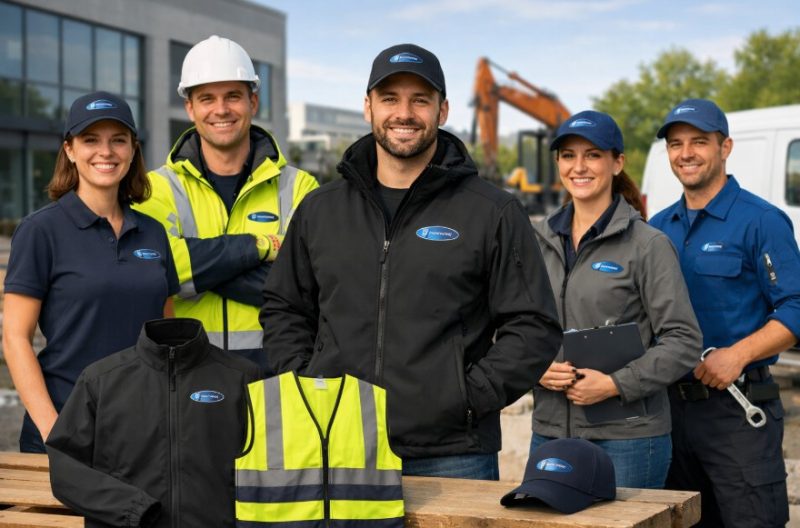
A workwear collection selected for a small team is seldom able to withstand the demands of a fast-growing team. The addition of items is reactive, the consistency of colours is lost, and the professional image that was effective with ten individuals starts to disintegrate with fifty.
Developing a branded workwear approach early in the process, with scalability in mind and based on flexible, work-related items like hi-vis softshell jackets, creates a programme that remains coherent and cost-effective, no matter how fast the organisation grows.
Why Reactive Workwear Purchasing Undermines Brand?
Companies that introduce workwear when the need arises, without a structure in place, are left with a collection that conveys inconsistency rather than professionalism.
The visual unity that branded workwear is meant to achieve is compromised by the different tones of the same colour across garment types, logos placed in varying sizes and locations, and varying quality levels within the team.
Employees at a client site wearing visibly inappropriate kit are unlikely to create a coherent, professional impression that fosters commercial trust, no matter how well the work is done.
How to Build a Branded Workwear Strategy for Long-Term Consistency and Scalability?
Establishing the Brand Standards Before the First Order

A set of brand standards, written down prior to placing an order for garments, serves as the basis for a scalable workwear strategy.
This involves the exact colour details of the main and secondary brand colours, the approved logo designs and their appropriate location on each type of garment, and the level of quality that the company wants its workwear to be associated with.
As these standards are established, all the further purchasing decisions can be measured against a common reference point instead of being made individually according to the immediate availability.
Choosing a Core Range With Modular Flexibility
A scalable programme is built on a base of garments that cover the majority of working conditions and occupations, with additional items offered to meet specific needs.
This modular designation implies that new entrants can be configured from a predefined, stocked set of options, rather than creating a custom order with every increase in headcount.
It also implies that as the business expands into new functions or working conditions, new modules can be incorporated into the programme without interfering with the core range that the current workforce is used to.
Softshell Jackets as a Versatile Programme Anchor

The branded softshell jackets occupy a specific place in a properly organised workwear line, as they can be used across a broad range of conditions and situations.
They offer light weather protection and wind resistance without the bulk of a full waterproof on active outdoor sites. When dealing with clients, they are more professional than fleece or heavy work jackets, yet they still have branding.
This is because of their versatility, making them among the most visible in the range and giving the brand significant exposure in diverse settings without needing to use several different types of garments.
Supplier Relationships and Long-Term Consistency
The most prevalent visual inconsistency in workwear programmes is colour matching across production runs. A supplier relationship in which consistency is given a high value, whereby the colour standards are documented and the new items are compared with the existing ones during quality checks, will help avoid the gradual drift that causes older and newer garments to appear to belong to different brands.
Setting this expectation clearly at the stage of selecting the supplier, rather than discovering the issue only after the first inconsistent delivery, is the strategy that will help avoid the problem, rather than dealing with it in hindsight.
Sizing and Inclusivity Across a Growing Workforce
With an increasing number of people in a workforce, the variety of body types, height, and physical proportions it represents also increases. A work wear programme with a small range of sizes is forcing some employees to wear clothes that do not fit them well and which undermine their comfort and work wearability.
The development of a size range incorporated into the programme specification from the very beginning, with the option to choose various cuts and proportions, will ensure that all members of the workforce can be equipped accordingly, regardless of when they enter. This inclusiveness is both a practical and cultural declaration of how the business treats all its people equally.
Budget Management at Scale

Expenses for workwear that are affordable for a small group of employees may become a large budgetary item as the company expands.
Creating a cost model that considers the entire programme as opposed to the individual items, such as replacement rates, staff turnover rates, seasonal additions, and so on, will enable the business to plan spending on workwear correctly instead of having it absorbed as an unpredictable operational expense.
This financial transparency helps make better buying choices and makes the argument about quality clearer, as the monthly cost of using a durable garment is more favourable than the cost of replacing less expensive options over the same time frame.
Reviewing and Evolving the Strategy
Branded workwear strategy is not a long-term choice. The environments in which the business operates, the roles of the workforce, and the brand image the business seeks to be perceived as are changing with the business.
The establishment of a formal review cycle into the programme, which is activated by a significant change in headcount, new type of contracts or brand identity, will ensure that the workwear range is up to date with the business that is currently operating and not the one that was operating when the strategy was initially created.
The programme that develops in a conscious direction with the business is much more serviceable than one that piles up changes in a haphazard way.