

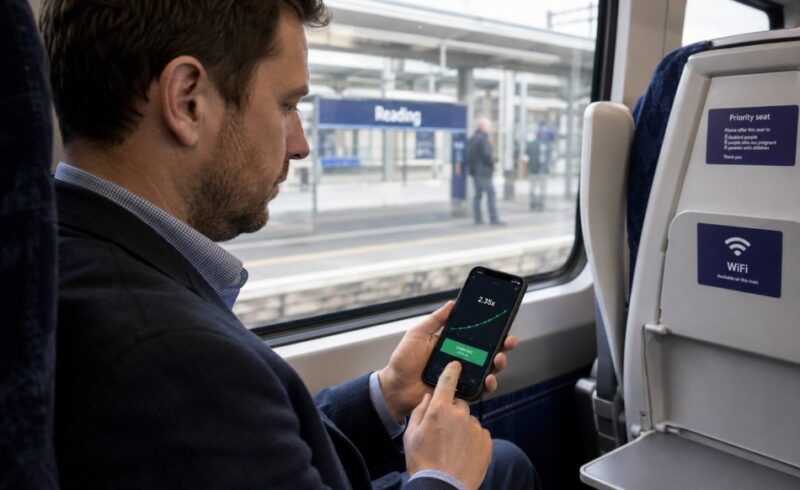
On a delayed train somewhere outside Reading, a passenger opens a phone, watches a line climb for eleven seconds, taps once, and locks the screen again before the next station. The whole episode is shorter than the wait for the doors to open.
That compression, an entire round of play folded into the gap between two thoughts, is the thing business owners outside this sector should be paying attention to.
The format driving it is the crash game, and it behaves unlike almost anything that came before it on a casino app. A multiplier rises, the player decides when to pull out, and the round ends the moment they do or the moment it collapses.
There is no hand to build, no board to read, no session to settle into. Short-round crash games strip out the long arc of strategy that older formats depended on and replace it with a single real-time decision made in seconds.
The skill, such as it is, lives entirely in the timing of one tap. That design choice is why the format travels so well on a phone. It asks for the exact unit of attention people actually have spare during a commute or an advert break, rather than the unit a product designer wishes they had.
Why Crash Games Are the New Face of Mobile Entertainment in Today’s Digital World?
The Market It is Feeding Into
Put the individual game to one side and look at the pool it sits in. The UK’s remote casino, betting and bingo sector generated £7.8 billion in gross gambling yield in the year to March 2025, a rise of more than thirteen per cent on the year before, with online casino games making up the largest slice.
Whatever one thinks of that number, it is not a fringe figure, and the growth is not coming from people sitting down for longer sessions. It is coming from more moments, more often, on smaller screens.
This is the part worth lingering on. The remote sector did not grow by deepening engagement in the old sense. It grew by colonising the dead air in a day, and the products winning that air are the ones that ask the least of the person holding the phone.
Regulation Has Caught Up Faster Than the Cliché Suggests

There is a lazy assumption that fast, app-native formats sit in some grey zone ahead of the rules. In Britain that is no longer true. Studios supplying these games to UK-facing operators need a Gambling Commission software licence, and the regulator has shown it will use its teeth: in late 2025 it suspended a major crash-game supplier’s licence over a hosting-compliance failure, then reinstated it only after the breach was put right months later.
For anyone running a regulated digital business, that sequence is the interesting bit. The format is novel, but the compliance scaffolding around it is conventional, and the cost of getting it wrong is a switched-off revenue line. Speed at the front end does not buy a pass at the back end.
The wider point for operators is that regulators now treat these instant formats as fully inside the perimeter rather than ahead of it. A product that loads in two seconds still sits behind the same licensing, the same audits and the same hosting requirements as a game built a decade ago. The novelty is all in the experience; underneath, the obligations are identical, and increasingly enforced.
The Lesson Sitting Underneath the Trend
Strip away the specifics and crash games are a very pure demonstration of a principle most digital businesses are still only half applying. People will engage readily, and repeatedly, with something that respects how little uninterrupted attention they can offer. The format succeeds because it removed steps, not because it added features.
The same pressure is reshaping plenty of businesses that have nothing to do with gambling. It is the logic behind one-tap checkout, behind the slow death of the long onboarding flow, behind the way the country has been quietly dismantling old friction in favour of instant alternatives, from contactless everywhere to the wholesale switch-off of the analogue landline network. Each is the same move: take a process that used to demand patience and collapse it into a moment.
A crash round lasts a few seconds because someone worked out that a few seconds was all they were going to get. Most products are still asking for minutes they are never going to be given.