


Supplier contracts attract most of the attention, but many avoidable costs begin inside the estate. From closed-store demand to poorly targeted capital spending, these are the five areas retail operators should examine first.
The Problem is Often Inside the Estate

A retail chain can overspend across dozens or hundreds of sites without any single bill looking obviously wrong.
The cause is often operational rather than contractual. Equipment runs after closing, controls no longer match trading hours, faults develop gradually, and investment decisions rely on too little site-level evidence.
One inefficient store may not alter a group result. Repeated across an estate, the same pattern can. The task is to identify unusual consumption, establish the cause and give the right team a clear action.
Why the Pressure Remains in 2026?
UK business energy prices have eased from the worst of the crisis, but they remain well above pre-crisis levels. Department for Energy Security and Net Zero figures put the provisional average non-domestic electricity price at 24.3p per kWh in 2025, compared with 26.3p in 2024.
Retail estates add another layer of difficulty. A group may operate high-street shops, retail-park units, shopping-centre premises and distribution sites with different leases, equipment and opening hours.
That pressure sits alongside rising employment costs, the 2026 business rates revaluation, weaker high-street footfall and continued online competition, leaving less room for avoidable operating spend.
Reporting and property obligations also matter. Streamlined Energy and Carbon Reporting applies to quoted companies and to qualifying large unquoted companies and limited liability partnerships, subject to the framework’s criteria and exemptions. The fourth Energy Savings Opportunity Scheme compliance deadline is 5 December 2027.
For rented non-domestic property in England and Wales, the current minimum standard is generally EPC E unless an exemption applies. The government dropped the proposed 2027 EPC C milestone in June 2026 and now proposes EPC B from 2031 for rented buildings above 1,000 square metres, where cost-effective and subject to legislation.
Depending on their corporate structure and estate, some retailers may also need to consider current TCFD-aligned disclosures, CSRD requirements for in-scope EU operations, UK ETS obligations for qualifying installations and Part L when relevant building work is undertaken.
1. Closed Stores Are Still Drawing Too Much Power
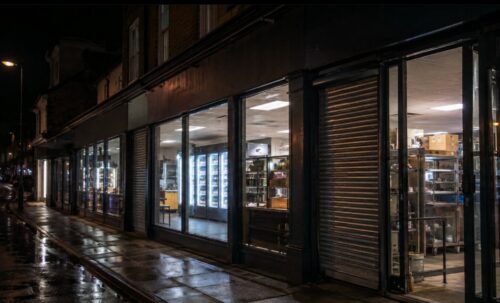
A dark shopfront does not necessarily mean a quiet meter.
Heating or cooling may follow an old schedule. Display equipment can remain on standby. External and security lighting may operate for longer than required. Hot water, extraction, cleaning equipment and back-office systems can add further demand.
Half-hourly data lets head office compare closed-hours demand across similar stores, then investigate unusually high baseloads and identify the equipment responsible.
Correcting a timer is not the end of the job. Seasonal overrides and local workarounds can restore the old pattern. Continued monitoring turns a one-off correction into a sustained saving.
2. Refrigeration Faults Are Adding Cost by Degrees
For businesses using chilled displays or cold storage, refrigeration can be one of the largest electricity loads. Carbon Trust guidance says it can account for half of the electricity bill in a small retail outlet.
The costly problems are often gradual. Door seals deteriorate, condensers collect dust, defrost cycles drift, refrigerant levels change, and temperature settings move below what is required. The cabinet continues to cool, so the problem may escape attention.
Comparable sites should be benchmarked, with unusual consumption investigated. Door seals, coils, condensers, refrigerant levels and defrost controls should form part of planned checks.
Temperature settings also deserve review, provided food safety and product requirements are protected. Carbon Trust guidance states that safely raising a cooling setpoint by 1°C can reduce refrigeration energy use by 2% to 4%.
3. HVAC Controls Are Working to Yesterday’s Timetable

Heating, ventilation and air-conditioning systems are often programmed when a store opens or is refurbished, then left unchanged while trading hours and routines move on.
That can mean heating before staff arrive, cooling after customers leave or conditioning back-of-house areas with limited occupancy. Poorly coordinated controls may also allow heating and cooling to operate at the same time.
Retailers should compare schedules with actual store activity. Till closure, alarm setting, cleaning shifts, deliveries and staff arrival times provide a better picture than an old timetable.
Setpoints must be reviewed carefully, with customer comfort, staff welfare and product conditions protected. For operators considering how technology can support that work, this overview of energy intelligence platforms for multi-site retail operators provides useful context on portfolio monitoring, site-level analysis and communication with frontline teams.
4. Lighting is Being Treated as One Uniform Load
Retail lighting supports safety, presentation and customer experience. Requirements differ between sales floors, displays, stockrooms, staff areas and car parks.
Waste occurs when every fitting is managed in the same way. Older fluorescent or halogen lamps may remain in parts of the estate. Display lighting can stay on after closing. Stockroom lights may operate in empty spaces, while external lighting follows fixed timers that no longer match daylight hours.
A portfolio audit should record fitting types, operating hours, controls and each area’s needs. Stores with long hours and extensive legacy equipment may warrant earlier attention.
LED upgrades can lower consumption, but specification and installation quality still matter. Light levels, colour rendering and glare affect the result. Occupancy sensors may suit intermittently used areas, while daylight controls can help near windows and outside.
5. Investment is Reaching the Wrong Sites First

Solar panels, batteries, EV charging, heat pumps and lighting programmes can support a retailer’s energy strategy. The mistake is assuming every property presents the same opportunity.
A solar project depends on roof condition, orientation, shading, available area, lease terms, grid capacity and daytime demand. Battery performance depends on the load profile, tariff and intended use. Heat-pump suitability varies with building fabric, operating temperatures and electrical capacity.
A uniform rollout can direct capital towards weaker projects while stronger sites remain untouched. Each location should be assessed using actual consumption and property data, then ranked against clear commercial and operational criteria.
Basic control and maintenance problems should be corrected before major investment is approved. New technology will not compensate for equipment that continues running unnecessarily.
What Retail Operators Should Do Next?
The priority is not another equipment list. It is establishing where the estate uses energy, when that consumption occurs and why comparable stores perform differently.
Operators should analyse half-hourly data, group similar stores and benchmark their performance. Unusual patterns can then be ranked by likely value, operational risk and ease of correction.
Each action needs a named owner. Head office may identify the issue, but store teams, facilities managers and contractors determine whether it is resolved. They need a clear instruction, deadline and verification method.
Monitoring should continue after each intervention. The same evidence can also support SECR, ESOS and, where applicable, current TCFD-aligned reporting, reducing duplication between operational management and compliance work.
Better Information Leads to Better Decisions

These five areas sit largely within the retailer’s operational control. Addressing them does not require a perfect wholesale-market forecast or another round of supplier negotiations.
The practical answer is disciplined multi-site operational energy management that turns store-level evidence into prioritised action. It identifies which locations need attention, what is causing the problem and who should respond.
UK retail chains that address the five overpayments above through considered action rather than default settings can improve margins, make meaningful compliance progress and reduce operational complexity. The specific saving depends on portfolio scale, but the operational logic applies across UK retail formats.
This article is for general information only and does not constitute financial, technical, regulatory or business advice. UK retail energy management, SECR compliance, MEES compliance, TCFD reporting, CSRD reporting, ESOS obligations and adjacent regulatory frameworks are subject to legislation and may change.
Individual multi-site energy management decisions require consideration of specific portfolio, operational, financial and regulatory circumstances that this article cannot address.
Anyone considering multi-site energy management strategy, low-carbon technology investment or compliance reporting approach should take advice from qualified regulatory, technical and business advisers appropriate to their circumstances.