

Polymarket has turned a quiet structural problem into front-page news.
On August 4, 2026, the prediction-market platform entered early talks to raise about $1 billion at a valuation above $20 billion, only four months after closing a $15 billion round backed by the owner of the New York Stock Exchange.
All of that value is being created inside a company that remains private, which leaves the employees and early investors holding its equity unable to sell on any public exchange.
Pre-IPO secondary markets are the mechanism that lets them cash out before an IPO, and knowing how they work matters more as companies stay private longer.
What a Pre-ipo Secondary Market is and Why It Exists?
A pre-IPO secondary market is a regulated venue where existing shareholders of a private company sell their shares to accredited investors ahead of any public listing. The primary market is where a company sells newly issued stock to raise capital for itself.
The secondary market moves shares that already exist from one holder to another, so the company raises nothing and the seller gets liquidity. That distinction turns locked equity into cash without waiting for an exit. The pressure behind these venues is structural.
Venture-backed companies now stay private for well over a decade, and the 2025 to 2026 IPO drought stretched that timeline further.
The result is a backlog often called the unicorn liquidity crunch, where employees hold stock options representing years of compensation they cannot touch, and early funds need to return capital to their own investors.
Polymarket is the most visible example of a company minting paper wealth while its shareholders wait.
How a Secondary Transaction Works?
Every secondary deal follows the same arc. A seller lists shares, a buyer is matched, a price is agreed, the company clears the transfer, and the position eventually resolves through a liquidity event such as a tender offer, another secondary sale, or an IPO or acquisition.
Two concepts shape the outcome more than any other. The first is pricing.
A company’s 409A valuation is an internal appraisal set for tax purposes when it grants stock options, and it usually sits below the real market, while the secondary price reflects live buyer demand and often runs higher for sought-after names.
The second is the right of first refusal, or ROFR, which lets the company or its investors match a pending sale and buy the shares themselves before an outside buyer can complete the purchase.
ROFR is the single biggest reason a secondary deal falls through, so each platform’s handling of it deserves attention.
1. Forge Global
Forge Global is the largest dedicated secondary marketplace and the closest the sector has to a public exchange.
It is listed on the NYSE under FRGE, has operated since 2014, and in November 2025 Charles Schwab announced an agreement to acquire it in a deal valued near $660 million. Charles Schwab completed its acquisition of Forge Global in March 2026.
Pricing/Fee Structure
Forge charges a transaction fee that typically ranges from 2% to 4% on direct secondaries, varying by deal size and lifetime volume, and it can reach as low as zero in some cases.
The standard direct minimum is $100,000, though Forge Funds lowers entry to roughly $5,000 for pooled indications of interest. Buyers should also watch the bid-ask spread, which is not always visible until inside a deal.
Accredited Investor Verification Requirements
Access requires verified accredited status under the SEC thresholds of $1 million in net worth excluding a primary residence, or income above $200,000 individually or $300,000 jointly for the past two years.
Forge verifies this through documentation rather than accepting self-certification, and it serves both individual and institutional accounts.
Liquidity Events
Forge runs a marketplace for direct secondaries, a self-directed IRA option through Forge Trust, and company-sponsored tender offers for employers running structured liquidity programs.
Reported first-quarter 2025 trading volume reached $692.4 million, which signals deep liquidity for buyers seeking an exit ahead of an IPO or acquisition.
Cap Table Impact and ROFR
Issuer approval is always required for transfers on Forge, and the company or its investors can exercise a right of first refusal before a trade settles.
Because Forge concentrates on larger and institutional flow, deals can involve more documentation, and closes have historically averaged several weeks from agreement to settlement.
409a Valuations vs. Secondary Market Pricing
Forge Price, the platform’s data set, publishes indicative daily marks across roughly 200 pre-IPO companies, giving buyers a market-based reference rather than relying on a company’s internal 409A valuation.
Since a 409A is a conservative tax appraisal, Forge’s traded prices often sit well above it for in-demand names, and the data layer is a core reason institutions use the platform for price discovery.
Employee Equity/Stock Option Liquidity
Employees holding vested shares or exercised options can sell through Forge’s marketplace or participate in an employer-run tender, subject to company approval.
The high direct minimum means individual employee sellers typically transact through structured company programs rather than ad hoc listings.
Pros
- Broadest company inventory and strongest private-market data tools
- Regulated, publicly traded, with IRA custody through Forge Trust
Cons
- The $100,000 direct minimum excludes smaller individual buyers
2. Hiive
Hiive runs a live order book, displaying real-time anonymous bids and asks from confirmed buyers and sellers rather than quoting a single negotiated figure.
It launched in 2021, operates as a FINRA-registered broker-dealer and SEC-registered alternative trading system, and lists more than 2,000 private companies for over 12,000 registered users.
Its research arm publishes investment insights for Polymarket and other high-demand names, giving buyers a read on where private-market pricing is heading.
Pricing/Fee Structure
Hiive sets a $25,000 standard minimum and charges disclosed bilateral commissions, up to 4.85% on the buyer side and up to 5.75% on the seller side, with buyer fees tiering down above $250,000.
Most Hiive Funds carry no management fee and no carried interest, which reduces fee drag on multi-year holds, though the upfront commission is heaviest at the $25,000 minimum before the tiers apply.
Accredited Investor Verification Requirements
Hiive verifies accreditation against the same SEC net-worth and income thresholds and accepts both individual and institutional investors.
It also registers as an exempt market dealer in several Canadian provinces, which widens verified access beyond the US-only reach of the other marketplace platforms here.
Liquidity Events
The platform supports direct share transfers and SPV-wrapped fund access, so a seller can offload shares and a buyer can hold equity directly or through a pooled vehicle.
Sellers list on the order book at a price they set, rather than waiting for a company-sponsored tender, which gives shareholders a route to liquidity between formal events. Its inventory skews toward late-stage technology and AI names.
Cap Table Impact and ROFR
Hiive manages the ROFR process on the platform, and issuer approval is sometimes required for a transfer to close.
The company reported an 18% ROFR exercise rate in 2024, a concrete figure that helps buyers weigh the odds of a company stepping in on a pending trade and a level of disclosure competitors rarely publish.
409a Valuations vs. Secondary Market Pricing
The live order book is Hiive’s defining feature for pricing. Instead of anchoring to a stale 409A valuation, both sides see real-time bids and asks, so the traded price reflects current demand for a name rather than a tax-driven appraisal.
That transparency is the platform’s main pitch to buyers who want to judge fair value themselves.
Employee Equity/Stock Option Liquidity
Employee shareholders can list vested shares directly on the order book to raise cash without waiting for an employer tender, setting their own asking price and negotiating against live buyer demand.
The $25,000 minimum keeps the platform accessible to individual sellers rather than only large blocks.
Pros
- Transparent live order book with real-time bids and asks
- No management fee or carry on most Hiive Funds, favoring long holds
Cons
- The self-directed model offers less guided support than Forge or EquityZen
3. EquityZen
EquityZen is the most retail-oriented of the marketplace platforms, built around pooled vehicles that keep entry accessible for smaller checks.
It has operated since 2013, and Morgan Stanley acquired it in January 2026, adding institutional backing and distribution.
Pricing/Fee Structure
Following the acquisition, Morgan Stanley cut fees to 2.5% on both the buy and sell side in February 2026, down from 5% for most transactions, while the minimum stayed at $5,000, among the lowest in the category.
That makes EquityZen the cheapest entry point of the four for a first-time buyer.
Accredited Investor Verification Requirements
Access is restricted to accredited investors verified through documentation, with offerings structured as Regulation D private placements through EquityZen Securities, a registered broker-dealer and SIPC member.
The platform reports roughly 800,000 registered users, the largest verified base among the marketplaces covered here.
Liquidity Events
Most access comes through special purpose vehicles that pool investors into a fund holding the shares, and the platform also runs Express Deals that let an investor sell an existing fund interest to another investor before a company exit.
It reports more than 51,000 private placements across nearly 500 companies, a deep track record with retail-scale buyers.
Cap Table Impact and ROFR
EquityZen administers ROFR at the platform level and typically works with companies whose transfers are pre-cleared, which lowers the chance of a deal being blocked after capital is committed.
The SPV structure means the buyer owns a fund interest rather than appearing on the company’s cap table directly, a trade-off in exchange for the lower minimum and simpler process.
409a Valuations vs. Secondary Market Pricing
EquityZen prices each offering per deal rather than through a continuous order book, so buyers evaluate a set price for a given SPV rather than watching live bids.
That price still reflects secondary-market demand rather than the company’s 409A, but with less minute-to-minute transparency than an order-book model provides.
Employee Equity/Stock Option Liquidity
EquityZen has long marketed to employee shareholders looking to sell vested equity, handling the paperwork and company approval on their behalf.
The low minimum and guided process suit first-time individual sellers who want a managed transaction rather than a self-directed listing.
Pros
- Lowest minimum and lowest post-2026 fees of the marketplace platforms
- ROFR handled before capital is committed, reducing settlement risk
Cons
- SPV-first structure gives less live price transparency than an order book
- Access is limited to companies EquityZen has approved and sourced
4. Nasdaq Private Market
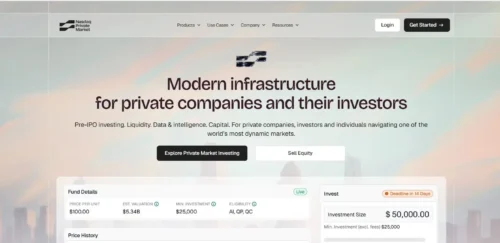
Nasdaq Private Market, formerly SecondMarket, works differently from the other three.
Rather than an open marketplace where individuals browse and buy on demand, it provides the infrastructure for company-sponsored tender offers and structured liquidity programs. It has operated since 2013 and is backed by Nasdaq.
Pricing/Fee Structure
For employee sellers using its SecondMarket Employee Direct product, NPM charges a flat 1% commission per transaction, a fraction of typical marketplace fees, while company-run tenders set their own terms because the employer organizes and funds the event.
Accredited Investor Verification Requirements
The buy side is oriented toward institutional and qualified purchasers who participate in tenders and auctions, while the sell side serves company-approved employees and existing shareholders.
Individual outside buyers cannot simply open an account and purchase shares the way they can on Forge, Hiive, or EquityZen, because access flows through the sponsoring company’s program.
Liquidity Events
NPM structures tender offers, Dutch auctions, and block trades, and provides cap table integration, order-book management, and settlement technology for the companies running them.
It has facilitated more than $55 billion in volume for nearly 200,000 participants over its history, and tender participants liquidated close to $15 billion in a single recent year.
Cap Table Impact and ROFR
Because the company itself sponsors the liquidity event, ROFR and transfer approvals are handled upstream as part of structuring the tender.
That makes execution more reliable once a program is live, since the company has already cleared the cap table questions that block ad hoc secondary sales elsewhere.
409a Valuations vs. Secondary Market Pricing
Tender offers on NPM are usually priced at a single set figure the company and its advisers establish for the event, often informed by a recent funding round or a third-party valuation rather than a live market.
That gives participants a clear, uniform price, though it reflects the sponsor’s chosen mark rather than continuous secondary-market discovery.
Employee Equity/Stock Option Liquidity
Employee liquidity is NPM’s core purpose. Company-run tenders let employees sell a defined portion of vested equity at a set price on a set date, which is the cleanest structured route for staff to convert options to cash, provided their employer chooses to run a program.
Pros
- Flat 1% employee fee is the lowest seller cost of the four
- Most reliable execution when a company sponsors the event
Cons
- Outside individuals cannot access deals without company participation
Comparing the Four Platforms
The split between fund and institutional buyers and individual shareholders runs through every choice here.
Institutions and funds gravitate to Forge for its inventory depth and data, and to NPM for structured tenders, while individual accredited buyers and employee sellers are better served by Hiive’s low-minimum order book or EquityZen’s pooled vehicles.
Forge and Hiive are active marketplaces for buyers who want inventory and pricing, EquityZen lowers the barrier for individuals, and Nasdaq Private Market serves employees and institutions inside company programs.
| Platform | Pricing and minimum | Key feature | Best for | Limitation |
| Forge Global | 2% to 4% fee, $100K direct or $5K via Forge Funds | Largest marketplace with Forge Price data | Institutional buyers wanting scale and data | Highest direct minimum |
| Hiive | Buyer fees up to 4.85%, $25K minimum, 0% fund carry | Live order book with real-time bids and asks | Active buyers who want price transparency | Higher upfront commission on small checks |
| EquityZen | 2.5% both sides, $5K minimum | Lowest entry point, pre-cleared ROFR | First-time individual accredited investors | SPV structure limits live price discovery |
| Nasdaq Private Market | Flat 1% on Employee Direct, program-set for tenders | Company-run tender offer infrastructure | Employees in sponsored liquidity programs | Access depends on company participation |
Conclusion
The best platform for a pre-IPO secondary depends on which trade-off matters most.
Forge offers the deepest inventory and strongest data at a high minimum, Hiive delivers live order-book pricing and a zero-carry fund structure for mid-sized checks, EquityZen sets the lowest entry point for first-time buyers, and Nasdaq Private Market runs the employer-sponsored tenders that give employees a clean exit.
All four beat ad hoc private sales on transparency and settlement, so the decision comes down to check size, whether you are buying or selling, and how much price visibility you need.
Frequently Asked Questions
Do I need to be an accredited investor to buy pre-IPO shares?
For all four platforms, yes. Forge, Hiive, EquityZen, and Nasdaq Private Market require verified accredited status, meaning $1 million in net worth excluding your home or income above $200,000 individually or $300,000 jointly.
Self-certification is no longer accepted, so each platform verifies the documentation.
What is the difference between a 409A valuation and the secondary market price?
A 409A valuation is an appraisal a company commissions to price employee stock options for tax purposes, and it tends to be conservative.
The secondary market price is what an accredited buyer will actually pay today, which often runs well above the 409A for in-demand companies because it reflects live demand rather than a tax-driven formula.
What is ROFR and how does it affect my transaction?
A right of first refusal lets the company or its existing investors match a pending sale and buy the shares themselves before an outside buyer can complete the deal.
It is the most common reason a secondary transaction falls through. Hiive, for example, reported that companies exercised ROFR on 18% of eligible transactions in 2024.
Can I sell my startup stock options if my company has not IPO’d?
Often yes, through a secondary sale or a company-sponsored tender offer, provided the company approves the transfer.
Employees can list shares on a marketplace like Hiive or sell through an employer program on Nasdaq Private Market, though vesting rules, transfer restrictions, and ROFR all affect whether and when a sale can close.
How long until I can exit a pre-IPO position?
A secondary position stays illiquid until a liquidity event occurs, whether another secondary sale, a tender offer, or an eventual IPO or acquisition. That horizon commonly runs one to five years or longer, so the capital committed should be money you can afford to hold for an indefinite period.
Key takeaways
- All four require verified accredited status, so the choice turns on fees, minimums, structure, and ROFR handling rather than eligibility
- A 409A valuation is a conservative tax figure, while the secondary price reflects live demand and often runs higher for sought-after names
- ROFR is the most common reason a deal falls through, so how each platform manages it matters as much as headline pricing
Next steps
- Match the platform to your role and budget, prioritizing a low minimum for first purchases and a sponsored tender for employee sellers
- Compare all-in economics deal by deal and confirm transfer approval and hold horizon before committing capital