

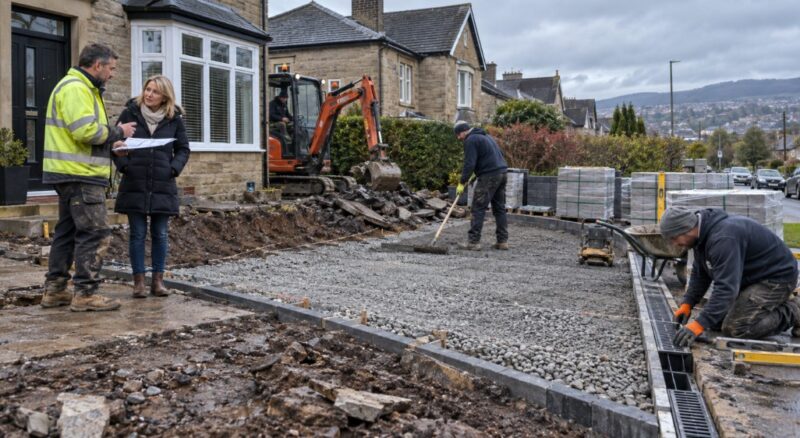
Most homeowners think about a new driveway in terms of the surface. What it looks like, what it costs per square metre, whether it will match the house.
The surface is the last decision made and the first thing you see when the job is done. But it is what happens before the surface goes down that determines how long it lasts and how good it looks five years from now.
This guide covers the full picture: the groundwork, the drainage, the material choices, and how a well-executed driveway changes the appearance of the whole front of a property.
For homeowners in Glasgow and Central Scotland specifically, there are climate and ground-condition considerations that make some of these decisions more consequential than they would be elsewhere in the UK.
What Does a New Driveway Actually Involve?
1. Excavation and Groundwork: The Foundation of Everything
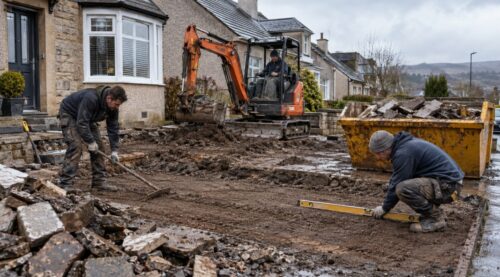
A new driveway begins with excavation. The existing surface, whether that is cracked concrete, old tarmac, overgrown gravel, or compacted earth, comes out. How deep the excavation goes depends on the ground conditions beneath, the proposed surface material, and what drainage solution the project requires.
Ground conditions vary across Central Scotland. Moisture, frost susceptibility, drainage and bearing capacity all affect the design. A contractor should assess these conditions and the expected vehicle loads before specifying excavation depth and supporting layers.
The spoil from excavation has to go somewhere. Skip hire and disposal are costs that some contractors include and others leave out of their headline figures. A written, itemised quote makes this clear. A vague verbal estimate does not.
Once excavated, the area is levelled, any soft spots or voids addressed, and the base prepared for the sub-base layer.
2. Sub-Base: The Layer Nobody Photographs
Type 1 aggregate is common beneath conventional driveway construction. Permeable systems require a compatible open-graded build-up instead. The selected material must be placed and compacted to the design and manufacturer’s requirements.
Sub-base depth depends on ground strength, drainage, vehicle loading and the complete paving system. There is no universal rule that block paving always needs a deeper base than asphalt. Ask the contractor to explain the specification for your site.
Edge restraints are set at the sub-base stage for block-paved driveways. Concrete haunching or block edging is fixed to line and level, giving the surface its boundary and preventing the outermost blocks from spreading over time.
This is a detail that distinguishes a professional installation from a DIY one. Poorly haunched edges lead to spreading, and spreading leads to an uneven surface.
3. Drainage: The Decision That Affects Everything Else
Water management is the most important design decision in a driveway project and the one most often treated as an afterthought.
A driveway needs to drain. Surface water that has nowhere to go sits on the driveway, finds the path of least resistance, and ends up either pooling against the house or running across the pavement. Neither is desirable and both can be avoided with proper design.
Conventional impermeable surfaces need falls and a suitable drainage route. Permeable block paving, gravel or resin-bound systems can allow water through when their base and drainage design support it. Permeability of the visible surface alone does not guarantee infiltration into the ground.
Check the Scottish permitted-development rules and any property-specific restrictions before starting. Drainage provisions can apply to hard surfaces between the house and a road, and separate consent may be needed for access works.
Confirm the proposed surface and runoff arrangements with the local authority rather than assuming every driveway is automatically permitted.
The junction between the driveway and the house is a particular drainage risk. If water cannot escape at the edges of the driveway, it tends to track toward the lowest point, which is often the wall of the house.
Properly specified drainage prevents this, an absent or inadequate drainage design allows it to become a damp problem over time.
4. Materials: What the Main Options Actually Mean in Practice?
Block paving uses individual concrete or stone units in a designed laying system. Conventional and permeable paving use different bedding and jointing materials. Individual units can often be lifted for access or repair, although the work still needs to restore the supporting layers and joints correctly.
Concrete blocks and natural granite setts are both available for driveway use. Check the product’s declared performance and suitability for the intended loads and exposure. Low price alone does not establish poor frost resistance, and granite is not a substitute for sound installation.
Asphalt can be a cost-effective option when properly specified, with its own drainage and maintenance requirements. Compare the full installed price and available finishes rather than assuming it is always the cheapest surface.
Resin-bound surfacing mixes aggregate with resin before it is laid. A suitable system can provide a smooth, permeable finish, but the base and drainage must also be compatible. Resin-bonded surfacing, where aggregate is scattered onto resin, is a different system and is generally impermeable.
For homeowners in Glasgow considering their options, a well-built driveway for a Glasgow home depends on material and specification choices that reflect the specific ground conditions and climate of Central Scotland. Guidance from those who install driveways in those conditions regularly is worth seeking before committing to a material or a contractor.
How a Driveway Changes the Whole Exterior?

This is the part of the project most homeowners think about last but feel most strongly about once it is done. A new driveway is one of the most visible changes you can make to a property.
It affects the whole front elevation, the relationship between the house and the street, and the perceived quality of the property from the outside.
A driveway that is well-proportioned for the plot, finished in a material that suits the house architecture, and edged cleanly where it meets the boundary and the lawn reads as an intentional design decision rather than a functional installation.
One that is the wrong scale, in a material that clashes with the house, or left with untidy margins reads as an afterthought.
The colour and pattern choice for block paving interacts with the house elevation more than most homeowners expect. A charcoal or grey block looks sharp against a rendered or painted house and can look cold against a warm red brick.
A buff or buff-mix block sits well with traditional Scottish sandstone. Looking at the house rather than just the sample card when choosing a colour saves a decision that is very hard to reverse.
Border or soldier course details at the edge of a block-paved driveway add definition and can visually frame the space in a way a plain surface does not.
A contrasting edge in a lighter or darker tone takes a standard driveway and makes it read more considered. These are details that experienced contractors raise as part of the design conversation and that less experienced ones often skip.
What to Check Before You Commission the Work?
A proper site survey before quoting is the minimum standard. Any contractor quoting from photographs or without visiting the site is guessing at the sub-base depth required, the drainage solution needed, and the access constraints that will affect the programme and cost.
An itemised written quote is essential for comparing contractors fairly. Labour, materials, sub-base depth and specification, drainage, edge restraints, disposal, and any remedial groundwork should all be separate line items. A single figure with no breakdown makes comparison impossible and dispute resolution difficult.
Ask about the sub-base specification specifically. What depth are they proposing, what material, and how many compaction passes. These are questions a good contractor answers without hesitation. A contractor who is vague about preparation work is one whose preparation is likely to be inadequate.
References and completed projects are worth reviewing, with an in-person visit where the owner agrees. A surface that looks good when new may perform differently after a winter, so ask about older installations too.
Preparation and drainage can be difficult to assess once the surface is finished. Ask for a written specification, photographs of the work as it progresses and clear handover information. These help you understand what was installed and how to maintain it.
A new driveway done well improves a property in ways that extend well beyond the parking space. Done poorly, it creates problems that take years and money to resolve. The difference between the two almost always comes down to what happens below the surface before the first slab is laid.