
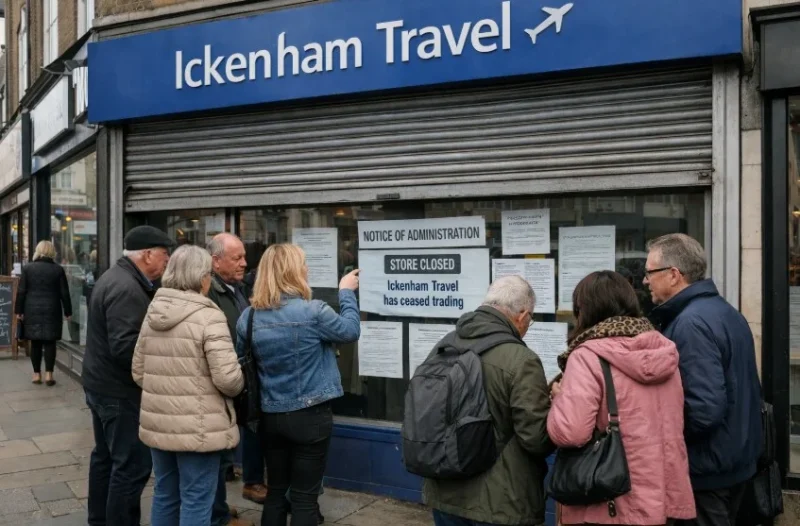
When a long established UK travel business enters administration, it is not just a corporate headline. It can disrupt holidays, trigger urgent consumer advice, and raise wider questions about how resilient the travel sector really is.
The Ickenham Travel collapse administration story has done exactly that, because it involves a company with decades of history, multiple trading names, and customers holding bookings at different stages of travel.
This article explains what happened, why a business can fail after more than half a century, and what affected travellers can do next. It also sets out how ATOL protection works in practice and what lessons UK consumers can take forward when booking future trips.
What Was Ickenham Travel Group and How Long Had It Operated?
Ickenham Travel Group was a London-based travel company with origins dating back to 1970, when it began as a single shop on Ickenham High Street, founded by Peter Reglar. Over the decades, the business expanded steadily, opening branches in areas including Hillingdon, Northwood, Harrow, and Rickmansworth.
The group operated under multiple brands and destination-focused websites, allowing it to reach a wide range of customers and market segments. Many holidaymakers may not have realised that different brands or websites were part of the same ATOL-protected company.
This multi-brand structure is common in the travel industry, helping companies target specific markets or budgets. However, when a business enters administration, customers can struggle to identify which legal entity is responsible for their bookings, complicating refunds or claims.
When Did Ickenham Travel Enter Administration and What Triggered It?

The defining moment came on 20 November 2025, when Ickenham Travel Group stopped trading as an ATOL holder. This date marked the point at which the company could no longer legally sell or operate flight-inclusive package holidays under the ATOL scheme.
Public updates at the time focused less on the company’s internal finances and more on customer protection. The Civil Aviation Authority confirmed the cessation and immediately issued guidance for travellers, particularly those already overseas or due to travel shortly afterwards.
This response is standard practice in travel company failures, where consumer safety and continuity of travel take priority.
Although the precise financial triggers were not publicly detailed in the guidance, administration at this stage usually reflects sustained financial pressure rather than a single event. What matters most for customers is not the exact cause, but how the administration affects existing bookings and what steps need to be taken next.
Why Did Ickenham Travel Collapse After More Than 55 Years?
A company operating for more than five decades has usually survived multiple economic downturns, so its failure naturally raises questions. While no detailed financial statement has been released publicly for consumers, the collapse can be understood in the context of wider industry pressures.
Financial and Operational Strain
Travel businesses operate on tight margins and rely heavily on cash flow. Customer payments are often taken months in advance, while suppliers such as hotels and ground service providers are paid later. If income slows or costs rise unexpectedly, the gap between incoming and outgoing payments can become unmanageable.
Official guidance warned that some local suppliers may not have been paid, even where customers held valid bookings. This highlights how fragile the payment chain can become when a company is under financial stress.
Changing Booking Habits
The UK travel market has shifted significantly, with more consumers booking directly online and expecting flexible terms, rapid responses, and transparent pricing. Traditional agencies have had to invest heavily in technology and customer support to keep pace, often increasing overheads.
Wider Industry Instability
The travel sector has faced repeated disruptions in recent years, including sudden demand changes and rising operational costs. Even established firms can struggle to adapt quickly enough.
Ickenham Travel Group was also not the only UK travel business to fail in the same period, underlining how challenging the environment has become.
What Role Did the Civil Aviation Authority Play in the Administration Process?

When an ATOL holder stops trading, the Civil Aviation Authority (CAA) plays a key role in guiding consumers and coordinating responses to minimise disruption. Its updates help reassure travellers and prevent panic bookings, especially for those already abroad.
For Ickenham Travel Group, the CAA confirmed that customers holding ATOL-protected flight tickets could generally rely on them for return travel and were advised to check in with airlines as usual.
It also coordinated with service providers to help ensure other trip elements—such as accommodation, transfers, and excursions, continued where possible.
Key points include:
- Package holidays with flights are typically protected under ATOL
- Accommodation-only or non-flight bookings are not covered
- The CAA clarifies coverage to prevent misunderstandings about protection
This guidance helps reduce immediate travel disruption and informs customers of their rights.
What Happens to Customers with Existing Ickenham Travel Bookings?
This is where the guidance becomes most practical. The right action depends on whether you are already abroad, whether your booking includes flights, and whether your trip is scheduled for after the cessation date.
If You Were Already Overseas on 20 November 2025
Customers overseas on the date the company ceased trading as an ATOL holder were told their return flight remained valid in many cases, provided they held a scheduled flight eticket. They were advised to check in with the airline as normal using the details on the existing ticket.
The reason this message is so important is that travellers often fear being stranded when a travel company fails. The guidance aimed to reassure travellers that they should not automatically need to buy new flights home.
If You Were Due to Travel After 20 November 2025
For customers due to travel after the cessation date, the Civil Aviation Authority indicated that flights might be valid if tickets had already been issued, but also warned that other services might not have been paid to local suppliers. That creates a risk of being asked to pay again in resort for accommodation or transfers, even if you have a confirmation.
Practical Actions Customers were Advised to Take
To manage this uncertainty, customers were advised to take specific actions:
- Confirm flight validity directly with the airline
- Check accommodation and transfer arrangements before departure
- Keep clear receipts for any additional payments made
- Obtain cash receipts if paying in cash, as claims cannot be processed without proof
These steps reflect the practical reality of travel disruption: the aim is to reduce on the ground stress and preserve evidence for any refund or replacement service claim.
How Does ATOL Protection Apply to the Ickenham Travel Collapse?

ATOL is designed to protect consumers who book flight inclusive packages through an ATOL holder. In this situation, ATOL related guidance was central because many customers had booked packages that included flights, and the status of those flights and other services could differ.
What Atol Generally Covers in This Situation?
Where a customer has an ATOL protected flight inclusive package, there are typically two broad priorities: ensuring travellers can complete their trip and return home, and providing a pathway for refunds or replacement costs where elements of the holiday cannot be delivered as booked.
The Civil Aviation Authority guidance highlighted that if you have been issued with flight tickets, those flights may be valid. However, other services may not have been paid to local suppliers. That is why the guidance includes the option to use the flights but replace accommodation or transfers and then claim for the cost of replacements.
Two Main Options for Customers with Valid Flights
For customers with flight inclusive package bookings due to travel after the cessation date, the guidance described two options:
- Claim for a refund if you do not want to use the flight
- Use the flight if valid, arrange replacement services such as accommodation or transfers, and then claim for the cost of those replacements
The best choice depends on personal circumstances. Some travellers may prefer certainty and avoid the risk of local disruption. Others may decide that the flight value is significant and the trip is still worthwhile if they can replace the ground arrangements.
What is Not Covered by ATOL?
A critical point in the official warning is that bookings sold as accommodation only, or non flight packages that do not include a flight element, are not covered by ATOL. In such cases, consumers are advised to contact the administrators when appointed.
This is an area where misunderstandings often occur, so it is worth stating plainly: ATOL protection is not automatic for every travel purchase.
ATOL protection overview:
| Booking type | ATOL protection | Next step |
| Flight-inclusive package | Yes | Follow refund or replacement guidance |
| Flight only | Limited | Deal directly with airline |
| Accommodation only | No | Contact administrators |
| Non-flight package | No | Review payment protections |
Customers were also advised to note the reported deadline for claims, which extended until 19 November 2026.
Which Brands and Websites Were Affected by the Ickenham Travel Administration?
The group traded through several brand names and websites, which contributed to customer confusion. These included destination-specific and all-inclusive holiday platforms linked to the same ATOL holder.
Associated trading names and websites:
| Brand | Website format |
| Ickenham Travel | ickenhamtravel dot co dot uk |
| Letsgo2 | letsgo2 dot com |
| Ras Al Khaimah Holidays | rasalkhaimahholidays dot com |
| Abu Dhabi Holidays | abudhabiholidays dot co dot uk |
| JA Resort Holidays | jaresortholidays dot com |
| Just All Inclusive | justallinclusive dot com |
Customers who booked through any of these brands were advised to check their ATOL certificate and booking documents carefully.
What Does the Ickenham Travel Collapse Reveal About the UK Travel Industry?

The UK travel market is dynamic, but it is also demanding. Traditional agencies compete with online platforms, and even established firms can be exposed to shifts in demand, supplier terms, and customer expectations. When a company with a long history fails, it highlights how unforgiving the sector can be.
One lesson is that longevity does not guarantee resilience. A company can have decades of local trust and a recognisable presence, yet still face modern pressures such as tighter margins, higher support costs, and more complex customer service requirements.
Another lesson is the importance of consumer protection schemes and clear communication. When a failure happens, the ability of consumers to understand what is protected, what is not, and what they need to do next can significantly reduce financial harm and stress.
Finally, travel failures can have a knock on effect. They can reduce consumer confidence, strain relationships with suppliers, and encourage travellers to prioritise protection and transparency even more strongly in future bookings.
What Are the Key Lessons for UK Travellers Booking Future Holidays?
For most people, the biggest takeaway is not the corporate story but how to reduce risk next time. Booking a holiday should be exciting, but it also involves significant payments and reliance on multiple suppliers.
Here are practical lessons UK travellers can apply when booking future trips:
- Check if your booking includes flights and has an ATOL certificate
- Know the ATOL holder and responsible company for each trip element
- Use secure payment methods and keep records of confirmations
- Verify the legal company behind unfamiliar brands
- Confirm flights, accommodation, and transfers before travel
These habits do not remove all risk, but they reduce uncertainty and make it easier to respond quickly if a problem arises.
What Should Readers Take Away from This Case?

The key takeaway from the Ickenham Travel collapse is the importance of consumer protection and preparedness. Customers overseas with scheduled flight tickets were generally able to rely on their return flights, while those travelling after 20 November 2025 had options to use valid tickets or claim refunds.
The case also highlights the complexity of companies operating under multiple brands and websites, which can make it harder to determine what protection applies. Maintaining receipts and proof of payment is crucial, especially if travellers need to pay again for services.
Understanding ATOL coverage, knowing what is included, and keeping detailed records help turn potential disruption into a manageable situation rather than a financial shock.
Frequently Asked Questions
Can travellers still fly home if their holiday company stops trading while they are abroad?
If a scheduled flight e-ticket has been issued, return flights are often still valid. Travellers should always confirm directly with the airline.
What if accommodation providers ask for payment again?
Travellers may need to pay again to continue their stay. Receipts are essential for any later claim.
Are accommodation-only bookings protected?
No, accommodation-only and non-flight packages are not covered by ATOL.
How long do customers have to make a claim?
In this case, claims could be submitted up to 19 November 2026.
Why is proof of payment so important?
Claims require evidence. Without receipts, refunds or compensation may not be possible.
What should customers do if their booking was cancelled before the collapse?
They may still be able to submit a claim if the booking was ATOL protected.
How can travellers protect themselves in future?
By checking ATOL protection, keeping documents, and confirming key services before travel.