

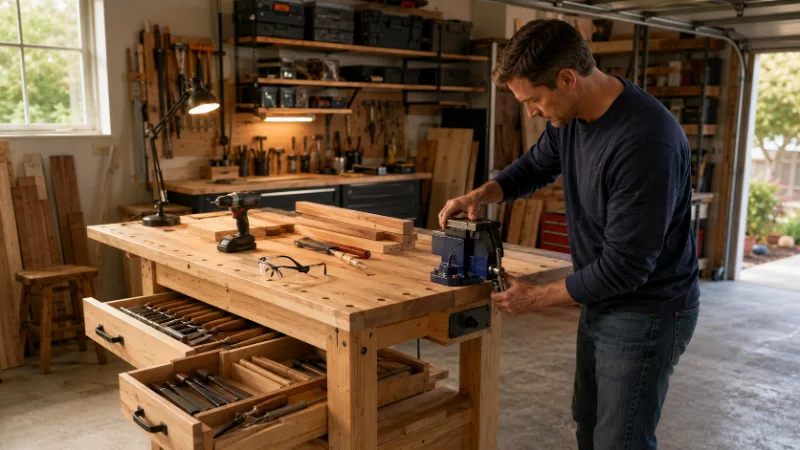
There is something deeply satisfying about having a space of your own to build and fix.
Whether you fancy restoring old furniture, taking on small DIY jobs, or finally learning how to make something from scratch, a home workshop gives you the freedom to get stuck in whenever inspiration strikes.
Setting one up does not need to be complicated or expensive. With a little planning, almost any home can find room for a workshop that works hard and feels good to use.
Pick the Right Spot
The first step is choosing where your workshop will live. A garage is the classic choice, offering space, sturdy flooring, and easy access for larger projects.
A shed or garden building works well too, particularly if you want a workshop that is separate from the main house and free from noise complaints.
If outdoor space is limited, even a corner of a spare room, cellar, or utility area can be turned into a perfectly functional set up.
Think about practicalities such as natural light, access to a power supply, and how easily you can bring materials in and out.
If you are converting a garden building, it is also worth thinking about the surface underfoot, since a workshop floor takes a fair amount of wear over time.
Plan Your Layout Before You Fill It
It is tempting to dive straight in and start buying equipment, but a little planning goes a long way. Sketch out roughly where your workbench, storage, and any larger machinery will sit before you commit to anything permanent.
Try to keep a clear path through the middle of the room and place the items you use most often within easy reach.
Good workshops tend to follow a simple flow: preparation and measuring in one area, cutting or shaping in another, and finishing touches somewhere with a bit more light and cleanliness.
You do not need to get this perfect from day one. As you use the space, you will naturally spot what needs to move and what is working well.
Storage That Keeps Things Simple
Clutter is the enemy of a good workshop, so it pays to think about storage early on.
Wall mounted shelving and pegboards are brilliant for keeping tools visible and off the workbench, while labelled boxes or drawers make it far easier to find screws, fittings, and small parts when you need them.
A tidy workshop is also a safer one. Cables kept off the floor, sharp tools stored properly, and materials stacked securely will all help prevent trips, cuts, and other avoidable mishaps.
Build Your Tool Kit Gradually
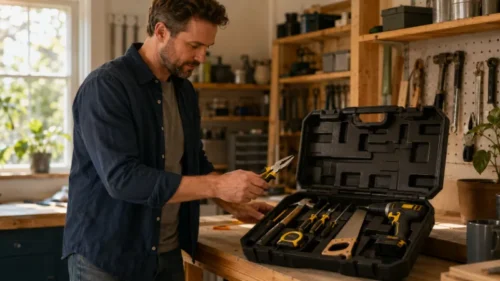
You do not need every tool under the sun to get started. A solid set of hand tools, including a tape measure, a spirit level, a decent set of screwdrivers, and a claw hammer, will see you through a huge range of jobs.
From there, you can build up your collection as your projects grow more ambitious.
For anything involving repeated drilling, cutting, or sanding, a good range of power tools will make life considerably easier and help you achieve a much neater finish than hand tools alone.
It is worth researching what suits your typical projects before buying, since the right tool for the job often saves both time and frustration.
Get the Lighting and Ventilation Right
Good lighting makes every task easier and safer, so aim for bright, even overhead lighting supplemented with a task lamp near your workbench for detailed work. If your workshop has a window, make the most of natural light wherever possible.
Ventilation matters too, especially if you will be working with paint, varnish, or anything that produces dust or fumes. A window that opens, an extractor fan, or simply keeping the door ajar while you work can make a noticeable difference to air quality and comfort.
Keep Safety Front of Mind
A well organised workshop should also be a safe one. Keep a basic first aid kit nearby, along with a small fire extinguisher suited to the type of work you do.
Safety glasses, ear protection, and a dust mask are inexpensive additions that are well worth having on hand, even for occasional jobs.
If children or pets have access to your home, consider how sharp tools and any electrical equipment are stored when not in use. A lockable cabinet or high shelf can offer real peace of mind.
Make It a Space You Enjoy
Finally, do not forget to make the space your own. A radio for background music, a comfortable stool, and a splash of paint on the walls can turn a purely functional area into somewhere you genuinely look forward to spending time.
A workshop that feels welcoming is one you will actually use, and that, more than anything, is what makes a project successful.
Setting up a home workshop is as much about the process as the finished space. Take your time, build it up gradually, and before long you will have a corner of the house that is entirely your own, ready for whatever project comes next.