
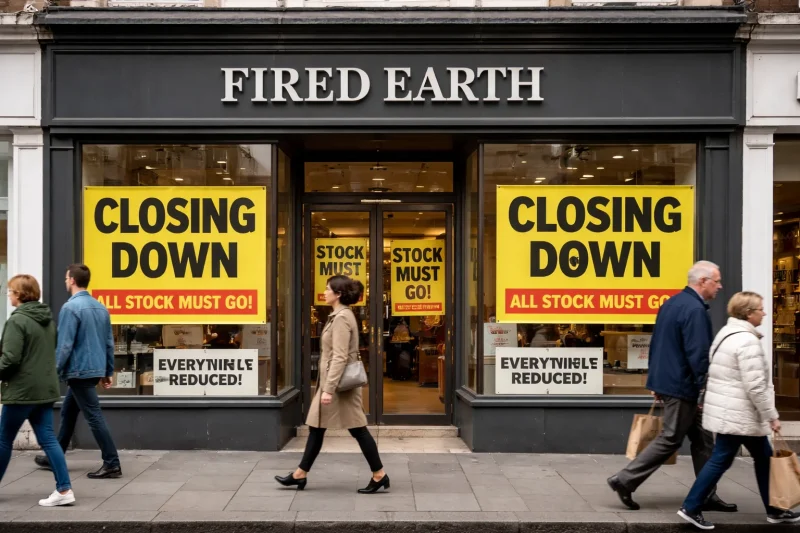
The sudden announcement of Fired Earth’s collapse into administration in October 2025 came as a shock to many in the UK’s home interiors sector.
As a luxury tile and bathroom retailer with a prestigious reputation and a 40-year history, the demise of Fired Earth is a cautionary tale of market shifts, operational strain, and the harsh realities facing mid-size multi-site retailers.
This article explores what led to the Fired Earth administration, the consequences for employees and customers, and what this means for the wider UK retail and interiors industry. We’ll also look at how the brand is evolving under its new ownership, and whether its legacy can be salvaged.
What Led to the Fired Earth Administration in October 2025?

Fired Earth, founded in 1983 in Oxfordshire, built a strong reputation as a premium UK interiors brand, known for luxury tiles, paints, and bathroom fittings sold through 20 showrooms and more than 20 independent stockists.
Despite its long heritage and loyal customer base, the business struggled to adapt to shifting market conditions.
By late 2025, Fired Earth had recorded several years of sustained trading losses. Although turnover remained close to £15 million in 2024, the company posted a £1.6 million loss, marking its second consecutive year in deficit.
Rising energy costs, increasing rents on high-end retail locations, and weakening consumer confidence in the home improvement sector added pressure. When its main investor withdrew ongoing financial support, administration became unavoidable.
Who Were the Joint Administrators, and What Did They Say?
On 31st October 2025, Leonard Curtis Business Solutions Group was officially appointed as the joint administrator of Fired Earth Limited.
Dane O’Hara and Alex Cadwallader, the appointed administrators, quickly moved to manage the business’s affairs and explore potential buyers through an Accelerated Mergers & Acquisitions (AMA) process.
In their public statement, O’Hara explained:
“Fired Earth has been loss-making for some time. In the last three years the company has been supported by its shareholder via substantial working capital loans, while efforts were made to return the business to profitability.
Unfortunately, the company continued to incur trading losses, and its investor was not prepared to provide further funding in the absence of a viable turnaround strategy.”
While multiple offers were received, none were deemed suitable to preserve existing staff or store locations. The administrators ultimately accepted an asset-only sale, focused on transferring the brand and remaining inventory to a third-party buyer.
When Did Fired Earth Begin to Decline, and How Serious Were the Losses?

The company’s financial difficulties didn’t arise overnight. Between 2023 and 2025, Fired Earth saw a steady erosion of profitability despite maintaining a respectable revenue stream.
A combination of stagnant growth, reduced consumer discretionary spending, and rising fixed costs chipped away at its bottom line.
Financial Performance Snapshot (2023–2025)
| Financial Year | Turnover (£m) | Net Loss (£m) |
| 2023 | 14.2 | -1.5 |
| 2024 | 15.0 | -1.6 |
| 2025 (YTD) | 11.3* | -2.1* |
*Estimated figures prior to administration
The company’s performance paints a familiar picture in today’s UK retail climate. Though sales figures remained relatively stable, operating costs outpaced revenues. High lease agreements for high-street showrooms, wage inflation, and increased logistics costs all contributed to its downward spiral.
How Did the Administration Impact Fired Earth Employees and Operations?
The administration led to the immediate closure of all 20 Fired Earth showrooms across the UK, resulting in the redundancy of all 133 employees. Independent stockists were also affected, as product availability and supply lines were disrupted during the transition period.
Which Areas Were Affected?
Showrooms in prominent retail areas such as Islington, Dulwich, Cheltenham, Harrogate, and Bath were among those shuttered.
These closures not only affected employees but also left significant gaps in the UK’s luxury interiors retail landscape, particularly in affluent neighbourhoods that relied on Fired Earth’s bespoke design services.
Remaining Operations
The Banbury head office and warehouse remained operational for a limited period post-administration to manage logistics and fulfil outstanding customer orders. Leonard Curtis confirmed that customer service teams were in place to handle enquiries and process deliveries using available stock.
What Does the Topps Tiles Acquisition Mean for the Fired Earth Brand?

In a deal reportedly worth £3 million, Fired Earth’s brand and select business assets were acquired by Topps Tiles, a major name in the UK tile retail sector. The acquisition followed Topps Tiles’ previous rescue of CTD Tiles in 2024 and is part of a broader consolidation strategy.
The purchase did not include any Fired Earth retail locations or staff, making it a true asset-only acquisition. Topps Tiles is expected to preserve the Fired Earth brand name, leveraging its design-led appeal in online and wholesale channels.
Topps Tiles’ Likely Strategy
Topps is likely to retain Fired Earth as a premium sub-brand. This enables them to broaden their market appeal, catering to both budget-conscious consumers and high-end design clients.
Fired Earth products are expected to be integrated into Topps Tiles’ e-commerce platform, with potential for future reintroduction into physical stores via concessions or hybrid formats.
Will Existing Fired Earth Customer Orders Still Be Fulfilled?
A key concern for many customers has been whether their orders would be honoured following the company’s collapse. The administrators confirmed that outstanding orders will be fulfilled, provided stock remains available in the Banbury warehouse.
A limited customer service function continues to operate, ensuring buyers receive goods already paid for.
Customer Support Overview
| Concern | Status |
| Existing orders | Fulfilled via Banbury warehouse |
| Refunds or returns | Subject to administrative review |
| Contact email | online@firedearth.com |
| Phone support | 0345 565 2032 |
| Physical store returns/exchanges | No longer available |
Customers are advised to keep all documentation and proof of purchase, especially if seeking refunds through banks or card issuers due to the company’s insolvency.
What Does This Mean for the UK Luxury Interiors and Tile Market?

The Fired Earth administration is not an isolated case. It reflects a broader pattern of retail contraction within the UK tile and home improvement sector.
The industry has been significantly impacted by post-pandemic shifts, high inflation, and the cost-of-living crisis, which have driven consumers to delay or scale back renovation projects.
In 2024 alone:
- CTD Tiles entered administration, later acquired in part by Topps Tiles and Stiled Ltd.
- Johnson Tiles closed its production facility in Tunstall, moving to an outsourced model.
These events suggest systemic issues within the tile and interiors supply chain — from manufacturing to retail.
Retailers with multiple physical sites, like Fired Earth, face disproportionate challenges compared to online-only or hybrid competitors. Rising rent, business rates, and the shift to e-commerce have forced even well-established names to reassess their operating models.
Could Fired Earth Have Been Saved with a Different Strategy?
Retrospective analysis suggests that Fired Earth may have struggled due to an overreliance on physical showrooms, combined with slow adaptation to the digital marketplace. While other retailers ramped up online capabilities and streamlined operations post-COVID, Fired Earth maintained a largely traditional retail structure.
Attempts to return to profitability were made, supported by shareholder loans, but no long-term turnaround strategy proved viable. The company’s premium price point also made it vulnerable during a time of tightening consumer spending.
A strategic shift to fewer flagship stores, stronger online presence, or B2B-focused wholesale partnerships may have extended the brand’s viability, but hindsight is, of course, clearer than foresight.
What Is the Future of Fired Earth Under Topps Tiles?

Fired Earth now joins the portfolio of Topps Tiles, which has been actively acquiring struggling competitors to consolidate market share. Under this new ownership, Fired Earth will continue as an online and wholesale brand, focusing on leveraging its design-led heritage while operating without the financial burdens of a large physical footprint.
Customers can expect to see Fired Earth collections featured online and possibly in selected Topps Tiles locations as premium product lines.
The long-term viability of the brand will depend on how well Topps Tiles can position it within their broader business ecosystem, and whether it can rebuild trust and visibility after such a dramatic collapse.
Timeline: Fired Earth’s Collapse at a Glance
| Date | Event |
| 1983 | Fired Earth founded in Oxfordshire |
| 2023 | £14.2m turnover, £1.5m loss reported |
| 2024 | £15m turnover, £1.6m loss reported |
| Sept 2025 | Leonard Curtis approached for business review |
| 31 Oct 2025 | Joint administrators appointed; 133 staff made redundant |
| Nov 2025 | Showrooms closed; asset-only sale pursued |
| Dec 2025 | Brand and assets acquired by Topps Tiles for ~£3m |
| Present (2026) | Operations continue online under Topps Tiles ownership |
Conclusion
The Fired Earth administration highlights the fragility of even well-loved, long-established brands in today’s retail climate. With high fixed costs, shifting consumer behaviour, and limited investor patience, traditional business models face existential threats.
While the Fired Earth brand will live on under the Topps Tiles umbrella, the collapse of its physical retail operations serves as a stark reminder: adaptation is not optional in a fast-evolving industry.
The story of Fired Earth is one of prestige, passion, and ultimately, the price of not changing fast enough.
Frequently Asked Questions
Is Fired Earth still trading in any physical stores?
No. All Fired Earth showrooms across the UK have been closed. Only online and wholesale operations continue under new ownership.
Who owns Fired Earth now?
Fired Earth is now owned by Topps Tiles, who acquired the brand and selected assets in a deal worth approximately £3 million.
Are Fired Earth’s products still available online?
Yes. The brand continues to operate online and through wholesale channels. Products may also appear in Topps Tiles retail stores in the future.
Can Fired Earth customers get refunds or order updates?
Yes, for a limited time. Customers with existing orders should contact Fired Earth directly. Refunds are subject to administration rules.
Why didn’t Fired Earth restructure instead of closing?
Leonard Curtis concluded the business was not viable in its current structure, and no investor was willing to fund a turnaround plan.
What are other recent tile retailer closures in the UK?
CTD Tiles and Johnson Tiles also experienced closures or restructures due to similar financial pressures and market trends.
How does Topps Tiles plan to use the Fired Earth brand?
Topps Tiles is expected to integrate Fired Earth as a premium online and wholesale brand, preserving its identity while cutting overheads.