


Yes, you can pay money into many UK bank accounts at a Post Office, provided your bank supports cash deposits through the Post Office banking network.
In most cases, you take your cash and debit card to the counter, the transaction is processed against your bank account, and you receive a receipt confirming the amount deposited.
Card-based cash deposits commonly appear in the account immediately or on the same day. Deposits using a paying-in slip can take until the next working day or longer depending on the bank and the branch cut-off time.
The service has become particularly useful as traditional bank branches have reduced their high-street presence. Official network figures show 11,718 Post Office branches operating as of March 2026, while around 4,000 branches are open seven days a week.
However, there are three important points to remember:
- Your bank determines how much cash you can deposit.
- Your local branch may apply an additional transaction limit.
- Coins normally have stricter sorting and quantity requirements than notes.
Generally, you can pay money into your bank account through the Post Office, but the amount you can deposit, how quickly it reaches your account and the payment methods available depend on your bank.
How Do You Pay Money Into a Bank Account at the Post Office?
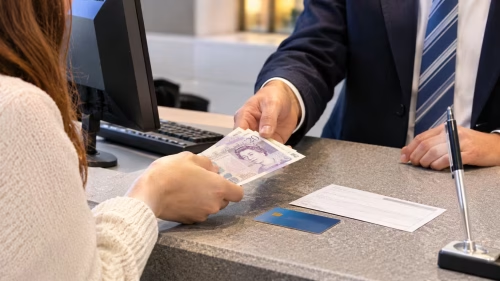
For most supported accounts, depositing cash is straightforward.
You will normally need to:
- Visit a Post Office branch offering banking services.
- Tell the counter assistant that you want to pay cash into your bank account.
- Present your debit card, deposit card, barcode or paying-in slip, depending on your bank.
- Hand over the notes and correctly sorted coins.
- Confirm the deposit if prompted on the card terminal.
- Collect your receipt and keep it until the money appears correctly in your account.
Many major banks now support debit-card deposits, which are normally faster than traditional paper paying-in slips.
You can check the current participating institutions and services through the official everyday banking service before making a special journey.
For businesses, regular cash deposits can also reduce the amount of money kept on commercial premises.
Recent research involving 500 UK small business owners found that businesses travelling to deposit cash do so around twice per week on average, while 70% said they had delayed depositing cash because they could not find the time.
That makes physical cash access relevant even as businesses increasingly adopt faster digital payout tools for other transactions.
How Long Does It Take to Put Money in a Bank From a Post Office?
Cash paid in using a debit card will normally reach the account much faster than money deposited using a paper paying-in slip.
| Deposit method | Typical time to appear |
| Debit card cash deposit | Immediately or same day in many cases |
| Cash using paying-in slip | Usually next working day, subject to cut-off times |
| Deposit after branch/bank cut-off | May take an additional working day |
| Weekend card deposit | Timing depends on the bank |
| Cheque deposit | Usually several working days |
The general Post Office guidance is that card-based cash deposits normally show in the account on the same day, while deposits made using a paying-in slip normally show on the next working day.
A frequently quoted 4:00 PM cut-off should not be treated as a universal rule for every bank. Some banks use it, but other institutions and branches have different processing arrangements.
For example, certain card deposits processed before 4:00 PM on a business day can be available immediately, while deposits after that point may not be fully processed until the next working day.
Other banks credit card-based deposits immediately regardless of the same timetable.
The practical approach is therefore to treat same-day credit as common rather than guaranteed.
Always keep your receipt. If your account balance does not reflect the correct deposit, the receipt provides evidence of the amount and transaction.
What Banks Do Post Offices Accept?
Most major UK banking groups participate in Post Office banking services, although the exact services vary.
The latest network information shows that cash deposits are supported for many institutions including Barclays, HSBC, First Direct, Lloyds Banking Group, NatWest Group, Santander, Starling, TSB, Virgin Money and Monzo.
| Bank or financial institution | Cash deposits at Post Office |
| Allied Irish Bank | Yes |
| Bank of Ireland | Yes |
| Barclays | Yes |
| CAF Bank | Yes |
| Co-operative Bank | Yes |
| Danske Bank | Yes |
| Handelsbanken | Yes |
| HSBC and First Direct | Yes |
| Lloyds Banking Group | Yes |
| Metro Bank | Yes – business customers |
| Monzo | Yes |
| Nationwide Building Society | No |
| NatWest Group | Yes |
| Reliance Bank | Yes |
| Santander | Yes |
| Starling Bank | Yes |
| TSB | Yes |
| Unity Trust Bank | Yes |
| Virgin Money | Yes |
| Zempler Bank | Yes |
One important exception is Nationwide Building Society. The current network table shows Post Office cash withdrawals and balance enquiries for Nationwide customers, but not cash deposits.
Services can also change. A bank may support cash deposits but impose different arrangements for cheques, business accounts or third-party deposits.
This distinction matters because physical banking access can vary significantly between transactions.
The wider issue has also become relevant when assessing how far lenders examine bank statements, particularly where unusual or unexplained cash deposits need to be evidenced.
How Much Money Can Be Transferred From Post Office to Bank Account?
Strictly speaking, paying cash through a Post Office is a cash deposit, rather than a bank-to-bank transfer.
There is no single Post Office limit that applies to every personal account. Your bank sets its own daily, monthly or annual allowance and may apply additional security checks.
Current personal-account examples demonstrate how significantly the limits can vary:
| Example | Post Office cash deposit allowance |
| Barclays personal account | Up to £3,000 per transaction; £10,000 per year through Post Office |
| NatWest personal account | Up to £3,000 per day; £24,000 annual limit |
| Santander personal account | Up to £3,000 per day; £10,000 rolling annual limit |
| Starling personal/joint account | Up to £1,000 per day; normally up to £5,000 per calendar year |
| Monzo personal account | Up to £750 per month |
Consequently, a general figure such as £1,000 to £3,000 per day is useful for understanding many personal-account limits, but it should never be treated as a universal maximum.
Annual allowances also vary considerably. Depending on the account, they can be £5,000, £10,000, £20,000, £24,000 or considerably higher.
If you regularly handle substantial cash, it is also worth understanding how banks assess unusually large cash deposits. There is no magic amount that automatically makes a deposit suspicious; banks assess the source of funds, normal account activity and transaction pattern.
Personal And Business Limits Differ
Business accounts can have substantially higher cash allowances.
For example, Starling currently allows qualifying business customers to deposit up to £5,000 per day and as much as £100,000 per calendar year, whereas its personal-account limits are considerably lower.
The Post Office also states that branch security arrangements can affect larger business deposits.
Guidance for business banking indicates that an open-plan counter may have a £4,000 deposit ceiling, while a counter protected by a glass screen may accept up to £20,000.
These branch limits do not give you permission to exceed your bank’s own account limit. The lower applicable limit normally determines how much can actually be deposited.
Can I Pay Coins Into My Bank Account at the Post Office?
Yes. Many supported banks allow customers to pay coins as well as banknotes into their account at a Post Office.
However, coins generally need to be sorted before you reach the counter.
A widely used limit across major banks is £250 of coins in a single deposit or transaction. Barclays, Lloyds and HSBC all publish £250 limits for relevant Post Office coin deposits.
Coin Sorting And Bagging Rules
For coins below £1, the normal requirement is to separate each denomination and place it into a full coin bag.
| Coin denomination | Full bag value |
| 50p | £10 |
| 20p | £10 |
| 10p | £5 |
| 5p | £5 |
| 2p | £1 |
| 1p | £1 |
These denominations must not be mixed in the same bag. Current bank guidance confirms these standard bag values.
For £1 and £2 coins, the rules are more flexible with many participating banks. They may be accepted loose or in part-filled bags, although the £1 and £2 coins should remain separated from one another.
For example:
- £6 in £1 coins should be kept together.
- £12 in £2 coins should be kept separately.
- 50p and 20p coins should not be mixed into one £10 bag.
- Loose mixed lower-denomination coins may be refused.
Sorting change before travelling can therefore prevent a deposit being delayed or rejected.
What Are the Main Post Office Cash Deposit Limits?
The figures below provide a practical summary rather than a guarantee for every bank account.
| Deposit issue | Typical/current position |
| Coin deposit | Frequently capped at £250 per transaction |
| Personal daily cash deposits | Often around £1,000–£3,000, but varies |
| Personal annual limit | Varies substantially by bank |
| Open-plan counter | Up to £4,000 for larger business deposits |
| Screened counter | Up to £20,000 for larger business deposits |
| Card deposit processing | Often immediate or same day |
| Paying-in slip | Commonly next working day |
| UK branch network | 11,718 branches as of March 2026 |
| Seven-day branches | Around 4,000 |
The most important point is that the bank’s account limit and the branch’s physical handling limit are separate controls.
You could, for example, visit a branch capable of physically accepting £4,000 while your personal bank account only allows £1,000 that day. In that situation, your banking limit still applies.
Do You Have to Pay a Fee to Deposit Cash at the Post Office?
The Post Office itself does not normally charge a separate counter fee for standard cash deposits, but your bank can charge you depending on the account you hold.
This is particularly important for digital banks and business accounts.
For example, some accounts provide an annual amount of free cash deposits before charging a percentage, while others charge for each transaction.
Starling personal customers currently receive a defined amount of free cash deposits before a 0.7% charge applies above the allowance, while some business deposits attract a fee from the outset.
Monzo also uses its own fee and cash-deposit structure.
Therefore, check:
- Your daily cash allowance.
- Your annual or monthly allowance.
- Whether there is a cash-deposit fee.
- Whether coin deposits are charged differently.
- Whether your account has a separate Post Office allowance.
Businesses comparing physical cash with electronic settlement should consider the full administrative cost rather than only the deposit fee. That is increasingly relevant as payment choices influence everyday spending behaviour.
Can a Post Office Refuse a Cash Deposit?
Yes. A deposit can be declined even when your bank normally allows Post Office deposits.
Possible reasons include:
- You have reached your bank’s daily, monthly or annual cash limit.
- The branch cannot safely handle the amount.
- Coins have not been correctly sorted or bagged.
- Your card cannot be authenticated.
- Your bank requires a particular card, barcode or paying-in slip.
- The transaction triggers additional security checks.
- Staff are unable to verify the deposit instructions.
- The notes appear damaged, altered or potentially counterfeit.
Large or unusual deposits can also lead to questions about where the money came from.
That does not automatically mean that something is wrong. Banks have financial-crime and anti-money-laundering obligations and may need additional information where activity differs significantly from the normal use of an account.
Keeping invoices, receipts, sale agreements, withdrawal records or other evidence is sensible when depositing substantial legitimate cash.
Is the Post Office a Practical Alternative to a Bank Branch?
For basic cash banking, it increasingly is.
The latest network report states that Post Office partnerships with UK financial institutions enable personal and business customers to deposit and withdraw nearly £4 billion in cash each month.
The current banking arrangement also extends access-to-cash services through to 2030.
Ross Borkett, Banking Director, described the continuing trend by saying:
“Customers and businesses are increasingly choosing post offices as trusted locations to deposit and withdraw their cash.”
The importance is particularly evident in communities where a traditional bank branch has closed.
There are also practical limits. A Post Office counter cannot normally provide the same services as a full bank branch. Staff generally cannot advise you about lending decisions, overdrafts, investments or complex account administration.
For everyday transactions, however, you may be able to:
- Deposit cash.
- Withdraw money.
- Check your balance.
- Pay in certain cheques.
- Obtain business change with supported accounts.
Weekend availability can also make the network useful, although banking services vary by location. Anyone specifically planning a weekend visit should check whether their local Post Office is open on Sunday before travelling.
Postmaster Jeet Jadeja has also highlighted the value of expanding cash-deposit access, describing wider availability as something that can “make a huge difference for banking customers.”
What Should You Check Before Going to the Post Office?
A few checks can prevent a wasted journey.
Before travelling:
- Confirm that your bank supports Post Office cash deposits.
- Check your remaining daily and annual deposit allowance.
- Make sure your debit card is active.
- Remember your PIN if your bank requires it.
- Ask whether a barcode or paying-in slip is required.
- Sort coins into the required denominations.
- Check the local branch’s banking services.
- Check opening hours.
- Contact the branch first if depositing a large amount.
- Keep evidence showing where unusually large sums came from.
If significant cash transactions will later appear in financial records, keeping clear documentation can also be useful because bank statements may be examined closely during major financial applications.
For most ordinary cash deposits, though, the process is designed to be simple: card, cash, counter and receipt.
Conclusion
Yes, you can pay money into many UK bank accounts through the Post Office, making it a useful alternative where a traditional bank branch is inconvenient or unavailable.
Card-based cash deposits are often credited immediately or on the same day, while paying-in slips may take until the next working day.
The most important restriction is that deposit limits are set mainly by your bank, while individual branches can impose additional cash-handling limits. Coins usually need sorting, with a common £250 coin limit.
Before travelling, check your account’s cash allowance, required deposit method, branch banking facilities and any applicable fees.
Frequently Asked Questions
Do I need my debit card to pay cash into my account at the Post Office?
Usually, yes. Many banks process deposits using your debit card, although some banks also support barcoded deposit slips, dedicated deposit cards or personalised paying-in slips.
Does cash paid into a Post Office appear immediately?
It can. Card-based deposits often appear immediately or on the same day, while cash deposited using a paper paying-in slip will normally take longer.
Can someone else pay cash into my account at the Post Office?
Possibly, but third-party deposits depend on your bank’s rules. Some banks restrict who can make cash deposits or require a dedicated deposit card for another person.
Can I deposit £5,000 cash at a Post Office?
It depends on your bank, account and branch. Some business accounts permit £5,000 or more, but many personal accounts have substantially lower daily limits.
Can I deposit notes and coins together?
Generally yes, provided your bank supports both. Coins below £1 normally need to be placed into correctly sorted full bags, and many banks impose a £250 coin limit.
Does Nationwide allow cash deposits at the Post Office?
The current Post Office network information shows Nationwide customers can use certain counter services, but cash deposits are not currently listed as available.
Can I pay a cheque into my account at the Post Office?
Many participating banks allow cheque deposits using a personalised paying-in slip and deposit envelope. Processing normally takes longer than depositing cash, so check your bank’s current arrangements first.