

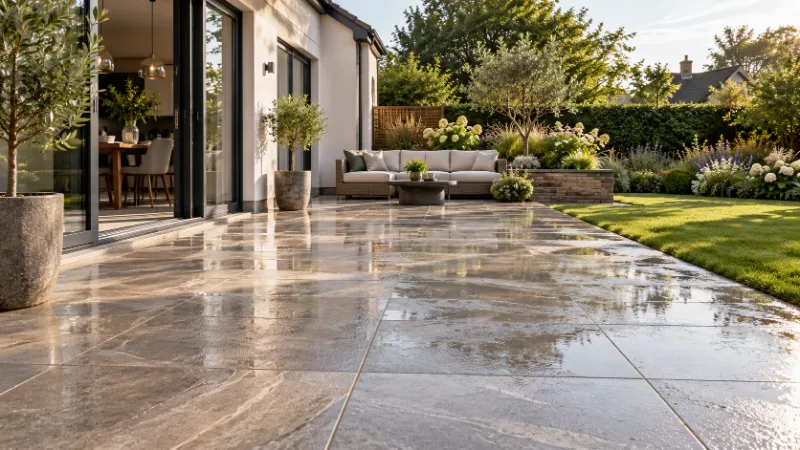
The garden hasbecome another room for a lot of UK households. It is where people cook in summer, eat long after the light goes and set up a laptop on a dry afternoon. That shift has changed what homeowners ask of the ground beneath them.
Outdoor tiles are now a common choice for patios and courtyards. You will find they are smoother than traditional paving and far easier to keep clean, with much more choice of colour and pattern.
However, a tile that looks right in a showroom still has to cope with frost and years of wet footfall. Choosing well means understanding a few practical details before you think about colour.
What Makes a Tile Suitable for Outdoor Use?
The short answer is density. Water that soaks into a tile expands when it freezes, and over a few winters that pressure can crack the surface or lift the glaze.
Porcelain is fired at high heat until it’s dense enough to soak up very little water, typically 0.5% or less. That’s why it’s become the default for outdoor floors, and why moss and barbecue spills wipe off rather than staining.
Thickness matters just as much. For an open patio, look for 20mm tiles. Standard indoor tiles are usually around 9mm to 12mm, which is why they crack outside.
You can lay them on a bed of mortar or straight onto a firm, well-prepared base of compacted stone. Thinner tiles are best kept to covered areas, or laid on solid concrete so they can’t flex underfoot.
Porcelain or Glazed Ceramic: Which Should You Choose?
For a patio floor, porcelain is usually the right option. Its density keeps water out and makes it low maintenance, so it’s the natural starting point for any outdoor floor.
Glazed ceramic is chosen for a different reason. It has more texture and richer colour, so it suits outdoor walls orthe front of a built-in barbecue.
A simple way to choose your material:
- Porcelain for anything you walk on, especially open terraces in all weathers
- Glazed ceramic for walls and sheltered spots where colour and pattern do the talking
Many gardens use both: a plain porcelain floor, and a patterned ceramic wall that gives the eye somewhere to land.
Natural stone is the other material many homeowners weigh up. Tile specialist Fired Earth puts the choice simply:
“Porcelain for durability and ease. Natural stone for material authenticity and character.”
Most stone needs sealing to guard against staining and algae, so porcelain tends to suit anyone who’d rather spend weekends on the patio than looking after it.
What Does an R11 Slip Rating Actually Mean?
An R rating tells you how well a tile grips when it’s slippery. Tiles are tested on a ramp that’s tilted until the person walking on it slips. The scale runs from R9 to R13, and the higher the number, the better the grip.
For outdoor floor tiles in the UK, treat R11 as the minimum. It rains a lot here, and you will walk on a patio by the back door in slippers just as much as you will in your muddy boots.
Finish plays its part too. A textured surface gives shoes something to hold on to, while a polished one can feel treacherous after a shower of rain.
The Health and Safety Executive’s guide to assessing slip resistance explains the main test methods if you want to understand tile suitability with more confidence.
Which Tile Size and Layout Works Best Outdoors?
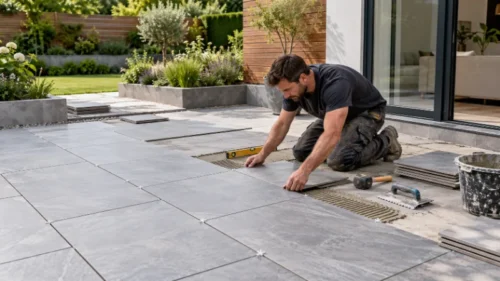
Large tiles suit big terraces. With fewer grout lines, the floor reads as one surface, so the space feels calmer and a little larger than it is.
Smaller tiles help where the space is awkward. A 20cm square tile can follow a curved path or fit a narrow side return without a wall of fiddly cuts.
The way you lay a tile changes the garden as much as the tile does. Run long tiles away from the house and the eye travels down the garden, so a short plot feels deeper. Lay them across the width and a narrow courtyard feels wider.
Pattern are easier to carry outdoors than many people expect. A single border of patterned porcelain around a plain floor gives a seating area its own identity, much as a rug does indoors.
How Can You Make the Garden Feel Like Part of the House?
The most effective trick is continuity. When the floor inside the back doors and the terrace outside share a colour and format, the threshold almost disappears and the kitchen seems to carry on into the garden.
That idea sits behind the outdoor tiles range at Fired Earth. The British tile and paint firm began in 1983, selling terracotta floor tiles from a farm in Oxfordshire.
Much of the range is rated for kitchens as well as outdoor use, so it’s far easier to keep one look running from inside to out.
Colour decides how the join reads. Neutral tones such as a soft taupe porcelain draw the inside out and let planting take the lead. Deeper shades, such as rich greens and near-blacks, hold their own in bright sunlight and look richer after rain.
It’s worth seeing a tile in your own garden before committing. Daylight is much brighter and cooler than kitchen lighting. A shade that looks warm indoors can look quite different on a grey February morning. A cut sample laid on the patio for a week will help you decide.n.
Now that more of us work and relax at home, the terrace often doubles as a spare room on dry days. That makes it worth choosing a floor you would be happy to look at from the kitchen table every morning.
How Should Outdoor Tiles Be Laid and Looked After?
Good groundwork does more for a tiled patio than the tile you pick. A firm base that drains well stops tiles rocking, and a gentle slope away from the house lets rain run off instead of pooling by the walls.
Before the work starts, it helps to check:
- The patio will sit well below the damp-proof course of the house, usually by at least 150mm
- The base suits the tile, whether that’s a mortar bed for 20mm porcelain or solid concrete for a thinner tile
- You’ve ordered a few extra tiles to allow for cuts and any future repairs
- The adhesive and grout are made for outdoor use
Once laid, porcelain asks very little. A sweep and a wash with warm water and a pH-neutral cleaner usually keeps it looking fresh, and it doesn’t need the regular sealing that natural stone does.
As with any garden kit, it’s worth keeping the manufacturer’s guidance to hand before reaching for a pressure washer or a strong chemical.
Conclusion
The right outdoor tiles start with two practical checks: dense porcelain rated R11 or above, and a thickness that suits the base beneath.
With those settled, the decision moves to where it belongs, with colour and the way the garden meets the house. Take a sample outside and let a few days of daylight tell you what works.