

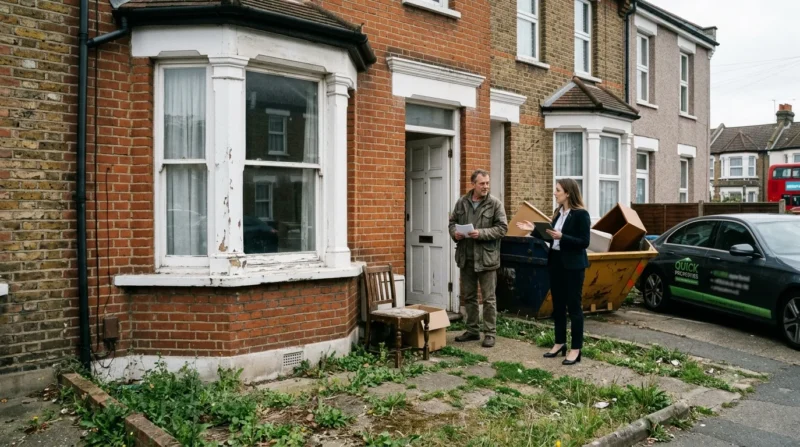
Selling a home in London can feel like preparing for an exam you never wanted to sit. There are estate agent valuations, viewings, photography, repairs, decluttering, paperwork, negotiations, and often months of uncertainty.
For some homeowners, that process is manageable. For others, it is exactly what they are trying to avoid.
Maybe the property has been inherited and is full of belongings. Perhaps tenants have just moved out and left it in poor condition.
You may be facing financial pressure, relocation, divorce, or simply need a clean break without spending thousands getting the place “market-ready”.
The good news is that selling quickly without preparing the property in the traditional sense is possible. The key is understanding your options, the compromises involved, and how to avoid common mistakes.
Why Preparing a London Property Can Be So Demanding
London buyers can be discerning. In many areas, presentation has a real impact on price and speed of sale. A freshly painted flat with professional photos and carefully staged rooms may attract stronger interest than a tired property with dated décor.
But preparation can be expensive and time-consuming. Even modest improvements add up quickly in the capital.
A basic refresh might include repainting, new carpets, garden clearance, minor repairs, deep cleaning, rubbish removal, and professional staging. If the property has structural issues, damp, lease complications, or outdated electrics, costs can escalate sharply.
There is also the emotional side. Preparing a home after bereavement, a relationship breakdown, or a stressful tenancy situation can be draining. In these circumstances, speed and certainty may matter more than achieving the absolute highest possible open-market price.
When Selling “As-Is” Makes Sense
An “as-is” sale means the buyer accepts the property in its current condition. You are not promising to renovate, redecorate, or clear every issue before completion. This can be especially useful when the property is hard to present well or when your timeline is tight.
Common situations where this route works
Selling without preparation may be worth considering if:
- The property needs significant repairs or modernisation
- You have inherited a house and do not want to clear or refurbish it
- You are dealing with problem tenants or a recently vacated rental
- You need to relocate quickly for work or family reasons
- The mortgage, service charges, or other costs are becoming difficult
- You want to avoid months of viewings and negotiations
Of course, convenience has a value. Buyers willing to take on a property as-is will usually expect a discount. That does not mean accepting an unfair price, but it does mean being realistic about what certainty and speed are worth to you.
Understanding Your Main Selling Options
If you want to sell fast in London without preparing the property, you generally have three routes: a traditional estate agency sale, an auction, or a direct sale to a professional buyer. Each has advantages and drawbacks.
Traditional estate agent sale
An estate agent can expose your property to the widest pool of buyers. This can help you achieve a strong price, particularly in desirable London locations with high demand. However, if the property is in poor condition or difficult to view, the process may be slower.
Open-market buyers often rely on mortgage finance, and lenders may hesitate if the property has serious defects, short lease issues, or missing documentation. Even after accepting an offer, surveys can trigger renegotiations. Chains can collapse. Completion dates can drift.
If you choose this route, be upfront with your agent. Ask whether the property should be marketed as a renovation opportunity and whether cash buyers or developers are likely to be interested.
Auction sale
Auction can suit unusual, tired, or investment-style properties. The competitive setting may create urgency, and once the hammer falls, the buyer is legally committed. This can be attractive if you want a defined timescale.
The downside is uncertainty. The reserve price must be set carefully, and there are fees to consider. If the property does not sell, you may lose valuable time. Auction also requires preparation of a legal pack, so it is not entirely hands-off.
Direct sale to a professional buyer
A direct sale can be the simplest option when speed matters more than presentation. Professional buyers are often used to properties needing repairs, clearance, or legal untangling. They may not require viewings in the usual sense and can often proceed without mortgage delays.
This is where comparing reputable firms and understanding the process becomes important. Homeowners researching practical routes often look at guides to London property sale solutions to understand how fast-sale models work, what questions to ask, and how to judge whether an offer is reasonable.
A direct buyer will usually offer below full market value because they are taking on risk, speed, and resale costs. The trade-off is greater certainty and less effort from you. For some sellers, that is worthwhile. For others, especially those who can wait, the open market may still be better.
How to Sell Without Refurbishing and Still Protect Yourself
Not preparing a property does not mean being careless. You still need to make informed decisions, especially in a high-value market like London.
Be honest about the property’s condition
Trying to hide problems rarely helps. Surveys, legal checks, and buyer inspections often reveal issues anyway. If there is damp, subsidence, a short lease, cladding concerns, Japanese knotweed, or missing building control paperwork, disclose what you know.
Transparency helps attract the right kind of buyer. It also reduces the chance of late-stage renegotiation.
Get a realistic sense of value
Even if you plan to sell quickly, do not rely on one opinion. Look at recent sold prices, speak to local agents, and compare offers where possible. London prices can vary dramatically from one street to the next, and condition is only one part of the equation.
For example, a dated terrace in Zone 3 with strong transport links may still attract fierce investor interest. A flat in a modern block with high service charges, however, may face a narrower buyer pool even if it looks presentable.
Check proof of funds
If a buyer says they can move quickly, ask them to prove it. Cash buyers should be able to provide evidence of available funds. If finance is involved, understand exactly what stage it is at. Speed claims are easy to make; completion depends on actual funding.
Read the small print
Before agreeing to anything, clarify fees, timelines, and obligations. Are there withdrawal penalties? Who pays legal costs? Is the offer fixed, or can it change after inspection? A professional buyer should be willing to explain the process clearly and put key details in writing.
What You Can Skip — and What You Shouldn’t
If you are selling as-is, you can often skip cosmetic improvements. Repainting, replacing carpets, staging furniture, landscaping, and upgrading kitchens or bathrooms may not be necessary. Buyers in this space are usually pricing in the work they intend to do.
However, you should not skip essential paperwork. Gather title documents, lease information if applicable, planning permissions, guarantees, building certificates, tenancy agreements, and utility details. Good paperwork can speed up any sale, even when the property itself needs work.
It is also worth removing anything truly hazardous or urgent if it could block access or create legal issues. You do not need to make the home beautiful, but it should be safe enough for inspections where required.
The Real Decision: Price, Speed, and Certainty

Every property sale involves a balance. In a perfect world, you would get the highest price, complete in days, and do no preparation. In reality, you usually prioritise two of the three: price, speed, or convenience.
If you have time and the property is mortgageable, the open market may deliver the best return. If certainty and speed matter most, an as-is sale to a cash buyer or investor may be more suitable. Auction sits somewhere in between, offering structure and urgency but not always guaranteed results.
The right choice depends on your circumstances, not just the property. A landlord exiting the market, an executor dealing with probate, and a homeowner relocating after a job offer may all value different outcomes.
Selling your house fast in London without preparing it for the market is not about cutting corners. It is about choosing a route that matches your priorities. With realistic expectations, transparent communication, and proper checks, you can avoid unnecessary work and move forward with far less stress.