
Combination padlocks are one of the most practical security options out there. No keys to manage, and a format that suits everything from a travel bag to a heavy-duty outdoor gate.
However, like any security hardware, how well one performs depends on more than just the lock itself. The code you set and the spec you choose for the location both feed into it, too.
This article runs through the most common mistakes people make with combination padlocks and how to avoid each one to keep your security high and stress-levels low.
What Combination Padlock Mistakes Weaken Security?
Buying a Four-wheel Lock for a Job That Needs Five
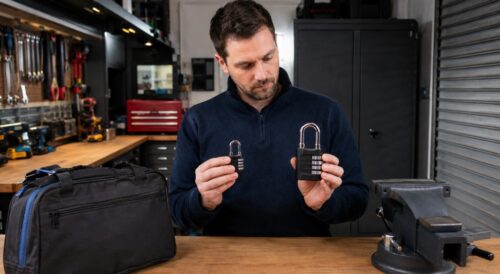
A four-wheel combination gives 10,000 possible codes. For a gym locker or a piece of luggage, that’s perfectly adequate. For a garage or anywhere securing equipment of real value, it’s a weaker starting point than it needs to be.
A five-wheel combination padlock gives 100,000 possible codes and is typically built to a higher specification throughout. The price difference is rarely significant, but the security difference can be. It’s worth checking the wheel count before you buy rather than assuming all combination padlocks are equivalent.
Choosing an Obvious Code
It sounds basic, but it’s the most common failure point. Birth years and sequential numbers like 1234 are the first combinations anyone tries on a lock they’re targeting. If your code has a personal connection or follows an obvious pattern, the lock’s physical security becomes almost irrelevant.
A good code has no connection to you and no logical sequence. Write it down and keep it somewhere separate from where the lock is used. That’s not overthinking it, that’s just using the lock properly.
Ignoring the Hasp
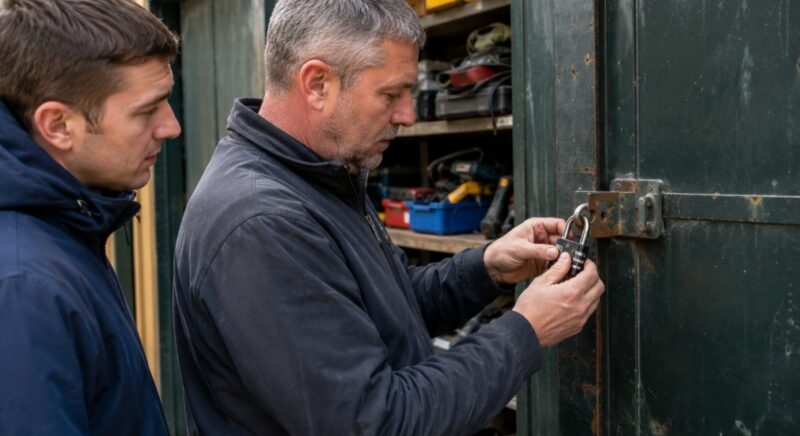
A well-chosen combination padlock fitted to a poor hasp is still a poor setup. The hasp and staple, the two-part fitting the padlock clips through, determines how much of the shackle is exposed and how resistant the whole arrangement is to attack.
A mild steel hasp with exposed fixing screws can be compromised faster than any decent lock. The hasp should hide its fixing screws when it’s in the closed position, and the hinge should be solid rather than something that levers apart under pressure.
Getting the lock right and skimping on the hasp is one of the most common mistakes in physical security generally, not just with combination padlocks.
Using an Open Shackle Where a Closed Shackle Would Be Better

On a standard open shackle padlock, a portion of the curved shackle bar is visible when the lock is closed. That’s what bolt croppers target. For many applications, that exposure isn’t a meaningful risk.
For a van or anywhere the lock is likely to be left unattended for extended periods, it’s worth considering a closed shackle design instead.
A closed shackle combination padlock recesses the shackle into the body of the lock, leaving very little accessible to attack. It’s a straightforward upgrade for higher-risk locations and one that’s often overlooked because most people default to whatever’s most familiar.
Neglecting Maintenance
Combination padlocks need less upkeep than keyed locks, but grit and moisture build up in the dials over time, particularly on anything kept outdoors. Left unchecked, this makes the wheels stiff and eventually unreliable.
The experts at LocksDirect recommend a dry silicone spray or graphite powder to keep the mechanism moving freely without attracting further debris. Oil-based products and WD-40 do the opposite, they pull in dust and end up making the problem worse rather than better.
A quick clean at the start of each season is all it takes to keep an outdoor combination padlock in good working order.
Not Resetting the Code When Access Changes
One of the advantages of a combination padlock over a keyed one is that you can change the code without rekeying or replacing the hardware. Most people don’t use that feature when they should.
If a staff member leaves, or you’ve shared the combination with someone temporarily, the code needs changing. Leaving it as is is the equivalent of not collecting a key back when someone leaves. The access you thought you’d removed is still there.
Opening the Lock While Someone is Watching

This one gets overlooked because it feels like common sense, but it’s a real security risk. The wheel positions on a combination padlock are visible to anyone standing nearby, which means someone can clock your code simply by watching you open it. For anywhere even semi-public, that’s a real consideration you should take into account.
Get into the habit of shielding the wheels when you open the lock, in the same way you’d cover a PIN pad. It takes no extra time and closes off a straightforward way for your code to be compromised.
Most of these aren’t complicated problems, just the kind of thing that’s easy to get right once you’re aware of them. Each one makes a meaningful difference to how well the lock actually performs.