Most business owners never think about who is allowed to lay a water pipe until a development stalls because the wrong question was asked too late. In the water industry, the answer to “who is allowed” comes down to four letters that rarely make it into a boardroom conversation: WIRS.
Understanding what the accreditation is, and why it matters commercially, is one of those small pieces of industry literacy that saves developers real money and real time.
What Is WIRS Accreditation and Why Does It Matter to Developers?
The Accreditation That Opens the Market
WIRS stands for the Water Industry Registration Scheme, and it is run by Lloyd’s Register, now trading as LRQA. In plain terms, it is the national assessment that allows a contractor to install new water mains and service connections that a water company will then adopt onto its network.
Ofwat’s guidance on self-lay sets out the logic clearly: rather than a contractor having to satisfy twenty-two separate water companies’ individual requirements, WIRS accreditation is recognised by every water company and by Water UK, so an accredited provider can be approved to work in any company’s area. It is, in effect, a single passport into a market that would otherwise be gated region by region.
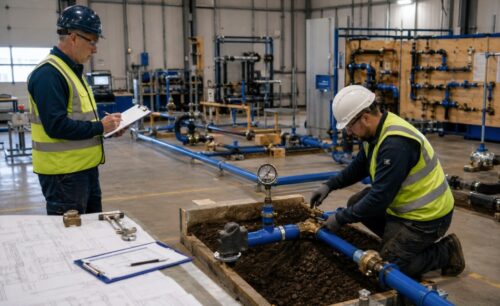
The assessment behind that passport is not a formality. LRQA assesses providers across design, construction, connections, commissioning and project management, and accreditation is granted for specific scopes of work rather than as a blanket approval. A provider might be accredited to install mains and services but not to design them, or accredited for some categories of connection and not others.
For a developer, that passport is the difference between two routes to a new water connection. One is to requisition the main from the water company and wait for it to be built on the water company’s programme.
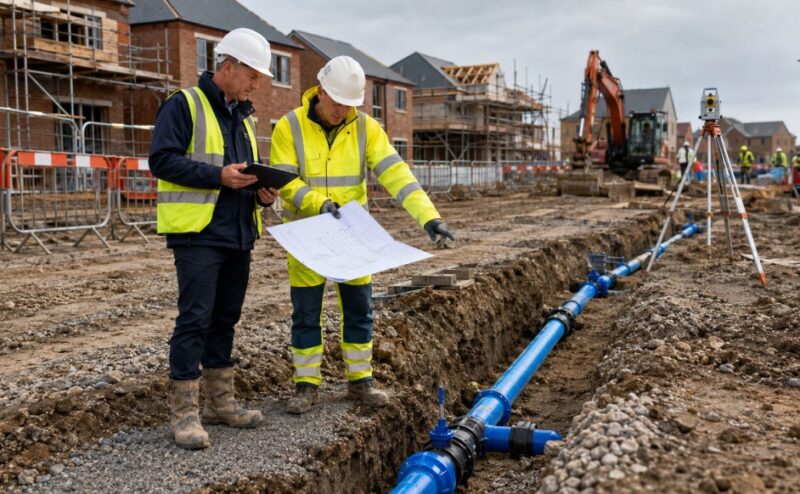
The other is to appoint a contractor to carry out the work independently, with the water company adopting the completed pipework at the end. Only a WIRS-accredited firm can take the second route, which is why the accreditation is not a badge on a website. It is market access.
Why This is a Business Issue, Not a Technical One?
The instinct is to file WIRS under “technical compliance” and move on. That is a mistake, because the accreditation maps directly onto two things every developer cares about: cost and programme. The water company’s own charges for a connection are fixed and published, so they do not change with the route.
What changes is the contestable construction, the actual building of the main, where using an accredited provider means paying the contestable rate rather than the water company’s delivery rate. And it changes the programme, because an independent provider installs to the developer’s build sequence rather than waiting for a slot in someone else’s schedule.
Even the incumbents present it in these terms. Thames Water tells developers that the best installer for their site “might not be us” and that independent providers may offer more flexible timescales.
There is a resilience angle too, and it favours specialists over generalists. The firms winning this work are not competing on being the cheapest gang on site. They are competing on the depth of their accreditation stack, because a water company will only adopt a network built to an adoptable standard, evidenced by the right approvals and paperwork.
A firm holding WIRS alongside ISO quality, environmental and safety certification, and the wider construction accreditations, is signalling that it can carry a scheme all the way to adoption without the developer inheriting the risk.
As an example of how that plays out in practice, McFadden Utilities, a family-run water contractor operating as an accredited self-lay provider, can carry a scheme from the initial point-of-connection enquiry through installation, chlorination, pressure testing and the final adoption handover under a single point of responsibility, rather than the developer stitching together design, build and adoption across three parties.
The Market this Creates

There is a market-structure point behind all this that business owners will recognise. Since 2021 the self-lay market in England has run under Ofwat’s Code for Adoption, a common set of rules that standardised what had been a patchwork of company-by-company processes, and there are now over two hundred WIRS-accredited contractors nationwide competing for this work.
Because water companies are legally required to provide connections at cost and make no profit from new mains, the competition is genuine rather than nominal, and the accreditation is what lets it exist at all. A parallel scheme, WIRSAE, extends the same logic into the business retail water market.
The pattern is the one competition regulators reach for again and again: set a common standard, make it verifiable, and let accredited operators compete on service and timescale rather than on who has cleared which company’s paperwork.
What Developers Should Actually Check?
The good news is that WIRS is verifiable. Lloyd’s Register maintains a public register of accredited self-lay organisations, and a developer can check any provider’s status and the scope of its accreditation before appointing them.
Scope matters, because accreditation is not all-or-nothing. The sensible question is not just “are you WIRS accredited” but “are you accredited for the work my scheme needs, and are you already approved with my water company”. Approval with the specific water company is a separate step that sits on top of the accreditation.
The wider takeaway travels well beyond water. In any regulated market, accreditation is rarely just a compliance cost. It is often the mechanism that decides who is allowed to compete at all, and the operators who treat it as a strategic asset rather than a box to tick tend to be the ones developers can rely on when a programme is on the line.
WIRS is simply a particularly clear example: four letters that quietly determine who can build the pipe under your new development, and how much control you keep over when it happens.