

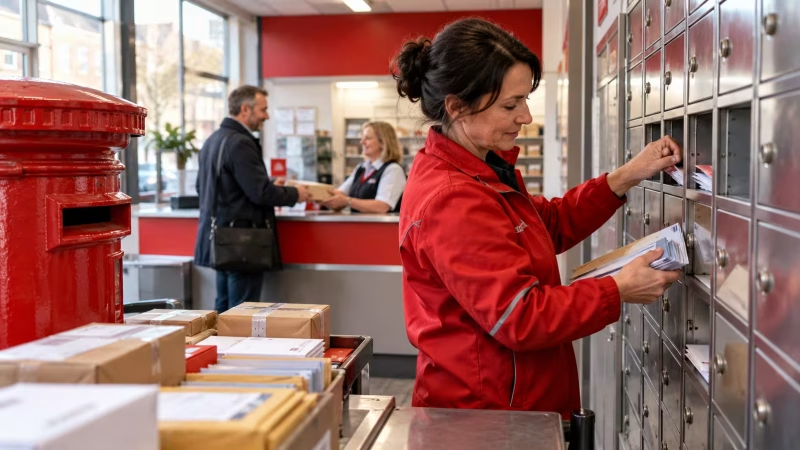
A PO Box allows individuals and businesses to receive letters and other eligible postal items without publicly sharing their residential or business premises address. It is particularly useful for freelancers, online sellers, small business owners and people who want more control over their correspondence.
However, many people misunderstand how a PO Box actually works. Some assume they must visit a Post Office every day, while others believe a PO Box automatically forwards letters to their home.
In the UK, Royal Mail offers two main arrangements: collecting correspondence from a designated location or having it delivered to the address provided during registration.
Understanding how these services operate, what they cost and where their limitations lie can help individuals and businesses choose the right postal arrangement.
What Is a PO Box?
A PO Box, short for Post Office Box, is a dedicated postal address that allows letters to be sent to a specific number rather than directly to someone’s residential or business address.
In the UK, Royal Mail operates the main PO Box service.
When someone rents a PO Box, they receive an assigned postal address containing a PO Box number, town or city and postcode.
Senders use this address when posting letters or other eligible correspondence.
Royal Mail identifies the destination through its postal network and processes the item according to the customer’s chosen collection or delivery service.
The important distinction is that a UK PO Box does not necessarily mean a physical locker that the customer opens with a key.
Instead, it is primarily an alternative postal address supported by Royal Mail’s mail-handling arrangements.
For example, someone operating an online consultancy from home might want customers to send correspondence to a professional postal address.
Rather than publishing their house number and street address, they can provide a PO Box number.
This allows them to separate public-facing correspondence from their private residential details.
However, Royal Mail still requires an underlying address when establishing the service.
How Does a PO Box Work Step by Step?
Understanding the complete journey of a letter is the easiest way to see how the service works.
Step 1: The Customer Registers for a PO Box
The process begins when an individual or business applies for a PO Box through Royal Mail.
Applicants provide the required personal or business information, an underlying address and payment details.
They also choose how they want incoming correspondence to be handled.
The two main options are:
- PO Box Collect
- PO Box Deliver
Once Royal Mail approves and activates the service, the customer receives the assigned PO Box address.
Step 2: The Sender Addresses a Letter to the PO Box
The sender writes the recipient’s PO Box address on the envelope instead of a conventional street address.
The letter is then posted through the normal postal network.
The sender must still pay the applicable postage.
Renting a PO Box does not make postage free for customers or other people sending letters to that address.
Step 3: Royal Mail Processes the Letter
After the letter enters the postal system, Royal Mail handles it through its sorting and delivery operations.
The PO Box number and associated postcode help identify the correct destination.
The item is routed according to the recipient’s active service arrangement.
For ordinary eligible mail, this means it will either be retained for collection or included in the delivery process for the address associated with the PO Box.
Step 4: The Mail Is Made Available for Collection or Delivery
This is where the two services differ.
With PO Box Collect, Royal Mail holds correspondence at the designated Customer Service Point.
With PO Box Deliver, Royal Mail delivers the PO Box mail to the address stated on the application.
The sender does not need to know which arrangement the recipient has selected.
Step 5: The Customer Receives and Manages the Mail
Once the correspondence reaches the customer, it can be opened, recorded, filed or passed to the appropriate person.
For individuals, this may simply mean reading their letters.
For businesses, it could involve processing invoices, customer enquiries, legal correspondence or financial documents.
From a business administration perspective, the important point is that receiving mail and acting on it are separate responsibilities.
A PO Box provides a route for receiving correspondence. It does not automatically manage deadlines, scan documents or respond to customers.
What Are the Different Types of PO Box Services?
Royal Mail offers two principal PO Box options.
Both provide an alternative postal address, but they involve different arrangements for receiving mail.
| Feature | PO Box Collect | PO Box Deliver |
| Dedicated PO Box address | Yes | Yes |
| Where mail is received | Customer Service Point | Registered delivery address |
| Travel required | Yes | Normally not |
| Annual price in 2026 | £416.40 | £499.80 |
| Best suited to | People wanting separate collection | People preferring home delivery |
| Main consideration | Collection location and opening hours | Higher annual cost |
How Does PO Box Collect Work?
PO Box Collect allows customers to receive letters at their dedicated PO Box address and collect them from the designated Royal Mail Customer Service Point.
The process is straightforward.
A sender posts correspondence to the PO Box address. Royal Mail processes the letter and makes it available at the associated collection point.
The customer visits during the location’s opening hours and follows the applicable collection procedure.
Royal Mail Customer Service Points are commonly situated within delivery offices, rather than ordinary Post Office branches.
Customers should confirm the correct location and any identification or authorisation requirements before travelling.
This service can be useful for people who want to keep business correspondence physically separate from their home.
However, it also creates a responsibility to collect mail regularly.
For example, a freelancer receiving important client agreements might prefer this option if the collection point is close to their workplace.
Someone who travels frequently or receives time-sensitive correspondence may find regular collections less convenient.
How Does PO Box Deliver Work?
PO Box Deliver allows customers to publish a dedicated PO Box address while receiving eligible mail at the underlying address associated with their application.
The sender uses the PO Box number, but Royal Mail delivers the correspondence to the nominated application address.
This means the customer generally does not need to visit a collection point.
For home-based businesses, the arrangement can provide a useful balance between privacy and convenience.
A consultant may want to publish a PO Box on business correspondence without spending time collecting letters.
Under the delivery arrangement, eligible incoming mail continues to reach the address associated with the service.
However, the address still needs to remain accurate and the subscription must remain active.
Our assessment: PO Box Deliver is generally more convenient for businesses receiving frequent or urgent correspondence. PO Box Collect may be more economical where collection journeys can be incorporated into an existing routine.
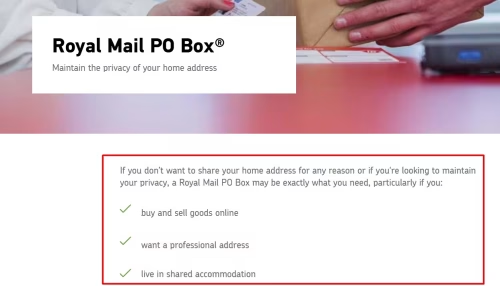
Royal Mail’s official PO Box Collect and PO Box Deliver options, showing how customers can receive their correspondence.
How Much Does a PO Box Cost in the UK in 2026?
Royal Mail charges a subscription fee for its PO Box services.
The cost depends on whether the customer chooses collection or delivery and the duration of the subscription.
The following prices are published for 2026 and include VAT.
| Subscription period | PO Box Collect | PO Box Deliver |
| Monthly | £50.40 | £50.40 |
| Six months | £243.00 | £276.60 |
| Twelve months | £416.40 | £499.80 |
| Effective monthly cost on annual plan | £34.70 | £41.65 |
Monthly payments are available through Direct Debit, subject to a minimum three-month commitment.
Royal Mail’s business-facing prices may be displayed excluding VAT, so businesses should ensure they compare charges on the same basis.
The latest charges can be checked directly through the official Royal Mail PO Box service and pricing page.
Is Paying Annually Cheaper?
Yes. At the published rates, an annual subscription is cheaper than making twelve monthly payments.
For PO Box Collect:
- Twelve monthly payments: £604.80
- Annual subscription: £416.40
- Annual saving: £188.40
- Percentage saving: approximately 31.2%
For PO Box Deliver:
- Twelve monthly payments: £604.80
- Annual subscription: £499.80
- Annual saving: £105.00
- Percentage saving: approximately 17.4%
These calculations use the currently advertised prices.
Businesses planning to use a PO Box for a full year may therefore benefit from an annual subscription.
However, choosing the lowest subscription price does not necessarily mean achieving the lowest operational cost.
Should Businesses Choose Collection or Delivery Based on Cost?
Consider a business owner comparing the two annual plans.
The difference between PO Box Collect and PO Box Deliver is £83.40 per year.
If the business owner makes twelve dedicated collection journeys annually, this saving represents £6.95 per trip.
If each journey involves additional fuel, parking or public transport costs greater than £6.95, collection could become more expensive overall.
The calculation also excludes the value of the owner’s working time.
Conversely, someone who passes the Customer Service Point during their normal commute may incur almost no additional collection costs.
For businesses, the most useful comparison is therefore:
Total PO Box cost = Subscription fee + Additional travel costs + Administrative time.
This approach produces a more meaningful financial assessment than comparing subscription prices alone.
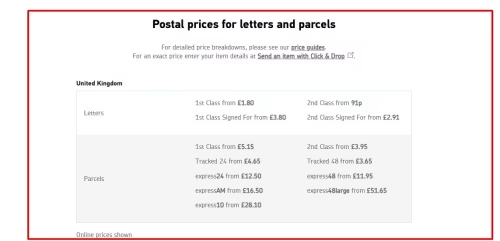
Official Royal Mail PO Box prices for monthly, six-month and annual collection and delivery services.
For a more detailed breakdown of costs, VAT and subscription savings, see the 2026 Post Office box prices comparison.
How Does Someone Set Up a PO Box in the UK?
Opening a Royal Mail PO Box generally involves completing an application, selecting a service and confirming the relevant information.
The usual process includes:
- Visit Royal Mail’s official PO Box application page.
- Choose between collecting correspondence and having it delivered.
- Provide the required personal or business information.
- Enter the underlying UK address requested by Royal Mail.
- Select the appropriate subscription period.
- Complete the necessary verification and payment requirements.
- Wait for confirmation that the service has been activated.
- Begin using the assigned PO Box address.
Royal Mail states that online applications can take up to seven working days to set up.
Postal applications generally take longer, with Royal Mail stating at least ten working days.
For online applications, the payment card must be registered to the address entered on the application.
Postal applications require the relevant documentation, including proof of identity, as specified by Royal Mail.
These requirements matter because a PO Box provides address privacy for correspondence but does not eliminate the need for the postal operator to know who is using the service.
Businesses should avoid publishing their new PO Box address until activation has been confirmed.
This reduces the possibility of customers sending important letters to an address that is not yet operational.
Anyone needing further application details can follow the step-by-step process for setting up a PO Box.
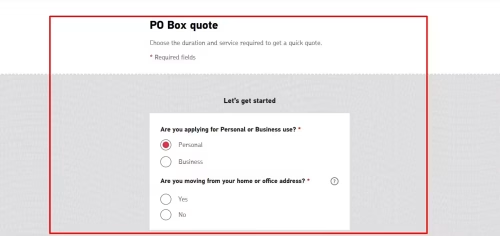
Royal Mail’s official PO Box application instructions and the information customers should prepare before registering.
How Do You Write a PO Box Address Correctly?
Once the service has been activated, Royal Mail provides the details needed to receive correspondence.
A typical format looks like this:
Example PO Box address:
ABC Consulting Services
PO Box 1234
Manchester
M1 1AA
This is an illustrative example only, not an assigned or verified PO Box address.
The recipient or approved business name should appear above the PO Box number.
The town or city and postcode must match the details supplied by Royal Mail.
Customers should not invent their own PO Box numbers or assume that a nearby postcode can be used.
Why Does the Correct Address Format Matter?
Postal sorting depends on accurate address information.
An incorrect PO Box number, recipient name or postcode may create delivery difficulties.
For a business, this can have wider consequences.
A delayed customer complaint or supplier notification could affect the company’s ability to respond within an expected timeframe.
It is therefore sensible to copy the confirmed address exactly when updating business documents.
A test letter can also help establish that the new arrangement is functioning as expected.
What Can You Receive at a PO Box?
A PO Box is primarily designed for receiving eligible correspondence through Royal Mail’s postal network.
Typical uses include receiving:
- Personal letters and general correspondence.
- Customer enquiries and business communications.
- Invoices and other financial paperwork.
- Supplier correspondence.
- Membership and subscription letters.
- Printed notices and administrative documents.
The suitability of a particular item depends on the relevant postal service and Royal Mail’s applicable conditions.
Customers should not assume that all parcel sizes, tracked services or delivery methods work identically.
Can a PO Box Receive Parcels?
Some parcels may be accepted through suitable postal arrangements, but a Royal Mail PO Box should not be treated as a universal parcel-delivery address.
Acceptance can depend on the delivery service, carrier, parcel characteristics and collection or delivery requirements.
This distinction is particularly important for online businesses.
For example, a customer returning a small item through Royal Mail may have different delivery options from a customer using a private courier.
Businesses should check whether their PO Box arrangement supports the type of parcel they expect to receive.
Can Amazon, DPD, Evri or Other Couriers Deliver to a PO Box?
Courier acceptance varies.
Some delivery companies and retailers require a conventional physical address.
Others may have specific restrictions for PO Boxes or offer separate collection-point services.
For these reasons, customers should not assume that an order can be delivered to a PO Box simply because the checkout page accepts a postcode.
Where parcels are essential, it is safer to confirm the carrier’s policy before placing an order.
A dedicated parcel collection point, appropriate commercial address or another parcel-receiving service may be more suitable.
Can You Receive Signed-For or Important Documents?
Customers may need to receive valuable documents, tracked correspondence or items requiring proof of receipt.
However, specific acceptance and handover arrangements depend on the postal product and PO Box service conditions.
Anyone expecting sensitive or time-critical documents should check with Royal Mail and the sender before using the address.
A PO Box should not be assumed to provide a guarantee of immediate receipt, unrestricted access or universal signature handling.
Does a PO Box Make Your Address Completely Private?
A major reason people obtain a PO Box is to avoid sharing their residential address with a large number of individuals or organisations.
For example, a person selling products online may prefer customers to contact them through a PO Box instead of displaying their home address on packaging or correspondence.
However, a PO Box improves address privacy rather than providing complete anonymity.
Royal Mail requires an underlying address and other application information.
Banks, insurers, regulators and other organisations may also require a physical residential or business address when verifying identity.
A PO Box cannot automatically replace those requirements.
Can People Find Your Real Address Through a PO Box?
The PO Box itself does not ordinarily display the street address associated with the customer.
However, it would be misleading to suggest that a PO Box guarantees a person’s physical address can never be discovered or disclosed.
Disclosure and verification depend on legal requirements, provider policies and the particular circumstances.
For business owners, public company records may also contain addresses that must legally be disclosed.
The practical advantage of a PO Box is therefore reducing how widely a personal address needs to be shared during ordinary correspondence.
How Does a PO Box Work for Small Businesses?
Small businesses often use PO Boxes to create a distinction between customer-facing correspondence and the location where they actually operate.
This can be valuable for sole traders, consultants, freelancers and home-based entrepreneurs.
For example, a freelance designer working from a residential property may want clients to send physical correspondence to a consistent business mailing address.
A PO Box allows that designer to use a dedicated address without routinely distributing their home details.
There are several business advantages.
Better separation between personal and business post:
A dedicated correspondence address helps keep customer and supplier letters separate from household mail.
Greater consistency:
A PO Box can provide a stable customer-facing mailing address while the underlying physical location remains unchanged or is updated subject to the provider’s rules.
A professional point of contact:
Customers may prefer dealing with businesses that provide a clear postal contact method.
Improved correspondence management:
Business owners can create routines for collecting, recording and handling incoming documents.
However, the operational benefit depends on the business using the service effectively.
A professional postal address has limited value if important letters are collected infrequently or not processed promptly.
For an organisation receiving financial or contractual correspondence, responsibility for checking mail should be clearly assigned.
Can You Use a PO Box as a Business Address?
Yes, businesses can generally use a PO Box for suitable correspondence.
However, it is important to distinguish between a mailing address, a trading address and a registered office address.
These terms have different meanings.
| Address type | Main purpose | Is a PO Box suitable? |
| General mailing address | Receiving ordinary correspondence | Generally yes |
| Customer correspondence address | Receiving customer enquiries | Generally yes |
| Registered office address | Official company registration | No |
| Physical trading address | Identifying operating premises | Not as a substitute for actual premises |
| Product returns address | Receiving returned goods | Depends on carrier and arrangements |
| Bank verification address | Meeting financial institution requirements | Depends on the institution |
Can You Use a PO Box as a Limited Company’s Registered Office?
No. A Royal Mail PO Box cannot be used as a limited company’s registered office address.
Companies House requires an appropriate physical address in the UK, within the relevant jurisdiction where the company is registered.
The address must be suitable for correspondence to reach the company and for delivery to be acknowledged.
These requirements have applied since March 2024.
The official rules can be checked through GOV.UK’s registered office address requirements.
For directors wanting to protect their residential addresses, a suitable accountant’s address, solicitor’s address or registered office service may be an alternative.
However, the third-party address must meet the relevant legal requirements and the company must have permission to use it.
A PO Box may remain useful for other company correspondence, even when the registered office is elsewhere.
Businesses should also remember that providing a PO Box on their website does not remove statutory requirements to display relevant company information, including their registered office details where required.
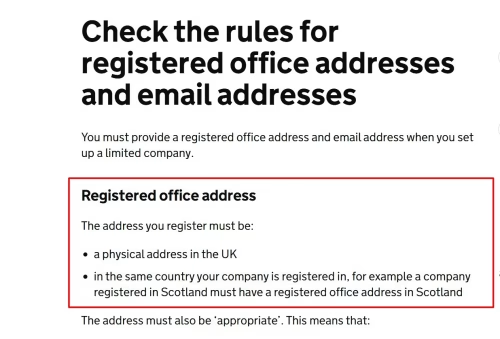
Companies House guidance confirming that a Royal Mail PO Box cannot be used as a limited company’s registered office address.
What Is the Difference Between a PO Box and a Virtual Office?
A PO Box and a virtual office can both provide alternatives to publishing a home address, but they are not identical services.
A PO Box is primarily a postal address service.
A virtual office usually provides a business address associated with a physical location and may offer additional administrative facilities.
| Feature | PO Box | Virtual office |
| Alternative mailing address | Yes | Usually |
| Physical street address | No | Usually |
| Mail collection | Available | Depends on provider |
| Mail delivery or forwarding | Depends on plan | Often available |
| Mail scanning | Not a standard feature | May be available |
| Meeting facilities | No | Sometimes |
| Registered office suitability | No | Possible if legally compliant |
| Telephone answering | No | Sometimes |
| Price structure | Published Royal Mail subscription | Provider-specific |
For individuals receiving occasional letters, a PO Box may be sufficient.
For companies requiring a registered office, document scanning, administrative assistance or a conventional business address, a suitable virtual office service could be more appropriate.
Businesses should review the exact services provided rather than assuming that every virtual office includes registered office facilities or unlimited mail handling.
What Are the Main Advantages and Disadvantages of a PO Box?
A PO Box can provide practical benefits, but it also creates recurring costs and operational limitations.
| Advantages | Disadvantages |
| Helps protect residential address privacy | Requires a paid subscription |
| Provides a dedicated correspondence address | Does not replace a registered office |
| Useful for home-based businesses | Not every courier accepts PO Boxes |
| Offers collection or delivery arrangements | Collection requires time and travel |
| Can separate private and business post | Does not provide office facilities |
| Provides a consistent point of postal contact | Mail access depends on the selected service |
The most useful way to assess these advantages is to consider the volume and importance of the correspondence being received.
Someone receiving a handful of non-urgent letters each month may have very different requirements from a company processing customer complaints or financial documents daily.
For example, a business expecting frequent correspondence should consider whether delayed collection could interfere with customer service.
A company that receives very little physical mail should consider whether the annual subscription represents good value.
The presence of a dedicated postal address can help establish an organised business operation, but it should not be treated as a substitute for effective customer support or financial administration.
How Do Large Companies Use PO Boxes?
Large organisations often use PO Box addresses to centralise correspondence.
Financial institutions, insurers, pension administrators and customer service operations may receive substantial volumes of letters.
Instead of directing every customer to a particular physical office, a business can use an address designed for postal correspondence and processing.
Some organisations also use specialist providers to print, dispatch and manage returned mail.
This means the address printed on a letter may serve a different purpose from the sender’s registered office.
For example, a financial services company might have separate addresses for customer enquiries, document processing, complaints and statutory company records.
Readers investigating specific addresses can see how such distinctions arise in the explanation of PO Box 200 Tadworth KT20 6YU and its association with financial-services correspondence
Does Receiving a Letter From a PO Box Mean It Is Genuine?
Not necessarily.
A PO Box is a postal address. Its existence does not establish the authenticity of every letter that uses it.
Fraudulent communications can contain real postal addresses, company names or other apparently legitimate information.
Anyone receiving unexpected correspondence involving payments or sensitive financial information should independently verify the organisation responsible.
Using a telephone number or website obtained directly from the organisation’s verified official channels is safer than relying solely on details printed in an unexpected letter.
This is particularly important when correspondence refers to debts, bank accounts, pension transfers or requests for identity documents.
What Happens If You Stop Collecting Mail From Your PO Box?
Customers choosing PO Box Collect need a reliable routine for retrieving correspondence.
Leaving letters uncollected can create practical difficulties.
Important documents may remain unread, and the amount of accumulated correspondence may increase.
Royal Mail’s applicable terms determine how held mail is managed and what happens if the service is no longer active.
Customers should not assume that correspondence can remain uncollected indefinitely.
For businesses, regular mail checks are especially important when letters may contain:
- Payment notices.
- Customer complaints.
- Supplier communications.
- Legal documents.
- Contractual correspondence.
- Financial account notifications.
The key risk is not only losing access to a letter but also failing to respond to information within it.
A business receiving an important document remains responsible for handling the matter appropriately.
What Happens If You Move House or Change Business Address?
Moving house or relocating business premises can affect a PO Box arrangement.
Customers should notify Royal Mail of relevant changes and confirm whether their existing service can continue under the updated circumstances.
With PO Box Deliver, the underlying delivery address is particularly important.
Mail should not be assumed to follow the customer automatically when they move.
For businesses, the change should be managed carefully.
Customer-facing information, suppliers, banks and other relevant contacts may need updating.
It is also advisable to confirm whether any separate mail redirection service is necessary and available.
A change of premises should not automatically be treated as a change to the PO Box address itself.
Royal Mail must confirm which changes can be supported under the existing service.
What Happens When a PO Box Subscription Expires?
A PO Box is a paid subscription service.
If the customer does not maintain an active arrangement, they should not assume that correspondence will continue to be handled in the same way.
Renewal and closure arrangements depend on the service conditions.
Before allowing a subscription to end, customers should review which individuals and organisations still use the PO Box address.
Businesses should pay particular attention to customers, suppliers, professional advisers and financial institutions.
Providing a replacement contact address before the service ends can reduce the risk of disrupted communication.
For anyone using a PO Box on printed packaging or permanent business stationery, subscription continuity should be considered before committing to a long-term address.
Who Should Consider Using a PO Box?
A PO Box can be suitable for different personal and commercial situations.
| User | Potential benefit | Important consideration |
| Freelancer | Keeps home address off routine client correspondence | Annual subscription cost |
| Online seller | Dedicated customer postal contact | Parcel and returns restrictions |
| Small business owner | Separates business and personal mail | Legal address obligations |
| Consultant | Consistent professional correspondence address | Speed of accessing important letters |
| Charity or community group | Centralised postal enquiries | Authorised access and continuity |
| Individual in shared accommodation | Greater control over correspondence | Collection or delivery requirements |
| Growing business | Organised mail reception | Whether broader office services are needed |
The right choice depends on the purpose of the address.
A business receiving mostly emails and very little physical correspondence may not need a paid PO Box.
By contrast, someone who regularly publishes a mailing address or receives confidential postal enquiries may find the privacy and organisational benefits worthwhile.
Frequently Asked Questions
How Does a PO Box Work for Personal Mail?
A PO Box provides an alternative address for receiving eligible letters. Royal Mail either holds the correspondence for collection or delivers it to the address associated with the customer’s service.
Do You Have to Collect Your Mail From a PO Box?
Not always. PO Box Collect requires collection from a designated Customer Service Point, while PO Box Deliver sends eligible mail to the address on the application.
Can You Have a PO Box Without a Physical Address?
Royal Mail requires an underlying address when establishing a PO Box. It is an alternative correspondence service, not a replacement for address verification.
How Long Does Mail Take to Reach a PO Box?
Delivery depends on the postal service used and Royal Mail’s processing arrangements. Having a PO Box does not automatically guarantee faster delivery.
Can You Use a PO Box for Online Shopping?
Sometimes, but acceptance depends on the retailer, delivery company and type of item. A conventional physical address may still be required for certain purchases.
Can Two People Use the Same PO Box?
This depends on Royal Mail’s account, naming and authorisation requirements. Customers should confirm whether additional recipients or authorised collectors can be included.
Can You Send Letters From a PO Box?
A PO Box is primarily a receiving address. Customers can post outgoing letters through normal postal services, but renting a PO Box does not itself provide free postage or an automatic outgoing-mail service.
Can You Use a PO Box for Your Business?
Yes, for suitable business correspondence. However, a Royal Mail PO Box cannot replace a limited company’s registered office or a physical address required for certain legal and verification purposes.