If someone asked you today what the financial capital of the United Kingdom is, you would certainly answer London. But being the financial capital does not mean having a monopoly on opportunities to make money.
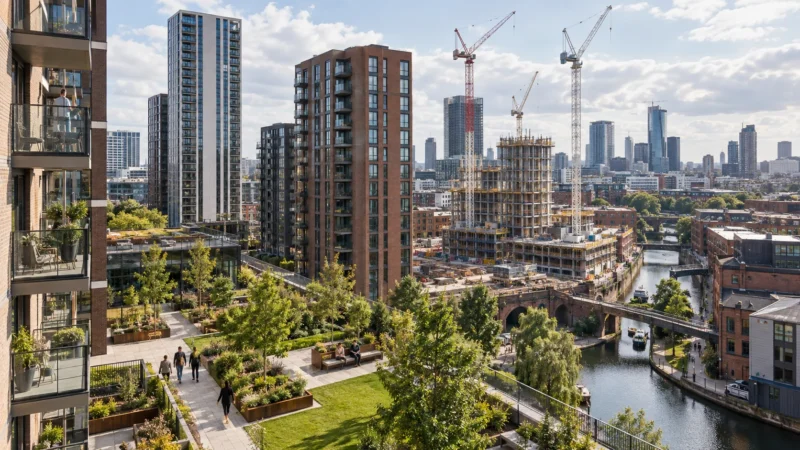
Birmingham is a case in point. The city can now make a credible claim to being Britain’s build to rent capital.
Since 2020, approximately £1.8 billion has been invested in Birmingham’s build to rent market by 12 institutional investors across 15 schemes. Together, those developments are associated with around 6,950 new homes in the city centre.
That scale of investment reflects growing confidence in Birmingham’s rental economy.
However, it is also changing the competitive environment for private landlords, who increasingly find themselves competing with professionally managed developments offering communal facilities, on-site services, and modern apartments.
The Numbers
The average Birmingham property cost £234,000 in July 2026, following annual growth of 2.5%. Flats and maisonettes averaged £145,000, while terraced properties came in at £222,000.
Average private rent reached £1,099 per month in August 2026, an increase of 3% over the previous year. The figure was £919 for a flat and £1,095 for a terraced property.
Combining those city-wide averages produces an indicative gross yield of approximately 7.6% for flats and 5.9% for terraced properties. These numbers, however, are just estimates, since the homes included in the rental and sales datasets are not necessarily comparable.
Moreover, actual yields will depend on the purchase price, achievable rent, occupancy, financing, and operating costs.
Investors examining current buy-to-let property in Birmingham should assess opportunities at asset and neighbourhood level rather than relying on a city-wide average.
Demand is Strong, but So is Competition
As in other cities throughout the United Kingdom, rent demand in Birmingham is well diversified. The market encompasses students, young professionals, families, and households unable or unwilling to purchase a home.
Private renting accounted for 22.6% of Birmingham households at the latest census, rising from 17.9% a decade earlier.
The city’s universities provide a substantial source of demand.
A Birmingham City Council assessment identified 84,093 full-time and sandwich-course students, with estimated accommodation demand of 43,575 bed spaces.
At first glance, high demand makes investing in rental property seem like an easy way for small investors to make money. However, build-to-rent operators are competing for many of the same tenants.
Their developments commonly offer professional management, communal areas, and additional amenities.
Furthermore, a conventional apartment must compete through its location, price, space, or overall quality rather than relying on strong city-wide demand alone.
This competition may be less direct for well-positioned family houses and properties serving neighbourhood markets outside the main concentration of city-centre developments.
Acquisition Costs Can Change the Calculation

One concern for investors trying to ride the market’s current upswing is the cost of acquiring property. Even though Birmingham is a relatively inexpensive city, the additional expenses involved in buying an asset remain high—as they do in the rest of the country.
A landlord purchasing an extra property for Birmingham’s average price of £234,000 would currently pay approximately £13,880 in Stamp Duty Land Tax before legal, mortgage, or refurbishment costs.
This calculation applies the higher rate of 5% to the first £125,000 and 7% to the remaining amount. Non-UK residents may also face an additional 2% surcharge.
Flats can appear particularly attractive on a gross-yield basis, but service charges, lease terms, and future building works can materially reduce their net returns. Investors must also allow for management, maintenance, insurance, and periods without a tenant.
Local regulation adds another consideration. Birmingham’s selective licensing scheme covers 25 of the city’s 69 wards. A licence costs £700 for each qualifying property and lasts for a maximum of five years.
Growth Without Guarantees
Birmingham’s long-term prospects are supported by its universities, employment base, transport connections, and extensive regeneration programme.
Developments around Smithfield, Digbeth, and Curzon Street are intended to create new homes, employment space, and better connections across the city centre.
This level of investment from pension funds, insurance companies, asset managers, real estate trusts, and private equity firms demonstrates that the local market is attracting large, highly professionalised players.
For individual investors, however, the opportunity lies in finding properties that remain competitive after tax, finance, management, and maintenance costs are included.
Birmingham may have become Britain’s build to rent capital, but successful investment will still be decided one property at a time.