

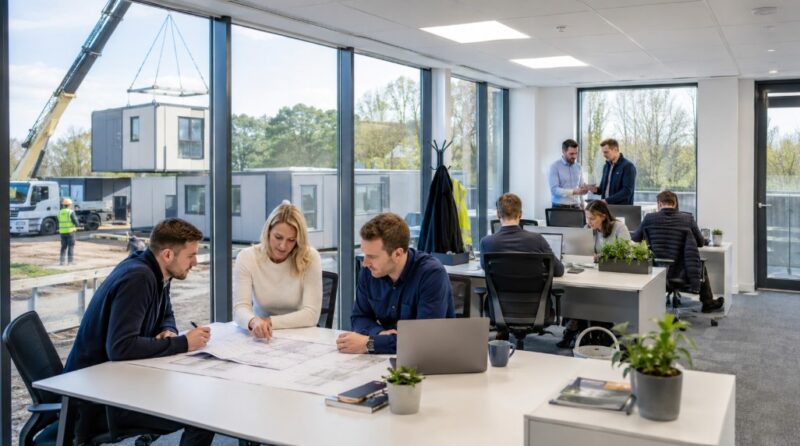
Deciding how to expand physical workspace is a pivotal moment for any growing organisation. While traditional brick-and-mortar builds have been the standard, modern off-site manufacturing has changed the commercial property landscape. Businesses no longer have to accept long delays and unpredictable budgets.
Choosing between traditional construction and a modular office depends on specific operational priorities. Here are the key scenarios where a modular approach offers a clear strategic advantage.
Tight Timelines and the Need for Continuity
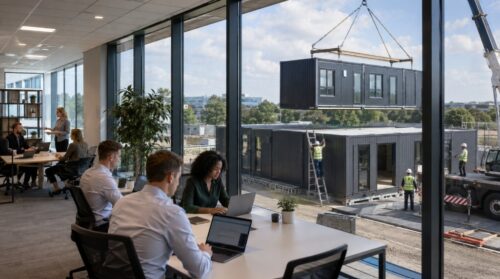
Traditional building projects are frequently delayed by bad weather, subcontractor availability, and supply chain issues. For an active business, a prolonged construction site means noise, dust, and operational downtime.
A modular office solves this problem through parallel scheduling. While groundworks are prepared on-site, the steel frames are manufactured inside a controlled factory.
This process can cut overall project schedules by up to 50%. The principal on-site installation phase can often be completed within days, although groundworks, utility connections, commissioning and approvals may extend the overall programme.
A Demand for Long-Term Cost Predictability
Budget overruns are a common risk in traditional construction. Unexpected ground conditions or material price spikes can quickly inflate costs.
Off-site manufacturing can improve cost certainty once the design, specification and project scope have been agreed. Because raw materials are sourced in advance and labour is managed in a factory environment, financial estimates are highly accurate.
Modern modular offices are engineered as permanent assets with a focus on low Total Cost of Ownership (TCO). High-quality modular offices are intended for long-term use, although their service life depends on their structural specification, maintenance, environment and frequency of relocation.
Future Flexibility and Relocation Needs
Traditional buildings are static. If your business needs change, or if you decide to lease a different plot of land, a traditional structure cannot move with you.
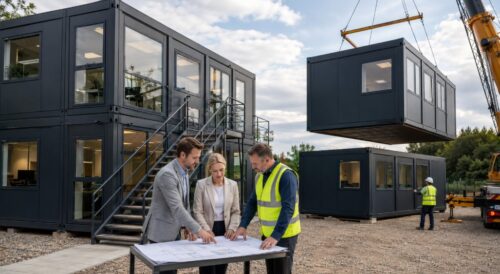
Modular offices offer asset flexibility. They can be expanded by adding new modules, reconfigured internally, or even dismantled and relocated to a completely new site.
This adaptability makes them an adaptable long-term investment for businesses operating on leased land or those anticipating rapid headcount changes.
Requiring Large, Open-Plan Workspaces
Older modular designs relied on closely spaced internal columns, which limited layout options. Bespoke structural frames can provide wide, open-plan layouts with fewer internal columns, subject to engineering design and project requirements.
This matches the open-plan flexibility of traditional architecture, allowing you to design collaborative layouts and meeting rooms without structural limitations.
Choosing the Right Engineering Partner
When a business requires speed, minimal site disruption, and permanent asset quality, a modular office can be a strong option. To secure these benefits, it is crucial to work with a partner who manages the entire process rather than just assembling pre-made parts.
At JCPSA, we are designers, engineers, and manufacturers. We deliver permanent modular offices built to last generations. Visit our website and discover how we can help.