

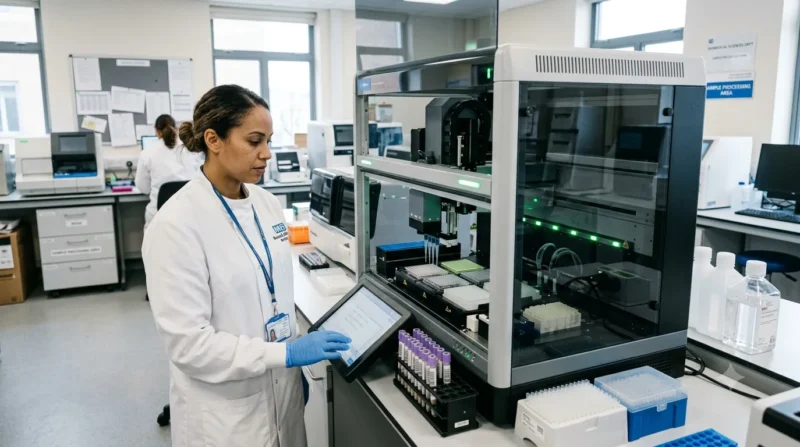
A pipette tip held at a slightly different angle. A reagent added two seconds later than it was in the previous run. A plate prepared by a scientist on the eighth hour of a shift rather than the first. None of those feel like mistakes.
In a healthcare laboratory, though, small differences stack up, and by the time a result reaches a clinician or a research lead, that accumulated drift can be the gap between a clean signal and a question mark.
Consistency is the quiet backbone of laboratory work. Medical laboratories in the UK deliver an average of 300,000 tests every working day, according to the United Kingdom Accreditation Service, and every one of those tests carries an implicit promise: run it again tomorrow, and the answer should hold.
Keeping that promise has less to do with heroic effort than with removing the small openings for variation that hide inside routine work.
That is where automation earns its keep. Not as a headcount argument, and not as a technology showcase, but as a way of making repetitive steps behave the same way every single time.
What follows looks at where manual variation actually enters a workflow, what automated equipment standardizes in practice, and why reproducible processes are far easier to monitor, defend, and improve.
Why Small Variations Carry Outsized Weight
Laboratory results are rarely the product of one step. A single assay might involve sample accessioning, aliquoting, dilution, incubation, plate transfer, reading, and analysis, and each stage adds its own small margin of imprecision.
Those margins do not cancel each other out. They compound, and the further downstream you look, the wider the spread becomes.The trouble is that variation of this kind is almost invisible while it is happening. Everyone follows the protocol.
Nobody skips a step. Yet two technicians working from the same standard operating procedure can produce measurably different coefficient of variation figures, simply because human hands and human timing are not machines. When a borderline result sits near a clinical decision threshold, that difference stops being academic.
Research labs feel the same pressure from a different direction. An experiment that cannot be reproduced by a colleague down the corridor is a weak experiment, regardless of how interesting the finding looked the first time.
Where Manual Variation Enters the Workflow
Liquid handling is the usual culprit, and for good reason: it is the most repeated physical action in most labs. Volume accuracy at low microliter ranges depends on tip seating, aspiration speed, angle, and dwell time, all of which shift subtly from operator to operator and hour to hour.
Sample preparation is the second pressure point. Serial dilutions, reagent additions, and plate mapping all involve counting, ordering, and transcription, and all of them are vulnerable to interruption. A phone call at the wrong moment can cost a whole plate.
Timing is the third, and it is the one labs underestimate most often. Incubation windows, reaction stops, and read intervals are usually specified as ranges because humans cannot hit exact marks reliably. Widen enough of those ranges across a protocol and the process quietly loses its edge.
What Automated Equipment Actually Standardizes
Automation attacks these problems by making the physical action deterministic. A programmed liquid handling system will aspirate and dispense the same volume, at the same speed, at the same tip depth, on the first plate of the morning and the four hundredth of the week.
Fatigue does not enter into it. Neither does the difference between an experienced technician and a new starter.
The same logic extends across sample preparation, plate handling, labeling, and storage retrieval. Once a method is defined in software, it is executed identically every run, and any change to it is deliberate rather than accidental.
That distinction matters enormously for quality management, because a controlled change can be documented, validated, and rolled back. A drift cannot.
Automation also standardizes the record. Manual workflows depend on someone writing down what happened; automated ones produce a timestamped log of what the instrument did, run by run, without anyone remembering to capture it.
Reproducibility Becomes a Property of the Process
The World Health Organization’s laboratory quality management system handbook frames quality as something built into the whole path of a sample rather than inspected at the end of it.
Automation fits that framing neatly. When the repetitive steps are locked down, quality stops depending on who happened to be at the bench.
This changes what a lab can promise. Method transfer between sites becomes realistic, because the method travels as a program rather than as tacit skill.
And when something does go wrong, the investigation has a much smaller search space, because the mechanical steps can largely be ruled out.
Consistency Makes Monitoring Possible
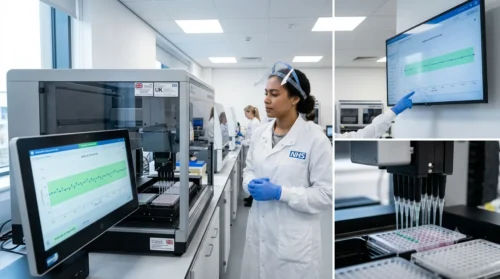
Process monitoring only works if the process is stable enough to have a baseline. Control charts, trend analysis, and risk-based quality plans all assume the underlying operation is repeatable; feed them noisy manual data and they flag everything or nothing.
Regulators have moved in the same direction.
The CDC’s guidance on individualized quality control plans encourages labs to tailor QC to their specific testing environment and risks rather than applying a blanket frequency, and that kind of tailoring only holds up when the lab can demonstrate its process behaves predictably. Automation supplies that evidence as a by-product of running.
Starting Small Beats Starting Everywhere
Few labs can automate an entire workflow at once, and few should try. The sensible approach is to find the step that is repeated most often, measured most tightly, and complained about most loudly, then automate that alone and measure the change.
Other sectors have learned the same lesson; the integration playbook that online retailers use when connecting fulfillment systems to their platforms rewards the same incremental, data-checked approach.
It also helps to bring the quality team in at the design stage rather than the validation stage. They know which steps generate the most deviations, and they will have to sign off on the new method anyway.
The Long Game of Consistent Workflows
Consistency does not announce itself. Nobody celebrates the assay that behaved exactly as it did last quarter, and no dashboard lights up when a coefficient of variation stays flat.
That is exactly why it is easy to underinvest in, and why the labs that get it right tend to look unremarkable from the outside while quietly outperforming on turnaround, repeat rates, and audit outcomes.
The case for automation in healthcare and research laboratories is not really about speed, though speed usually follows.
It is about narrowing the range of possible outcomes for every routine action, so that the interesting variation in a dataset comes from biology rather than from technique. That is a modest-sounding goal with a large payoff.
For any lab weighing the investment, the useful question is not how much of the workflow could be automated.
It is which repeated step is currently costing the most confidence. Answer that honestly, automate it properly, and the consistency gains tend to make the next decision much easier.