


The argument that the new State Pension is unfair to existing pensioners largely comes from the difference between the headline rates paid under the old and new systems.
For the 2026/27 tax year, the full new State Pension is £241.30 a week, while the full basic State Pension under the old system is £184.90 a week. That creates a headline difference of £56.40 a week, or £2,932.80 over 52 weeks.
However, those figures do not mean every pensioner who retired before April 2016 receives £56.40 less each week.
The old State Pension can include an Additional State Pension on top of the basic amount, while not everyone covered by the new State Pension receives the full £241.30 rate. This makes the debate more complicated than simply comparing the two headline figures.
The central fairness question therefore concerns not only how much is paid, but why pensioners remain under different systems depending largely on when they reached State Pension age.
Why Are There Two Different State Pension Systems?
The UK has two State Pension systems because a major reform came into effect on 6 April 2016.
People who reached State Pension age before that date remained under the old State Pension rules. Those reaching State Pension age on or after 6 April 2016 generally fall under the new State Pension system.
The House of Commons Library describes the old system as having two main tiers: the basic State Pension and an earnings-related Additional State Pension.
The new State Pension was intended to replace that structure with a simpler system for future pensioners.
What Changed On 6 April 2016?
The new State Pension became available to people reaching State Pension age from 6 April 2016.
It applies broadly to men born on or after 6 April 1951 and women born on or after 6 April 1953, although individual entitlement still depends on a person’s National Insurance record and transitional rules.
People who had already reached State Pension age did not automatically move onto the new system.
That cut-off is one reason the issue remains controversial. Two people with similar working histories can potentially be covered by different State Pension structures because they reached pension age on opposite sides of the April 2016 change.
Who Gets The Old State Pension And Who Gets The New State Pension?
The old State Pension normally applies to:
- Men Born Before 6 April 1951
- Women Born Before 6 April 1953
- People Who Reached State Pension Age Before 6 April 2016
The new State Pension normally applies to people who reached State Pension age from 6 April 2016 onwards.
The distinction is important because existing pensioners cannot simply choose whichever system currently has the higher headline rate.
Old State Pension Vs New State Pension: How Much Is The Difference In 2026/27?
The difference between the published full rates is substantial.
According to the government’s 2026/27 pension rates, the full basic State Pension increased to £184.90 per week, while the full new State Pension increased to £241.30 per week.
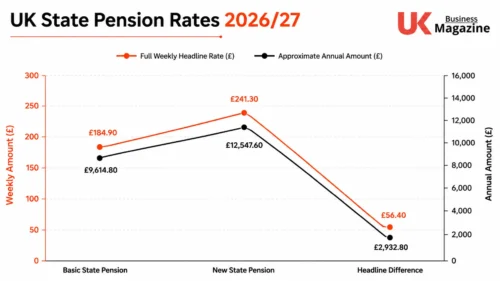
| Pension | Full Weekly Headline Rate | Approximate Annual Amount |
| Basic State Pension | £184.90 | £9,614.80 |
| New State Pension | £241.30 | £12,547.60 |
| Headline Difference | £56.40 | £2,932.80 |
The table helps explain why searches for old State Pension vs new State Pension often focus on fairness.
A pensioner looking only at these figures could reasonably ask why somebody reaching pension age after April 2016 can have a headline rate nearly £3,000 a year higher.
But the comparison has an important limitation. £184.90 represents the full basic State Pension, rather than necessarily representing everything a pensioner under the old system receives.
State Pension Changes: 2025/26 Vs 2026/27 And What’s Coming In 2027/28
The full new State Pension increased from £230.25 a week in 2025/26 to £241.30 in 2026/27, while the full basic State Pension rose from £176.45 to £184.90 a week. These increases were made under the Government’s State Pension uprating arrangements.
The State Pension age also began its gradual rise from 66 to 67 between 2026 and 2028, affecting people according to their date of birth.
What Is Ongoing And What Could Change In 2027/28?
The old and new State Pension systems continue to operate separately, with the basic and new State Pensions receiving annual uprating.
As of August 2026, the final 2027/28 State Pension rates have not yet been confirmed, so any precise weekly figure for next year would be premature.
One confirmed ongoing change is the phased increase in State Pension age towards 67, which continues through 2027 and is due to complete in 2028.
The Government is also carrying out a further review of State Pension age, meaning longer-term pension-age policy remains under consideration.
Why Do Existing Pensioners Receive A Lower Basic State Pension?
Existing pensioners receive a lower headline basic State Pension because the old pension system was structured differently.
The old system could combine the basic State Pension with an Additional State Pension built up during a person’s working life.
Depending on their circumstances, this could include entitlement accumulated through the State Earnings Related Pension Scheme (SERPS) or the State Second Pension.
The new State Pension was introduced as a different structure rather than simply as an increased version of the old basic pension.
How Additional State Pension Affects The Comparison
Additional State Pension is one of the most important factors when asking why older pensioners appear to receive less.
Someone receiving the old State Pension may receive:
- Basic State Pension
- Additional State Pension
- Graduated Retirement Benefit In Some Cases
- Pension Increments Where Applicable
This means £184.90 should not automatically be treated as that person’s entire State Pension income.
For 2026/27, government pension-rate information shows that Additional State Pension continues to exist within the old system and is uprated separately.
Two pensioners therefore cannot always be compared accurately by placing £184.90 beside £241.30.
Why Not Everyone Gets The Full New State Pension?
The other side of the comparison is equally important.
The full new State Pension is a maximum headline rate, not a guaranteed payment for everybody who retires under the new system.
The amount a person receives can depend on their National Insurance history, including their record before the new system was introduced.
Transitional arrangements also matter for people who had built up National Insurance contributions before April 2016.
This is why the claim that every newer pensioner automatically receives £241.30 while every older pensioner receives £184.90 would be inaccurate.
Why Do Pensioners Say The New State Pension Is Unfair?
There are nevertheless understandable reasons why some existing pensioners believe the arrangement is unfair.
The clearest is the difference between the published full rates.
Existing pensioners may have worked and paid National Insurance for decades but remain under a system with a significantly lower basic headline rate because they reached State Pension age before the April 2016 cut-off.
For people who receive little or no Additional State Pension, the difference can feel particularly significant.
The 2016 Cut-Off And The “Two-Tier” Pension Argument
Concerns about a two-tier State Pension are not a recent development.
Before the new system was introduced, pensioner organisations were already questioning whether existing pensioners should remain outside it.
In written evidence submitted to Parliament in November 2015, Later Life Ambitions said it wanted the Government to consider transferring existing pensioners onto the new State Pension on a “no detriment” basis.
It also warned that the reform would create what it described as a “two-tier” system.
The evidence is historically important because it shows that concerns over different treatment were being raised before the new State Pension even came into effect.
Campaigns To Extend The New State Pension To Existing Pensioners
Campaigners have also called for the newer pension arrangements to apply more widely.
A 38 Degrees petition argued that people already above State Pension age with sufficient qualifying National Insurance years should receive the new State Pension.
The figures quoted by that campaign relate to the period before the April 2016 reform and should not be confused with today’s pension rates.
The debate has continued.
A separate UK Parliament petition published in January 2026 called for the old basic State Pension to be abolished and the new State Pension to be paid to all pensioners.
It closed on 30 July 2026 after receiving 292 signatures, well below the 10,000 required for a formal government response.
These campaigns demonstrate continued dissatisfaction among some pensioners, but they do not mean that equalisation has been adopted as government policy.
What Does The Government Say About The Difference?
The Government’s position is that the two systems should not be compared solely on their headline weekly rates.
In a parliamentary answer on 17 March 2026, the Department for Work and Pensions said it was not possible to make a direct like-for-like comparison between the pre-2016 State Pension and the new State Pension. The Government pointed to several differences.
People reaching State Pension age under the newer system generally claim their pension at a later age than many earlier generations did. It also highlighted different National Insurance arrangements and the effects of contracting out before 2016.
Why The Old And New State Pensions Are Not Directly Comparable
Under the old system, qualifying pensioners could accumulate Additional State Pension alongside the basic amount.
Under the new system, that separate earnings-related structure was removed for future accrual.
This means comparing only the basic State Pension with the full new State Pension excludes an important part of the old arrangement.
The distinction does not settle the question of whether the system is fair. It does, however, explain why headline figures alone cannot establish how much better or worse off an individual pensioner is.
How Contracting Out And National Insurance Records Affect Payments?
Contracting out adds another layer.
Under previous arrangements, some employees and employers paid reduced National Insurance contributions because the employee was contracted out of the Additional State Pension through an eligible workplace or private pension arrangement.
As a result, pension outcomes can differ considerably between people with apparently similar working histories.
This history also affects some transitional calculations under the new State Pension.
A comparison based only on age or the number of years a person worked may therefore overlook significant differences in how pension rights were accumulated.
Does The Triple Lock Apply To Old And New State Pensions?
Yes. The triple lock applies to both the basic State Pension under the old system and the new State Pension.
For 2026/27, both increased by 4.8%, reflecting the highest applicable triple-lock measure used for that year’s uprating.
However, the distinction becomes important when looking at Additional State Pension.
The Department for Work and Pensions confirmed in January 2026 that Additional State Pension, including SERPS and State Second Pension, is generally uprated according to prices rather than the triple lock.
For April 2026, those elements increased by 3.8%, based on the relevant Consumer Prices Index measure.
This means a pensioner receiving the old basic State Pension plus an additional component may have different parts of their total pension increased at different rates.
It is one reason campaigners argue that differences between the two systems can become more noticeable over time.
Can Existing Pensioners Switch To The New State Pension?
No. Existing pensioners cannot simply switch to the new State Pension because its full headline amount is higher.
Which system applies generally depends on whether a person reached State Pension age before or from 6 April 2016.
A pensioner receiving the old State Pension therefore remains within that system.
This does not necessarily mean their entitlement is incorrect or that they are receiving less than they should.
Anyone concerned about an individual State Pension payment should check the components of their award rather than assuming the difference between the two headline rates represents an underpayment.
Should The New State Pension Apply To All Pensioners?
Whether the new State Pension should apply to all pensioners is ultimately a policy question.
There is a straightforward argument in favour of equal treatment. Applying one pension structure across generations could appear simpler and remove the visible difference between the £184.90 basic rate and the £241.30 new State Pension rate.
It could also address the concerns of pensioners who believe a retirement date should not determine access to a different headline pension.
However, equalisation would be much more complicated than raising every old State Pension payment to £241.30.
Existing pensioners have different combinations of:
- Basic State Pension
- Additional State Pension
- SERPS Or State Second Pension Entitlement
- Contracted-Out Pension Arrangements
- National Insurance Histories
- Inherited Or Deferred Pension Rights
Simply adding the difference between the old basic and new full rates to every pension could therefore ignore benefits already accumulated under the old system.
Any government attempting equalisation would have to decide how those existing rights should interact with a new universal amount and how the additional public expenditure would be funded.
Will The Old And New State Pensions Ever Be Equalised?
There is currently no general mechanism that moves existing pre-2016 pensioners onto the new State Pension.
The two systems continue to operate alongside each other.
Campaigns have periodically called for the distinction to end, but a campaign or petition is not the same as an announced government policy.
The Government’s most recent parliamentary explanation has instead emphasised that the two pension systems contain different features and should be considered as complete packages rather than compared through individual headline rates.
Future governments could change State Pension policy, but it would be misleading to tell existing pensioners that equalisation is scheduled unless a formal policy is announced.
What Should Existing Pensioners Do If Their State Pension Seems Too Low?

Being on the old State Pension does not automatically mean a pensioner has been underpaid.
A pensioner who believes their payment is lower than expected should first establish exactly which components make up their State Pension.
Useful steps include:
- Check The State Pension Payment Breakdown
- Identify Any Additional State Pension Entitlement
- Check Whether SERPS Or State Second Pension Is Included
- Review Relevant National Insurance Information
- Check Whether Pension Credit Could Be Available
- Contact The Pension Service If The Award Appears Incorrect
This distinction matters because a disagreement over whether the system is fair is different from an individual pension being calculated incorrectly.
People on lower retirement incomes should also check whether they qualify for Pension Credit or other support rather than assuming their State Pension amount is their only possible entitlement.
Conclusion: Is The New State Pension Unfair To Existing Pensioners?
The question of whether the new State Pension is unfair to existing pensioners has no simple yes-or-no answer.
There is a clear headline difference. In 2026/27, the full new State Pension is £241.30 a week compared with £184.90 for the full basic State Pension. For pensioners looking at those figures alone, concerns about a two-tier State Pension are understandable.
Those concerns also have a long history. Pensioner representatives were warning about unequal treatment before the new system was introduced in April 2016, and campaigns for equalisation have continued since then.
But the old State Pension vs new State Pension comparison is more complicated than the headline rates suggest.
Some existing pensioners receive Additional State Pension on top of their basic payment. Some were contracted out during their working lives. Not everyone under the new system receives the full new State Pension either.
The difference between the systems therefore represents a genuine policy debate about fairness, rather than proof that every existing pensioner is automatically being short-changed by £56.40 a week.
Frequently Asked Questions
Why Do Existing Pensioners Not Get The New State Pension?
The new State Pension generally applies to people who reached State Pension age on or after 6 April 2016. Those who reached it earlier remain under the old system.
Why Is The Old State Pension Lower Than The New State Pension?
The old system has a lower basic rate because some pensioners can also receive Additional State Pension, while the new system uses a different structure.
Can Existing Pensioners Switch To The New State Pension?
No. Pensioners cannot normally choose between the old and new systems, as eligibility depends mainly on when they reached State Pension age.
Does Every Old State Pensioner Receive Only The Basic Rate?
No. Some existing pensioners receive Additional State Pension on top of the basic State Pension, depending on their individual record.
Does The Triple Lock Apply To Existing Pensioners?
Yes. The triple lock applies to the basic State Pension as well as the new State Pension, although some additional pension elements are uprated differently.
Will The Old And New State Pensions Ever Be Equalised?
There is currently no confirmed policy to move all existing pensioners onto the new State Pension, although campaigners have called for equal treatment.
What Should Pensioners Do If Their State Pension Seems Too Low?
They should check their payment breakdown and entitlement. Those on a low income should also check whether they may qualify for Pension Credit.