
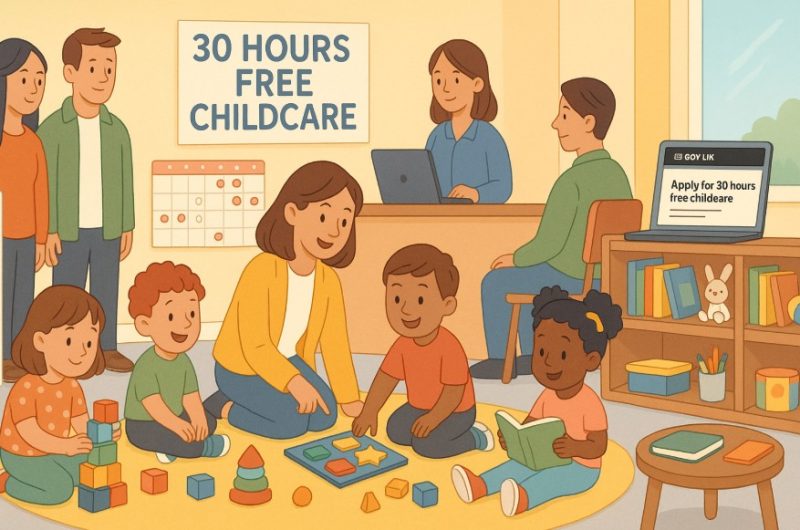
Childcare costs in the UK can be incredibly high, but the government-funded 30 hours free childcare scheme helps ease this burden for working families.
This initiative is available to parents of children aged three and four, and from September 2025, it will also extend to all under-fives. The scheme aims to support parents in managing childcare expenses while they work or study.
In this guide, we will explore how the scheme works, the eligibility criteria, and the step-by-step application process. We will also cover important aspects like renewal, what is not covered, and what to do if your application is rejected.
What is 30 Hours Free Childcare?

The 30 hours free childcare scheme is a government initiative designed to provide working parents with financial relief by offering up to 30 hours of free childcare per week for 38 weeks of the year.
This adds up to a total of 1,140 hours per year, which can be used during school term times. For parents who prefer to stretch these hours across the full year, the scheme allows for about 22 hours per week for 52 weeks. The primary goal is to make it easier for parents to work without being overwhelmed by nursery or childcare costs.
It also supports early education, giving children a head start before entering primary school. Parents can use this free childcare at various registered providers, including nurseries, childminders, and preschool centres, as long as they are registered with Ofsted.
It is important to note that not all childcare providers participate, so checking with your local nursery or childminder is crucial before applying.
What Is the Difference Between 15 Hours and 30 Hours Free Childcare?
The UK government provides both 15-hour and 30-hour free childcare schemes, but they are tailored to different age groups and circumstances. The 15 hours free childcare is available for:
- Two-year-olds from low-income families or those who meet specific criteria.
- All three and four-year-olds, regardless of the parents’ work status.
The 30 hours free childcare is specifically for working parents of three and four-year-olds and will extend to all under-fives from September 2025. To qualify, parents must meet certain income thresholds.
Comparison Table
| Aspect | 15 Hours Free Childcare | 30 Hours Free Childcare |
| Age Group | 2-year-olds (low income), 3-4 years | 3-4 years (expanding to under-fives) |
| Eligibility | Universal for 3-4 years, criteria for 2 years | Working parents, income criteria |
| Weekly Hours | 15 hours per week | 30 hours per week |
| Term Time or Year-Round | Usually term time (38 weeks) | Can be stretched to 52 weeks |
The key difference is that 30 hours are only available to working families, while 15 hours are accessible to more families, including non-working households.
Who Is Eligible for 30 Hours Free Childcare?

Parents can access 30 hours of free childcare if they meet certain eligibility requirements. These criteria are set to ensure support reaches working families who need it most.
Basic Eligibility Requirements
- Your child must be three or four years old (expanding to all under-fives in September 2025).
- You must live in England.
- Both parents (or the sole parent in single-parent households) need to be working.
- Each parent must earn at least the National Minimum Wage for 16 hours a week:
- £2,539 over three months if you are aged 21 or over.
- £2,080 over three months if you are aged 18–20.
- £1,570 over three months if you are under 18 or an apprentice.
Additional Eligibility Conditions
- If you are self-employed, you can still apply as long as you meet the income criteria.
- Parents on maternity, paternity, or adoption leave remain eligible.
- Foster carers can apply if they meet the income and work requirements outside of their fostering role.
- If one parent is unable to work due to disability or is a registered carer, the family may still qualify.
Income Cap:
- If either parent earns £100,000 or more annually, the family is not eligible for the scheme.
- Both parents can earn money up to £99,999 each and still qualify, as the cap is per individual, not per household.
Understanding these eligibility requirements ensures that you know exactly what to prepare before applying. If you are unsure of your eligibility, you can use the Childcare Calculator on the GOV.UK website to double-check.
What Will You Get from 30 Hours Free Childcare?
When you apply for the 30 hours free childcare scheme, you gain access to a substantial amount of funded childcare that can significantly reduce your monthly expenses.
The scheme provides 30 hours of free childcare per week for 38 weeks of the year, which matches the school term schedule. This amounts to 1,140 hours per year.
Benefits of the 30 Hours Free Childcare Scheme
- Reduced Childcare Costs: The scheme helps families save hundreds of pounds each month by covering 30 hours of childcare.
- Flexibility with Childcare Providers: You can use the hours with various types of childcare settings, including:
- Registered nurseries
- Preschools
- Childminders
- School-based nurseries
- Spread Over 52 Weeks: If you prefer, you can stretch the hours across 52 weeks instead of 38. This would give you around 22 hours per week year-round. This option is ideal for parents who need continuous childcare outside of school terms.
- Support for Working Parents: By covering a significant portion of childcare costs, parents can return to work or increase their working hours without the heavy financial burden of childcare fees.
What Is Included in the 30 Hours Free Childcare?
- Basic childcare provision for the specified hours
- Early education activities that prepare children for school
- Access to outdoor play, structured learning, and social development
However, it’s important to note that some costs are not covered, such as meals, nappies, and extracurricular activities. You may need to discuss these details with your childcare provider to understand any additional charges.
How to Apply for 30 Hours Free Childcare?

Applying for the 30 hours free childcare scheme is a simple process if you follow the correct steps. The application is managed through the GOV.UK website, where you will be required to set up a childcare account. Here’s a step-by-step guide to help you through the application process:
Step 1: Create a Childcare Account
- Visit the official GOV.UK website and navigate to the childcare section.
- You will need to create an account by providing your National Insurance number and, if self-employed, your Unique Taxpayer Reference (UTR).
Step 2: Submit Required Information
Fill out the application with your personal details, including:
- Your employment status
- Your partner’s details if you have one
- Information about your child, including their birth date and residency status
Step 3: Verification Process
- The government will verify the information you provided to confirm your eligibility.
- This may take up to 7 days, but many parents receive approval instantly.
Step 4: Receive Your 11-Digit Code
- If your application is successful, you will receive an 11-digit eligibility code.
- You must give this code to your chosen childcare provider to activate your free hours.
- You will also need to provide your National Insurance number and your child’s date of birth.
Step 5: Confirm with Your Childcare Provider
- Ensure your childcare provider is registered with the 30 hours free childcare scheme.
- They will validate your code with the government, and your free hours will begin.
Important Notes:
- You must reconfirm your eligibility every three months to continue receiving the child benefit.
- If your application is delayed or you experience issues, you can contact the Childcare Service Helpline for assistance.
By following these steps, you can smoothly navigate the application process and begin using your childcare hours.
When to Apply 30 Hours Free Childcare?
Applying for 30 hours free childcare requires careful timing to ensure your child can begin receiving the hours at the start of a new school term.
Eligibility for the scheme begins the term after your child turns three, or from September 2025 for children under three.
The application deadline depends on your child’s date of birth. If your child is born between 1 September and 31 December, apply by 30 November to start in January.
For children born between 1 January and 31 March, apply by 28 February to begin in April. If born between 1 April and 31 August, apply by 31 July to start in September.
You must complete the application and receive your 11-digit code before the term starts. Applying early helps secure places in popular childcare settings and allows time to correct any issues. To avoid missing out, it’s best to apply at least one month before the deadline.
How to Renew and Maintain Your 30 Hours Free Childcare?

Once you receive your 30 hours free childcare, it’s crucial to maintain your eligibility to avoid interruptions. This involves reconfirming your details every three months.
Steps to Renew Your Childcare Eligibility
- Reconfirm Every Three Months: You must log in to your childcare account every three months to confirm your employment status and income. The GOV.UK Childcare Service will send you reminders two weeks before the deadline.
- Report Any Changes: It’s essential to update your account if your income or work situation changes. Report events like job loss, a new job, or a significant pay rise promptly.
- Avoiding Interruptions: Failing to reconfirm on time may cause your 11-digit code to expire, risking a pause in childcare support. This could lead to your provider temporarily stopping your child’s place.
- Communication with Your Provider: Many providers need proof of your reconfirmation to continue offering the free hours. Stay in regular contact with them to avoid unnecessary disruptions in childcare.
Maintaining your eligibility is straightforward if you adhere to the three-month confirmation schedule and keep your account up-to-date.
What is Not Covered by 30 Hours Free Childcare?
Although the 30 hours free childcare scheme covers a substantial portion of childcare costs, there are specific expenses that are not included. Understanding these can help you budget more effectively and avoid unexpected fees.
Expenses Not Covered
- Meals and Snacks: Most nurseries charge separately for meals, snacks, and drinks.
- Nappies and Wipes: If your child is still using nappies, you may need to provide them or pay a fee.
- Educational Outings and Trips: School trips and outings are typically not covered.
- Extra Sessions: Extended hours before or after the funded 30 hours are often charged additionally.
- Additional Services: Some childcare providers may charge for specialist activities like dance classes or language lessons.
Typical Additional Costs
| Expense | Approximate Cost per Week |
| Meals (Lunch/Snack) | £10–£20 |
| Nappies and Wipes | £5–£10 |
| School Outings | £5–£15 |
| Early Drop-off | £5–£10 per hour |
| Late Pick-up | £5–£10 per hour |
It’s important to discuss potential additional costs with your childcare provider before your child starts, so you are fully aware of any out-of-pocket expenses.
What to Do if Your Application is Rejected?
If your application for 30 hours free childcare is rejected, it’s important not to panic. There are several steps you can take to resolve the issue and reapply.
Steps to Take
- Check the Rejection Reason: Log in to your UK account to view the reason for the rejection. Common reasons include incorrect information or failing to meet income requirements.
- Update Information: Correct any mistakes in your application, such as employment status or income details.
- Reapply: Once corrected, resubmit your application online.
- Contact the Helpline: Call the Childcare Service Helpline for support if you encounter issues during reapplication.
- Consider Alternative Options: Look into 15 hours free childcare, Tax-Free Childcare, or Universal Credit childcare support.
By taking these steps promptly, you can resolve issues and secure your childcare place without long delays.
How Will 30 Hours Free Childcare Change in 2025?

The 30 hours free childcare scheme will see major changes from September 2025. Currently, only three and four-year-olds are eligible, but the government has announced an expansion to include all children under five.
This means parents of children as young as nine months will be able to access 30 hours of funded childcare each week, offering significant support to working families.
To accommodate the increased demand, around 70,000 new childcare places will be introduced across the UK, alongside the recruitment of approximately 35,000 new staff.
These changes aim to help more parents, particularly mothers, return to work or increase their working hours, supporting the government’s wider goals of boosting employment and economic growth.
The scheme may also offer more flexibility by allowing hours to be used over a 52-week period, providing year-round support. Parents are advised to stay in contact with local providers to learn how these updates will be applied in their area
Conclusion
The 30 hours free childcare scheme is a vital resource for many working families across England, providing significant relief from the high costs of childcare.
With the upcoming expansion in 2025, even more families will benefit as the scheme extends to all children under five.
Applying for the scheme is a straightforward process, but it is crucial to understand the eligibility requirements, application timelines, and what is and isn’t covered. Ensuring you maintain your eligibility by updating your childcare account every three months helps prevent interruptions.
Understanding what to do if your application is rejected also empowers you to take corrective action swiftly. By planning ahead and familiarising yourself with the process, you can make the most of the government’s support and secure quality childcare for your child.
FAQs About How to Apply for 30 Hours Free Childcare
How long does it take to process the 30 hours free childcare application?
It usually takes about 7 days to process your application, although some may receive confirmation immediately.
Can self-employed parents apply for 30 hours free childcare?
Yes, self-employed parents can apply as long as they meet the minimum income requirements.
Are foster carers eligible for 30 hours free childcare?
Foster carers may be eligible if they are working outside of their fostering role and meet the income criteria.
Can I use 30 hours free childcare with Tax-Free Childcare?
Yes, you can combine 30 hours free childcare with Tax-Free Childcare for additional savings.
What if my earnings change during the application period?
If your earnings change, you must update your details during the three-month reconfirmation process.
Is it possible to use the hours across multiple childcare providers?
Yes, you can split your 30 hours across multiple approved childcare providers.
What childcare services accept 30 hours free childcare?
Nurseries, preschools, childminders, and school-based nurseries that are registered with Ofsted accept the scheme.