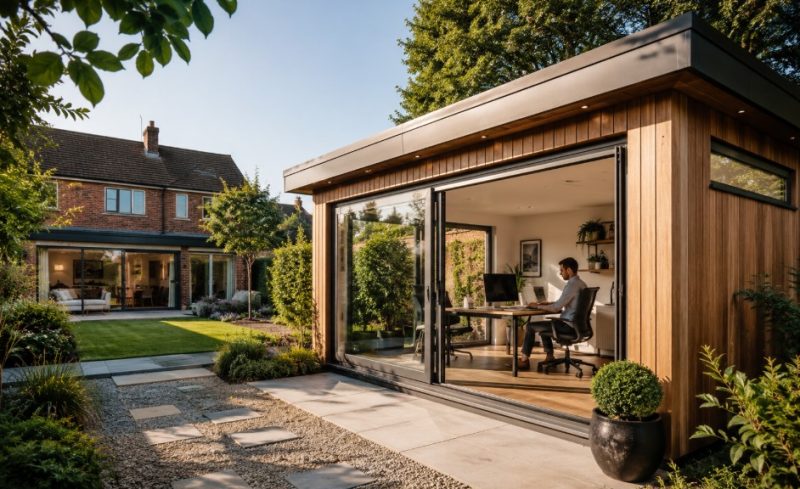
Insulated garden offices have emerged as one of the highest-ROI home improvements for UK homeowners in the 2026 market. These structures offer a dual benefit: immediate functional workspace and significant enhancement of a property’s resale value.
A well-executed, insulated garden office can transform unused garden space into a highly desirable asset, typically increasing overall property value by 5-15% depending on the build quality and location.
How Much Value Does an Insulated Garden Office Add?
A quality insulated garden office typically adds between 5% and 15% to UK property value, with averages often cited around 8.4%. This translates to a cash increase of roughly £12,000 to £45,900+, influenced by the property’s initial value, location, and the office’s build quality.
Compared to other home improvements, a garden office offers a competitive value-add. While loft conversions often yield the highest percentage ROI (20-25%), and extensions can provide the largest absolute value increase, garden offices offer a strong return with lower upfront costs and less disruption.
- London properties with high-spec garden offices can see premiums, especially in areas where space is at a premium.
- Regional markets also benefit, with the value-add solving space problems for remote workers.
- Factors pushing value to the higher end include year-round usability, high-quality finishes, and seamless integration with the main property.
Why Insulation Quality Directly Impacts Property Valuation?
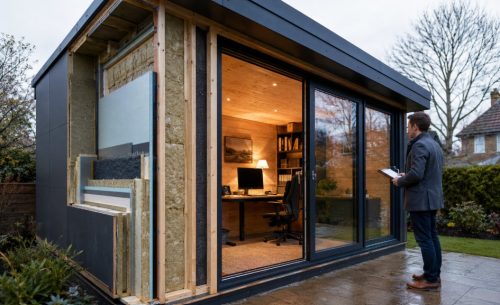
The insulation quality of a garden office can affect the value of your property. Insulation affects both energy efficiency and year-round usability, which are important considerations for modern buyers and valuers. A poorly insulated structure can quickly become a liability rather than a valuable asset.
Energy efficiency ratings are playing an increasingly important role in UK property assessments, and sustainability factors are often considered during valuations. Meeting the 2026 Building Regulations Part L thermal performance requirements provides reassurance to buyers and can enhance property value.
A well-insulated garden office that remains comfortable while consuming less energy clearly stands out:
- Year-round usability adds value by transforming a seasonal structure into a practical all-weather workspace.
- High energy efficiency can contribute to a better EPC rating for the overall property. Properties with stronger EPC ratings may achieve sale price premiums of 1% to 3%.
- Compliance with thermal regulations, such as wall U-values of 0.18 W/m²K, helps ensure the structure meets modern standards.
The 5 Features Valuers Look for in Garden Offices
Valuers assess garden offices based on features that demonstrate quality, functionality, and compliance. These elements help ensure the structure adds genuine value to the property.
- Proper Foundations and Structural Integrity: Valuers look for evidence of professional installation, including robust foundations such as concrete slabs or ground screw systems. This guarantees safety and durability.
- Electrical Certification and Part P Compliance: All electrical work must be carried out by a qualified electrician and must come with an Electrical Installation Certificate that demonstrates compliance with Part P of the Building Regulations.
- Insulation Specifications: Insulation specifications, including U-values for the walls, roof, and floor, help demonstrate that the office is suitable for year-round use. When it comes to extensions, we can expect valuers to be looking for performance in line with Part L. To give two examples: walls 0.18 W/m²K and roof 0.15 W/m²K.
- Planning Permission or Permitted Development Evidence: Documentation confirming that the office was built under permitted development rights or with full planning permission is important. This helps to prevent legal issues and assures buyers.
- Quality of Finish and Integration: Office valuations are strongly influenced by the quality and appearance of internal and external finishes, as well as the integration of the office with the main property and garden. A good finish denotes a well-cared-for and valuable addition.
Cost vs. Value: Investment Breakdown for UK Homeowners

The average cost of a quality insulated garden office in the UK ranges from approximately £8,000 to £25,000, while custom-designed high-specification builds can cost £40,000 to £80,000 or more. The return on investment is often strong, with the added property value frequently exceeding the initial cost.
For instance, a £20,000 build could add £30,000 to the sale price, representing a 1.5x return on investment. Financing options such as home improvement loans or remortgaging may affect overall returns, so careful planning is important.
Maximising Value: Strategic Decisions Before You Build
To maximise the value of a garden office, strategic decisions should be made before construction begins. These choices help ensure the office appeals to buyers and integrates well with the property.
- Optimal Sizing: Avoid making excessive improvements which are not suitable for your property type and street. A 3m x 3m (9m²) to 4m x 3m (12m²) office is often a good fit for the average UK home, providing sufficient space without overwhelming the garden.
- Positioning and Garden Integration: The office should be positioned to maximise natural light and privacy. The design should blend well with the main house and garden. Thoughtful landscaping around the office enhances its overall appeal.
- Design Choices: Choose a neutral, adaptable design that appeals to the widest range of potential buyers. Full-width glazing, adaptable layouts, and quality cladding (like cedar) are often sought after.
- Future-Proofing: Ensure robust connectivity, such as hardwired Ethernet, sufficient power capacity for multiple devices, and a flexible layout that can adapt to future uses, including a home office, gym, or studio.
Considering these factors from the outset helps ensure the garden office is viewed as a valuable asset rather than a simple garden shed.
Conclusion
Insulated garden offices represent a valuable investment for UK homeowners, providing immediate practical benefits while also increasing property value. By applying a value-focused approach, homeowners can maximise returns and transform garden space into a highly desirable asset.
The 2026 UK market context points to an opportunity for this type of improvement because remote working looks likely to continue and demand for flexible home space is growing.
Prioritising quality insulation, regulatory compliance, and thoughtful design helps ensure a garden office becomes a genuine property value enhancer.