

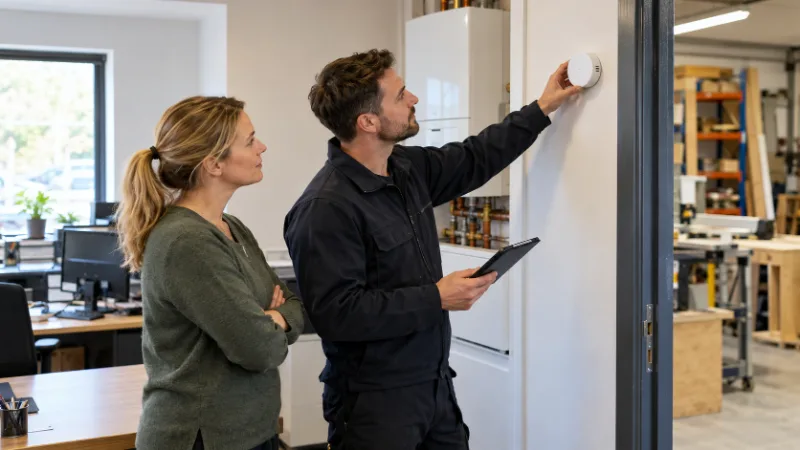
Lots of UK restaurants have put in a wood-fired pizza oven or a tandoor in the last few years. HSE’s advice on those ovens points to something most owners never think about.
Carbon monoxide from commercial kitchens has reached people living in the homes next door.
You can’t see, smell or taste the gas, so a carbon monoxide detector is the only real way to know it’s there before anyone feels unwell.
Whether the law makes you fit one depends on the building. The answer for a café isn’t the same as the answer for the flat above it.
Here’s how the rules work, and where the alarm should go once you’ve got one.
Is a Carbon Monoxide Detector a Legal Requirement for Businesses?
For most offices and shops, no law names CO alarms directly. What the law does ask is that every gas appliance and flue at work is kept safe, and that you protect staff and the public from the risks your business brings with it.
Wherever fuel is burned indoors, a detector is usually part of how you show you’ve done that.
Two groups face firmer rules. Landlords have clear alarm duties, and caterers who burn solid fuel have HSE guidance telling them to fit one.
What Do Landlords in England Have to Fit?
Since 1 October 2022, private and social landlords in England must fit a CO alarm in any room used as living space that has a “fixed combustion appliance”.
In plain terms, that’s anything fixed in place that burns fuel for heat, from a gas boiler to a log burner. Gas cookers are the one exception. A fireplace that’s purely for show doesn’t count either.
The word “room” covers more than most landlords expect. The rules treat a hall or landing as a room, and a bathroom as living space. If the combi boiler sits on a landing or in a bathroom, the alarm goes there too.
You’ll also need to check each alarm works on the day a new tenancy starts. If a tenant reports a fault, it’s on you to repair or replace it.
The government guidance for landlords suggests asking the tenant to sign the inventory to confirm the test. It also makes clear that councils can fine up to £5,000 per breach, not per property.
Are the Rules Different in Scotland and Wales?
Yes, and the gaps matter if you let homes on both sides of a border. Here’s how the three nations compare:
| Nation | Who the rules cover | Rooms that need an alarm | Gas cookers |
| England | Private and social landlords | Living space with a fixed fuel-burning appliance | Excluded |
| Wales | Private and social landlords | Any room with a gas, oil or solid fuel appliance | Included |
| Scotland | Every home, owned or rented | Any room with a fuel-burning appliance or a flue | Not required |
Wales is the one that catches people out. Rent Smart Wales uses the example of a flat with a gas hob in the kitchen and a boiler in the bedroom. In Wales it needs an alarm in both rooms, while the same flat in England needs one in the bedroom only.
What Should Restaurants and Commercial Kitchens Fit?
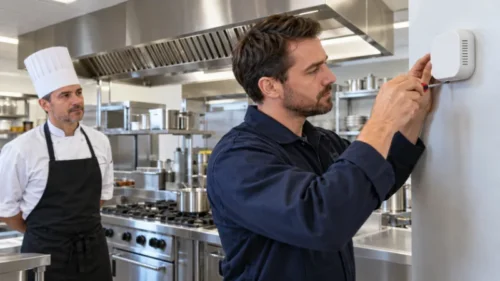
If you cook over charcoal or wood, HSE’s guidance on solid fuel catering appliances says you should fit a working CO alarm with a loud sounder.
It needs to be suited to a commercial kitchen, and you need a plan to get everyone out when it goes off. HSE’s own guidance for its inspectors prefers a mains-wired alarm to a battery one in this setting.
Why Does the Ductwork Matter?
Smoke from charcoal and wood eats into metal, and a lot of kitchen ducting is made from galvanised steel, which wears away under it month by month.
Once the ducting starts to fail, CO can leak into other parts of the building or next door, and HSE links worn ducting directly to that risk. Stainless steel copes far better, so check what your system is made of before a solid fuel oven goes in.
What Happens After Closing Time?
A tandoor can hold glowing charcoal for hours after the last order. HSE asks caterers to keep the extraction fan running until all the fuel is out, even with nobody on site.
That stops gas drifting next door overnight or greeting the morning shift. The simplest way to manage it is to link the fan to the CO detector, so the fan can’t switch off while the alarm is picking up gas.
If the alarm keeps going off, HSE is clear that a competent person needs to find out why before the oven is used again.
Where Should a Carbon Monoxide Detector Be Placed?
In the room with the appliance, fit it 1 to 3 metres away from it, measured across the room. It should sit somewhere between the top of the appliance and just below the ceiling.
In a room without an appliance, such as a flat above a shop or a back office, head height works best. That’s roughly where you’ll be breathing.
A few spots to avoid when you fit one:
- Above a hob or near a shower, where steam and fumes can set it off.
- Close to doors and windows, where draughts thin the air before it reaches the sensor.
- Dusty areas like workshops and garages, which clog the sensor over time.
- Inside a boiler cupboard too small to give a metre of space. Fit it just outside the cupboard instead.
If your premises has a garage with a door into the main building, an alarm on the inside of that door is a sensible extra.
Terraced high streets add a twist that’s easy to miss. Safelincs, the Lincolnshire fire safety firm, points out in its advice on where to fit alarms that CO has been shown to pass between homes through shared lofts in terraced and semi-detached rows.
A detector in your own unit can warn you about a boiler you don’t own and have never seen.
Which Type of Detector Suits a Business?
Start with the standard printed on the box. In the UK that’s BS EN 50291, and a Kitemark alongside it is a good sign. It shows the alarm has been tested to go off at the right levels of gas. After that, the right type depends on the building.
For battery alarms in rented homes, the government recommends sealed 10-year models. Nobody can borrow the battery for the TV remote and forget to put it back.
In a single flat or a small office, one of these is usually a better choice than a mains unit, which needs an electrician to fit.
Mains alarms with a back-up battery suit busy kitchens and larger lets better, because they don’t rely on anyone keeping up with battery checks.
If your premises is spread over several rooms, linked alarms mean a detector in the back storeroom sets off the one at the front, where staff will hear it.
Some tenants or staff are deaf or hard of hearing. For them, alarms that flash or use a vibrating pad may be needed, and landlords should think about their duties under the Equality Act when choosing.
What Should Staff Do When the Alarm Sounds?
CO stops the blood carrying oxygen, and the first signs are easy to mistake for a bug. People tend to get a headache and feel sick, then dizzy and short of breath.
Gas Safe Register puts the toll at around 50 deaths a year in England and Wales, so treat every alarm as real until an engineer says otherwise.
To stay safe when the alarm sounds, work through this order:
- Switch off any fuel-burning appliance if you can do it straight away.
- Open doors and windows on your way out.
- Get everyone outside into fresh air and keep them there.
- Call the National Gas Emergency Service on 0800 111 999, and call 999 if anyone is unwell or has collapsed.
Don’t relight the appliance until a Gas Safe registered engineer has checked it. Talking new staff through this takes two minutes and saves a lot of dithering on the day.
How Often Should You Test and Replace a CO Alarm?
Press the test button as often as the maker suggests, which is weekly for many models. If you’re a landlord or an employer, keep a simple log, because it’s the evidence a council will look at if a tenant ever raises a complaint.
Sensors don’t last forever. Most current alarms last up to 10 years and usually give an end-of-life warning that sounds different from a low-battery chirp. Write the fitting date on the back of each one and you’ll never have to guess.
Is a Detector Enough on Its Own?
No. A detector tells you something has already gone wrong, and it can’t fix a blocked flue or a badly kept boiler.
Landlords need a yearly gas safety check by a Gas Safe registered engineer, while caterers need their extraction checked and cleaned on schedule. The alarm sits behind that work as the last line of warning, never in place of it.
If you’re not sure which rooms on your premises need cover, or which alarm suits a hot kitchen rather than a quiet office, a specialist supplier such as Safelincs can match the detector to the building.
Your local fire and rescue service can also help with wider fire safety advice.