

Thomas Cook went bust on 23 September 2019. The High Court made winding-up orders against Thomas Cook Group plc and several associated companies, placing them into compulsory liquidation.
The Official Receiver was appointed as liquidator, and the company stopped trading immediately.
The collapse ended the operations of a travel business whose origins dated back to 1841. Around 150,000 UK customers were abroad when the company failed, while approximately 9,000 UK employees lost their jobs.
The wider group employed about 21,000 people and had approximately 600,000 customers overseas at the time of the collapse.
Thomas Cook Collapse Summary:
| Key point | Confirmed information |
| Date Thomas Cook went bust | 23 September 2019 |
| Insolvency procedure | Compulsory liquidation |
| Immediate outcome | Trading and UK flight operations stopped |
| Age of the underlying Thomas Cook brand | Approximately 178 years |
| UK customers abroad | Around 150,000 |
| Customers affected globally | Approximately 600,000 |
| UK jobs affected | Around 9,000 |
| Worldwide workforce | Approximately 21,000 |
| Reported debt burden | Around £1.6 billion to £1.7 billion, depending on the date and accounting measure |
| Final funding shortfall | Approximately £200 million |
| Repatriation operation | Operation Matterhorn |
| Known estimated government cost reported in 2020 | At least £156 million, including repatriation and insolvency-related costs |
The official UK Government information for Thomas Cook customers, employees and creditors confirms that winding-up orders were made on 23 September 2019.
What Happened When Thomas Cook Collapsed?
Thomas Cook had been negotiating a major financial restructuring during the summer of 2019. The proposed arrangement included funding from its banks, bondholders and Chinese investor Fosun International.
Although a rescue package worth approximately £900 million had been assembled, lenders reportedly required the group to secure an additional £200 million.
They wanted sufficient liquidity to cover the quieter winter trading period, when holiday bookings and cash receipts would normally be lower.
Thomas Cook approached the UK Government for support. Information later reviewed by the National Audit Office showed that the company sought government backing for between £150 million and £250 million of loans.
The Department for Transport told the company on 22 September 2019 that it would not provide the requested support.
A final attempt to complete the rescue failed during the evening of 22 September. Shortly after 2am on 23 September, the Civil Aviation Authority announced that Thomas Cook had entered liquidation and ceased trading.
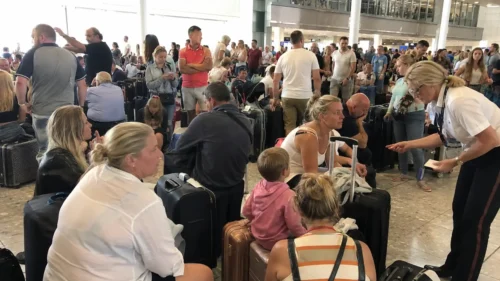
All Thomas Cook UK flights and holidays were cancelled. Aircraft arriving at UK airports were grounded, and customers who were already overseas no longer had valid Thomas Cook flights home.
The chronology supplied in the original Thomas Cook Group reference also records the failed rescue negotiations and immediate cessation of operations.
Why Did Thomas Cook Collapse?

Thomas Cook did not fail because of one isolated event. Its collapse resulted from a combination of heavy borrowing, weak cash generation, changing consumer habits, intense competition and several external shocks.
Heavy Debt and Refinancing Costs
Thomas Cook carried a substantial debt burden for many years. Much of the financial strain was linked to earlier acquisitions, mergers and restructuring programmes.
During evidence given to a House of Commons committee after the collapse, former chief executive Peter Fankhauser said Thomas Cook had paid approximately £1.2 billion in interest and refinancing costs since 2012.
Money used to service debt could not be invested in technology, hotels, customer service or the modernisation of the business.
This created a difficult cycle:
- Large debts generated substantial interest charges.
- Interest payments reduced the cash available for investment.
- Limited investment made it harder to compete with online travel companies.
- Weak performance made refinancing more difficult and expensive.
The debt burden did not automatically make Thomas Cook insolvent. However, it left the company with little room to absorb poor trading, unexpected costs or a decline in customer demand.
The MyTravel Merger Added Financial Complexity
Thomas Cook Group plc was formed in 2007 through the merger of Thomas Cook AG and MyTravel Group. The combined company expected the deal to produce annual savings of more than £75 million.
However, the transaction also increased the size and complexity of the group. Significant acquisition-related goodwill remained on Thomas Cook’s balance sheet for years.
In 2019, the company recorded a major goodwill impairment as expectations for the profitability of its UK operations deteriorated.
Goodwill is an accounting asset representing factors such as brand value and expected future earnings. It is not cash that a business can use to pay staff, hotels, aircraft suppliers or lenders.
Audit scrutiny continued long after the collapse. In April 2025, the Financial Reporting Council imposed sanctions relating to serious breaches of auditing standards in EY’s audits of Thomas Cook’s 2017 and 2018 financial statements.
The regulator highlighted failures involving goodwill, going-concern assessments and professional scepticism. These audit findings should not be interpreted as evidence that the auditor alone caused the collapse.
Thomas Cook Was Slow to Adapt to Online Booking
The travel market changed significantly during the 2000s and 2010s. More customers began booking flights, accommodation and package holidays through websites and mobile platforms rather than visiting traditional travel agencies.
Thomas Cook retained an extensive high-street network at a time when online competitors operated with fewer physical locations and lower fixed costs.
In March 2019, the company announced the closure of 21 shops and the loss of around 300 jobs, noting that 64% of its UK bookings had been made online during the previous year.
Its stores still offered value to customers wanting face-to-face support, complex itineraries or assistance with package holidays.
The problem was that maintaining hundreds of branches, employees and leases created substantial costs while customer behaviour was moving online.
Competition Put Pressure on Prices and Margins
Thomas Cook competed with several different types of businesses, including:
- Large integrated tour operators such as TUI;
- Low-cost airlines;
- Online travel agencies;
- Accommodation booking platforms;
- Hotels and airlines selling directly to consumers.
Customers could increasingly build their own holidays by combining separate flights and hotel bookings. Price-comparison tools also made it easier to compare deals, putting pressure on the margins earned by traditional package holiday companies.
Thomas Cook attempted to respond by developing its online services and investing in its own hotel brands. However, the transformation was expensive and did not progress quickly enough to overcome its financial constraints.
The 2018 Heatwave Weakened Holiday Demand
The prolonged European heatwave in 2018 reduced demand for some overseas summer holidays. Many UK consumers delayed booking or chose to remain at home because of the unusually warm weather.
For a financially resilient company, one weak season may be manageable. For Thomas Cook, lower demand intensified existing cash-flow and debt problems. It contributed to weaker trading and lower confidence in the future value of parts of the business.
Brexit Uncertainty Affected Consumer Confidence
Brexit was frequently mentioned as one of the pressures affecting Thomas Cook. Political and economic uncertainty weakened consumer confidence, while fluctuations in sterling affected the cost of holidays and overseas operations.
However, it would be misleading to say that Brexit alone caused Thomas Cook to collapse. The company’s debt, financing structure and strategic problems had developed over many years. Brexit uncertainty was an additional pressure rather than the sole cause.
Terrorism, Fuel Costs and Destination Disruption Added Pressure
Travel companies can be severely affected by events outside their control. Thomas Cook faced disruption connected with terrorist attacks in popular destinations, political instability, changing travel advice and higher aviation fuel costs.
When demand for a particular destination falls suddenly, a tour operator may still have financial commitments to airlines, hotels and other suppliers. A highly indebted company has less capacity to withstand these shocks.
Was the £200 Million Shortfall the Main Cause?

The missing £200 million was the immediate trigger that prevented the proposed rescue from being completed. It was not the underlying cause of Thomas Cook’s problems.
Providing the additional funding may have allowed the company to continue trading temporarily. It would not automatically have removed its debt, improved its margins or completed its digital transformation.
The Government concluded that support would expose taxpayers to considerable risk without guaranteeing the company’s long-term survival.
The National Audit Office later examined how the Government prepared for and responded to the collapse, but it did not assess whether refusing the requested financial support represented value for money.
What Happened to Thomas Cook Customers?
The immediate priority was returning customers who were already abroad.
The Government and Civil Aviation Authority launched Operation Matterhorn, described as the largest peacetime repatriation operation in UK history.
More than 150,000 Thomas Cook customers were expected to require assistance, and over 1,000 charter flights were planned across approximately 50 overseas locations.
The precise totals differ depending on whether figures refer to customers registered as being abroad, passengers who required replacement flights or people who made their own arrangements.
Official reports commonly refer to approximately 150,000 affected customers and around 140,000 passengers transported through the organised repatriation.
Customers with qualifying package holidays were generally protected by the Air Travel Organiser’s Licence, commonly known as ATOL. The Government also instructed the CAA to arrange flights for affected passengers who did not have ATOL protection.
The National Audit Office investigation into the Government’s response estimated that the total repatriation cost was approximately £152 million. The Department for Transport was expected to contribute around £83 million, while the wider known cost to government from the collapse was estimated at no less than £156 million as of March 2020.
What Happened to Thomas Cook Employees?

Around 9,000 people in the UK lost their jobs when Thomas Cook entered liquidation. Employees worked across its airline, retail stores, headquarters, tour operations and support businesses.
The Insolvency Service handled claims for statutory redundancy payments and other eligible employment-related sums. Its annual reporting stated that almost £30 million in redundancy payments was processed within the first two weeks of the liquidation.
Some jobs were later recovered. Hays Travel acquired most of Thomas Cook’s UK retail estate, helping more than 2,000 former employees return to work. Other parts of the international group, including airlines, hotel interests and overseas tour operators, were sold or restructured.
Practical Example: Why Profitable Sales May Not Save a Business?
A simplified example helps explain Thomas Cook’s underlying difficulty.
Suppose a travel company receives £1 million from holiday bookings. That revenue cannot be treated as immediately available profit.
The company may need to use it to pay:
- Airlines and aircraft leasing companies;
- Hotels and destination operators;
- Employee wages;
- Shop rents;
- Technology and marketing costs;
- Interest and refinancing charges;
- Refunds and customer protection costs.
A company can therefore process billions of pounds in bookings and still face a cash-flow crisis. When debt repayments and fixed costs consume most available cash, even a relatively small decline in bookings can create an urgent funding gap.
Thomas Cook’s collapse demonstrated the difference between a recognisable brand with substantial revenue and a financially resilient company with sufficient liquidity.
What Happened to the Thomas Cook Brand?
The collapse of Thomas Cook Group did not mean that every company using the Thomas Cook name disappeared.
The Official Receiver sold numerous assets, including airport slots, shop locations, hotel interests and intellectual property. In November 2019, Fosun International purchased the Thomas Cook name, logo and certain hotel brands.
A new online travel business using the Thomas Cook name was launched in 2020. It was not a continuation of Thomas Cook Group plc’s original corporate structure or liabilities.
Thomas Cook India was also unaffected by the 2019 group collapse because it had been separately owned since 2012. This is a frequent source of confusion when people encounter businesses operating under the Thomas Cook name.
The broader Thomas Cook Group corporate history provides a chronology of the original group, its subsidiaries and the sale of assets following liquidation.
What Can Businesses Learn From the Thomas Cook Collapse?

The failure provides several practical lessons for UK companies.
Cash Flow Can Be More Important Than Revenue
High turnover does not guarantee that a company has enough accessible cash. Businesses must understand when customers pay, when suppliers must be paid and how much liquidity remains after debt servicing.
Debt Can Restrict Business Transformation
Borrowing can finance growth, but excessive interest and refinancing costs may prevent investment in technology, employees and customer experience.
Changing Customer Behaviour Cannot Be Ignored
Thomas Cook’s branch network had once been a major competitive advantage. As bookings moved online, the same network became a substantial fixed-cost commitment.
Contingency Planning Matters
Businesses exposed to seasonal demand, weather, fuel prices, political events or consumer confidence need sufficient reserves and credible contingency plans.
Financial Reporting Requires Realistic Assumptions
Goodwill, projected growth and going-concern assessments must be supported by robust evidence. Optimistic forecasts cannot replace sustainable cash generation.
Final Takeaway
Thomas Cook went bust on 23 September 2019, when the company entered compulsory liquidation after failing to secure the final funding needed for a rescue.
The immediate funding shortfall was approximately £200 million, but the collapse had much deeper causes.
Years of heavy debt, expensive refinancing, intense online competition, high operating costs and weak cash generation left the company unable to withstand falling demand and external disruption.
Its failure affected hundreds of thousands of travellers, resulted in around 9,000 UK job losses and triggered an unprecedented government-backed repatriation operation.
It remains one of the clearest modern examples of how a famous brand and substantial revenue cannot protect a business that lacks sufficient liquidity and financial resilience.
Frequently Asked Questions
What exact date did Thomas Cook go bust?
Thomas Cook went bust on Monday 23 September 2019. The company entered compulsory liquidation and stopped trading immediately.
What time did Thomas Cook cease trading?
The Civil Aviation Authority announced shortly after 2am British Summer Time on 23 September 2019 that Thomas Cook had ceased trading.
How old was Thomas Cook when it collapsed?
The Thomas Cook business traced its history to 1841, making the underlying brand approximately 178 years old when the group collapsed in 2019.
Why could Thomas Cook not pay its debts?
The company faced a combination of heavy borrowing, significant interest and refinancing costs, weaker trading, high fixed costs and insufficient liquidity. It could not secure the final funding required to complete its rescue package.
How much debt did Thomas Cook have?
Figures of approximately £1.6 billion to £1.7 billion were widely reported around the time of the collapse. The exact amount varies according to the reporting date and which financial liabilities are included. Parliamentary discussion referred to debt of about £1.7 billion.
Did the UK Government refuse to save Thomas Cook?
Thomas Cook requested government support for its rescue financing. The Government declined, concluding that the proposal involved significant taxpayer risk and did not provide sufficient confidence that the company would become financially sustainable.
How many Thomas Cook passengers were stranded?
Around 150,000 UK customers were abroad when Thomas Cook collapsed. Approximately 600,000 customers were affected internationally.
Were Thomas Cook holidays ATOL protected?
Many package holidays were ATOL protected, but not every customer or booking had the same protection. The Government instructed the CAA to organise return flights for affected UK passengers, including those without ATOL protection.
Does Thomas Cook still exist?
Thomas Cook Group plc, the company that collapsed in 2019, no longer trades. However, the Thomas Cook brand was purchased and later used for a separate online travel business.
Was Thomas Cook India affected?
No. Thomas Cook India had been separately owned since 2012 and was not part of the UK group that entered liquidation in September 2019.
Note: This article has been reviewed against official UK Government, Civil Aviation Authority, National Audit Office, Companies House and UK Parliament information.