

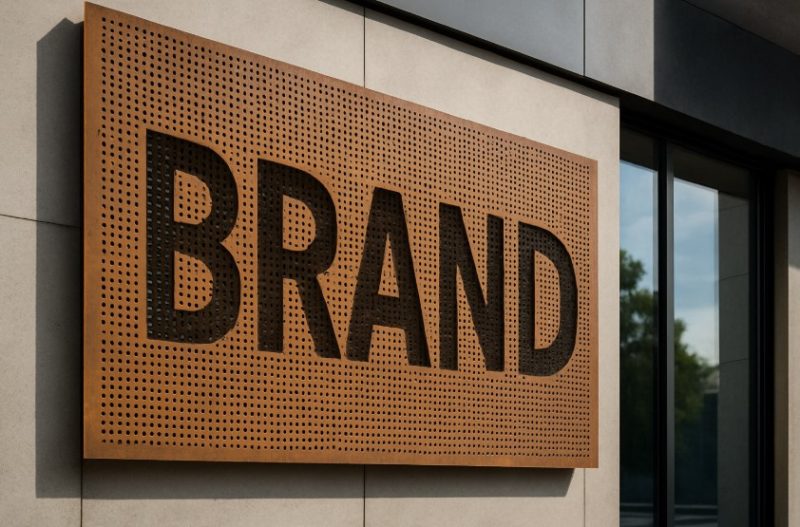
Perforated metal is known for being functional, durable, and adaptable across industries. But in recent years, it has also taken centre stage in design and branding.
One standout example of this is perforated lettering, often referred to as alpha perf. From architectural signage to interior feature walls, more and more businesses are turning to this bold yet refined technique to make a lasting impression.
Here, we explore why perforated lettering is becoming a popular choice, where it can be used, and how it can serve both decorative and practical purposes.
What Is Perforated Lettering?
Perforated lettering is the process of punching a pattern of holes into metal to form letters, numbers, or even full brand names.
Rather than attaching raised letters or applying vinyl signage, the message is created through negative space, making it part of the material itself. The result is sleek, minimal, and often far more eye-catching than traditional signs.
Perforated can also refer to raised perforations that are not actually pierced but embossed into the material to create a raised dimple. This technique is useful in applications where Alpha Perf is required alongside braille functionality.
This technique is typically applied to metals like stainless steel, aluminium, and corten steel, but can also be fabricated in mild steel, and other more luxurious materials such as brass and bronze for a warmer or more premium finish.
Why Are Businesses Choosing Perforated Lettering for Modern Branding?
Making a Statement with Subtlety
What makes perforated lettering so appealing is the balance it offers between bold branding and understated design. The lettering can be seen clearly up close, while at a distance it can appear more abstract or pattern-like, depending on the hole size and spacing. This adds a level of visual interest without overwhelming the surrounding space.
For architects and designers working on projects in retail, hospitality, or public buildings, alpha perf provides a creative way to incorporate branding into cladding, wayfinding, and decorative panels. It is also increasingly used in corporate headquarters or cultural spaces where subtlety and sophistication are valued.
Branding That Lasts
Unlike surface-printed or applied signage, perforated lettering is built to last. Because the letters are formed as part of the material, they are not prone to fading, peeling, or damage over time. This makes it a dependable choice for outdoor applications like building façades, entrance panels, or rainscreen cladding.
Corten steel is often used for this purpose thanks to its distinctive weathered appearance and low maintenance qualities. It develops a stable patina over time that adds depth to the design while protecting the metal beneath.
Customisation and Flexibility
Perforated lettering can be fully customised to suit each project. Whether the aim is to create a clean, modern typeface or something more expressive and artistic, the design can be adapted to match the visual language of the brand. It can also be scaled up for large signage or scaled down for use on panels, screens, and furniture.
This flexibility makes it suitable for a wide range of settings, including:
- Shopfront signage
- Architectural panels
- Reception feature walls
- Decorative partitions
- Wayfinding in commercial or public buildings
- Exterior fencing or gates
Combined with lighting, it can also create striking visual effects. Backlighting or natural sunlight shining through the perforations can bring the design to life and draw attention to the branding even at night.
Performance Meets Design
One of the most useful qualities of perforated metal is its ability to perform double duty. In addition to serving as signage or decoration, it can also act as a functional element.
Perforated panels with alpha perf can be used as perforated cladding or screens that allow airflow, reduce solar gain, or provide partial privacy. This makes them especially popular in spaces where aesthetics and performance go hand in hand.
In industrial settings, for example, perforated signage can be integrated into enclosures, security fencing, or machinery guards. In terms of architectural perforated metal, it might be used for wayfinding while also providing shade or ventilation.
Supporting Businesses and Designers

More companies are turning to perforated lettering not just for its appearance, but because it offers a practical and long-lasting branding solution.
Whether for a new building, a renovation, or a one-off installation, it is a versatile option that brings personality to a space while staying true to the performance standards expected in commercial settings.
Manufacturers with experience in perforation can work closely with architects, designers, and fabricators to turn even complex lettering designs into durable, metal-based signage.
This is particularly helpful for bespoke projects where branding needs to feel integrated into the fabric of the building rather than simply applied to it.
Conclusion
Perforated lettering is more than just a design choice. It represents a shift towards branding that is both architectural and permanent, able to withstand time and weather while still capturing attention.
Whether used in a large-scale commercial project or a small bespoke fitout, it provides a refined way for businesses to express who they are, all while contributing to the form and function of a space.
As interest continues to grow, it is likely we will see more and more brands choosing this subtle yet powerful technique to make their mark.