

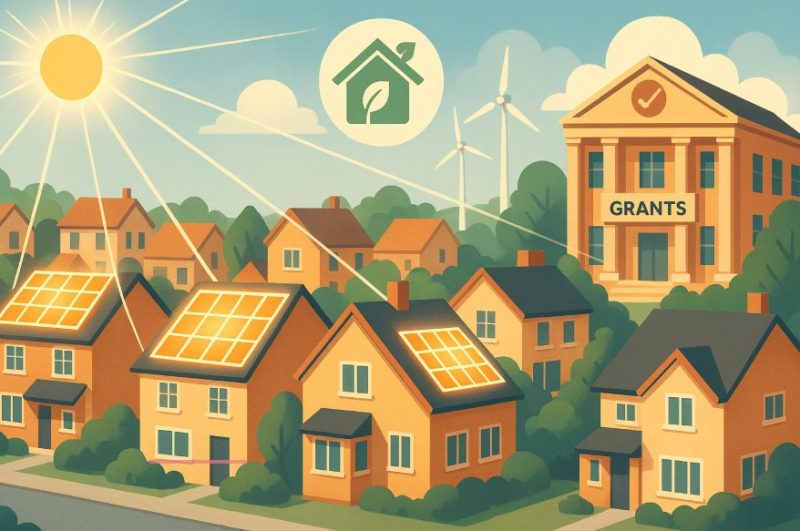
Solar energy has become one of the most sustainable and cost-effective ways to power homes in the UK. With rising energy costs and a growing focus on reducing carbon emissions, more homeowners are turning to solar panels.
To support this transition, the UK government has introduced several grants and schemes that make solar installations more affordable. In 2025, there are numerous government-backed options that can help you save money and contribute to a greener future.
Understanding these grants can significantly reduce the cost of solar panels and make clean energy accessible for all.
Why Are Solar Panels a Smart Investment?
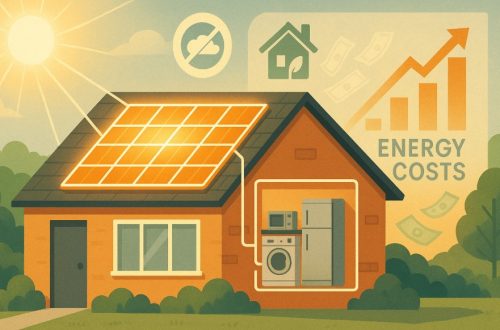
Solar panels are a smart investment for UK homeowners for several reasons. Firstly, they help reduce your energy bills by allowing you to generate your own electricity.
Once installed, solar panels use sunlight to create power, cutting down on your dependence on energy suppliers. This means that even as electricity costs rise, your bills remain stable, offering long-term financial savings.
Additionally, solar panels increase the value of your property. Homes with renewable energy solutions are more attractive to buyers, often commanding a higher resale price.
Solar energy is also a clean, renewable resource that contributes to reducing your carbon footprint. By switching to solar, you are directly supporting the UK’s commitment to reaching Net Zero by 2050.
Finally, government grants and schemes can significantly offset installation costs, making it a cost-effective and sustainable choice.
How Do Government Grants Support Solar Panel Installation?
Reducing Upfront Costs
One of the primary benefits of government grants is the reduction in upfront costs for solar panel installations. Schemes like the Energy Company Obligation (ECO4) can cover up to 100% of installation costs for eligible households.
This makes solar power accessible to low-income families and reduces financial barriers for those wanting to adopt renewable energy.
Encouraging Energy Efficiency
Government schemes are designed not only to promote solar energy but also to enhance energy efficiency. For example, the Green Homes Grant, reintroduced in 2025, encourages homeowners to make their properties more energy-efficient.
This includes not just solar panels but also insulation and heating upgrades, ensuring that energy use is maximised effectively.
Supporting Long-Term Savings
In addition to lowering installation costs, government grants contribute to long-term savings. With schemes like the Smart Export Guarantee (SEG), homeowners can sell excess energy back to the grid, generating a steady income from their solar panels. Over time, this offsets initial costs and boosts the financial return on investment.
What Are the Eligibility Criteria for Solar Panel Grants in the UK?
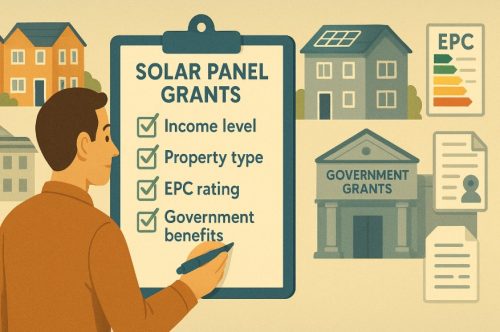
Government grants for solar panels come with specific eligibility criteria. Understanding these requirements can help you determine if you qualify for financial support.
General Requirements Include
- The property must be located in the UK.
- The homeowner must either own the property or have the landlord’s permission for installation.
- The home should have a low Energy Performance Certificate (EPC) rating (often D or below).
- Eligibility is often linked to income levels or receipt of certain government benefits.
Income-Based Criteria
- Universal Credit
- Income Support
- Pension Credit Guarantee Credit
- Child Tax Credit
- Working Tax Credit
Property-Specific Requirements
- Homes with electric heating systems may qualify for additional funding.
- Social housing and community projects often receive prioritised support.
Meeting these criteria increases your chances of receiving grants that can significantly reduce the cost of solar panel installation.
How Much Can You Save with Solar Panels?
The potential savings from solar panels in the UK depend on your system size, energy usage, and whether you install a battery.
A typical household can reduce electricity bills and even earn money by exporting excess energy to the grid through the Smart Export Guarantee (SEG). Adding a battery can further increase these benefits by storing unused energy for later use.
Over 25 years, the savings can add up significantly. With available government grants, the initial installation costs are also reduced, making solar panels a smart long-term investment.
Estimated Annual Savings
| Setup | Estimated Annual Benefit |
| 4kW Solar Panel System | £329 (bill savings) |
| SEG Income (without battery) | £467 |
| With 5.1kWh Battery | £706 (savings) + £174 (SEG) = £880 |
| Estimated 25-Year Total Savings | Over £25,000 |
Switching to solar not only lowers your energy bills but also contributes to a greener future. With financial support available, now is a great time to invest in sustainable energy.
Can You Combine Different Solar Panel Grants and Schemes?
Combining different solar panel grants and schemes is possible, but it depends on specific guidelines for each program.
For example, you can pair the Smart Export Guarantee (SEG) with the VAT Reduction on Solar Panels, allowing you to earn money while benefiting from lower installation costs.
Local council grants can sometimes be stacked with national schemes like ECO4, although you must meet the criteria for each.
For instance, if you qualify for the ECO4 scheme, which covers up to 100% of installation costs, you may still be eligible for SEG payments for any excess energy exported back to the grid.
However, some schemes, like the Green Homes Grant, have restrictions on stacking with others, so it’s important to check each program’s specific rules.
Consulting with an energy advisor or your local council can help you understand the best way to maximise benefits.
What Are the Available Government Grants for Solar Panels in UK?
1. Smart Export Guarantee (SEG)
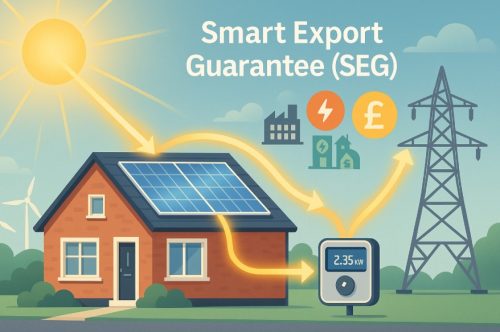
The Smart Export Guarantee (SEG) is a government-backed initiative that allows homeowners to earn money for the excess electricity their solar panels generate. This program is crucial for making solar panel installations more financially rewarding.
How Does SEG Work?
Under the SEG, homeowners are paid for the energy they export back to the National Grid. This is particularly beneficial if your solar panels produce more energy than you consume.
The amount you earn depends on the energy supplier and their tariff rates, which typically range from 20p to 40p per kWh.
Eligibility for SEG
- You must have a certified solar panel installation (MCS certificate or equivalent).
- An export meter or smart meter is required to measure energy sent back to the grid.
- The property must be located in Great Britain.
Application Process
To apply, contact your energy supplier directly. Many large suppliers like Octopus Energy and British Gas participate in the SEG scheme. You will need to submit documentation like your MCS certificate and details of your export meter.
2. Social Housing Decarbonisation Fund (SHDF)
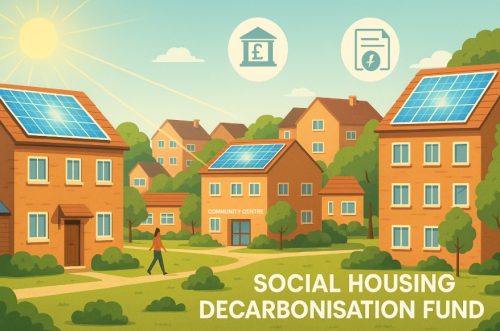
The Social Housing Decarbonisation Fund (SHDF) is designed to improve the energy efficiency of social housing properties across the UK.
This fund supports renewable energy solutions, including solar panels, to lower energy costs for tenants and reduce carbon emissions.
What Does SHDF Cover?
- Installation of solar panels to reduce electricity costs.
- Energy-efficient insulation and heating systems.
- Upgrades to windows and doors for better energy retention.
Eligibility for SHDF
- Only available to social housing providers and local authorities.
- Properties must meet specific energy efficiency standards.
- Projects must demonstrate a commitment to lowering carbon emissions.
How to Apply for SHDF?
Local authorities and social housing providers can apply directly through the government’s online portal. The application process includes submitting property details, energy ratings, and intended improvements.
3. Green Homes Grant (Revived Edition 2025)
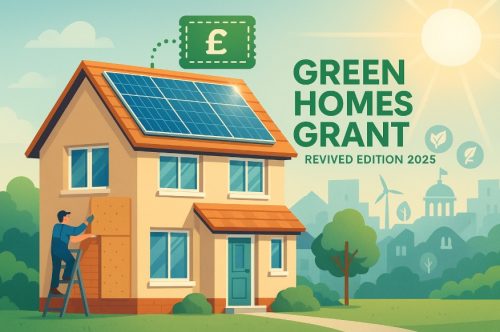
The Green Homes Grant, reintroduced in 2025, focuses on making homes more energy-efficient. Solar panels are one of the primary upgrades covered under this scheme, which aims to reduce carbon emissions and lower household energy costs.
What Does the Green Homes Grant Cover?
- Up to £5,000 in vouchers for home energy improvements.
- Low-income households can access up to £10,000.
- Covers solar panels, heat pumps, and insulation upgrades.
Eligibility Criteria for Green Homes Grant
- Available to homeowners and landlords in the UK.
- Properties must have an Energy Performance Certificate (EPC) rating of D or below.
- Landlord permission is required for rental properties.
How to Apply
Homeowners can apply online through the UK government’s dedicated Green Homes Grant portal. The application requires proof of ownership and the EPC rating of the property.
4. Home Energy Scotland Grant and Loan Scheme
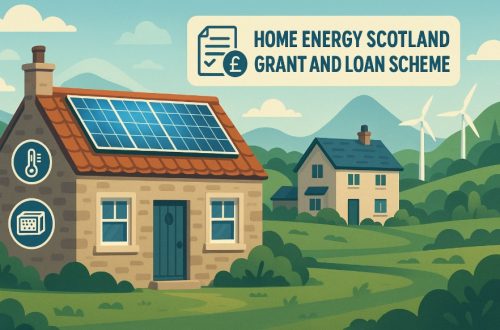
The Home Energy Scotland Grant and Loan Scheme is a financial initiative designed specifically for homeowners and landlords in Scotland. It provides grants and interest-free loans to encourage the adoption of renewable energy technologies, including solar panel installations.
This scheme aims to improve energy efficiency, reduce carbon emissions, and cut down on electricity bills across Scottish homes.
How Does the Home Energy Scotland Grant and Loan Scheme Work?
This scheme allows homeowners to apply for a combination of grants and loans to fund energy-efficient improvements.
For solar panels, the scheme provides up to £1,250 as a grant and an additional £4,750 as a loan, offering substantial financial support for solar installations. The loan is interest-free, making it a cost-effective option for those looking to invest in clean energy.
Eligibility for Home Energy Scotland Grant and Loan Scheme
- Applicants must be homeowners or landlords based in Scotland.
- The property must have a low Energy Performance Certificate (EPC) rating.
- Combined household income should not exceed £36,000 annually.
- Properties not connected to the main gas grid are prioritised for funding.
Application Process
Applications for the scheme are made directly through the Home Energy Scotland website. Homeowners are required to provide proof of income, property ownership, and energy performance certificates.
Successful applicants receive grant and loan packages tailored to their specific needs, enabling them to install solar panels and improve overall energy efficiency.
5. Energy Company Obligation (ECO4)
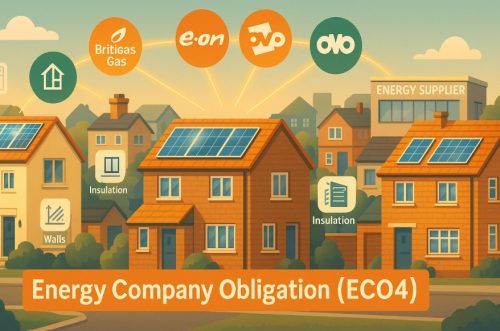
The Energy Company Obligation (ECO4) is a government initiative aimed at reducing carbon emissions and tackling fuel poverty across the UK.
It primarily focuses on providing energy-saving improvements, including solar panel installations, for low-income and vulnerable households. ECO4 is the latest phase of the scheme, running from 2022 to 2026.
How Does ECO4 Work?
Under ECO4, large energy companies are mandated to fund energy-efficient upgrades for eligible households.
This includes the installation of solar panels, improved insulation, and more efficient heating systems. The aim is to reduce energy bills and improve the living standards of fuel-poor households.
Eligibility for ECO4
- Homeowners and tenants in privately owned or rented properties.
- Must be receiving certain government benefits such as Universal Credit, Income Support, or Pension Credit.
- Properties should have an EPC rating of D, E, F, or G.
- Electric heating systems are prioritised for funding.
Application Process
To apply for ECO4, homeowners must contact their energy supplier or local council. The application process involves verifying eligibility through benefit status and property energy ratings. Approved applicants may receive up to 100% of the costs covered for solar panel installations and other energy-saving measures.
6. Renewable Heat Incentive (RHI)
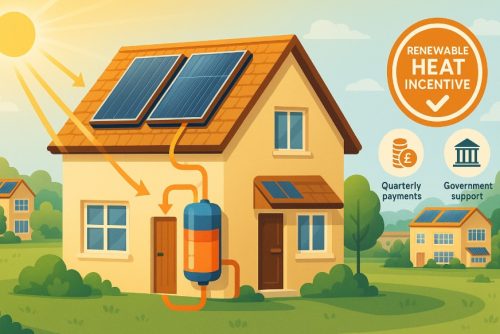
The Renewable Heat Incentive (RHI) is a UK government scheme that encourages homeowners to adopt renewable energy technologies for heating purposes.
Unlike typical solar panels, RHI specifically supports solar thermal installations, which use solar energy to heat water for domestic use. This initiative aims to reduce carbon emissions and promote cleaner heating solutions across the UK.
How Does RHI Work?
Homeowners participating in the RHI scheme receive quarterly payments for the heat their solar thermal systems generate.
The payments are calculated based on the amount of heat produced, measured through the installation’s heat meter. The scheme runs for seven years from the installation date, offering long-term financial benefits.
Eligibility for RHI
- Applicants must own the property or have the landlord’s permission for installation.
- The solar thermal system must be MCS-certified and properly installed.
- An Energy Performance Certificate (EPC) is required, showing the property is energy efficient.
- The property must be located in England, Scotland, or Wales.
Application Process
Applications are processed through the Ofgem RHI Portal. Homeowners are required to submit details of their solar thermal installation, including certification and proof of installation. Once approved, payments are made quarterly for up to seven years.
7. Community Energy Schemes
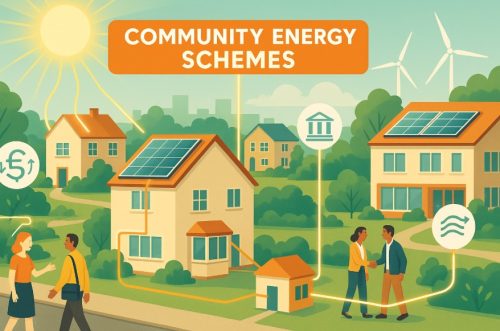
Community Energy Schemes are local initiatives that encourage groups of homeowners or entire communities to invest in renewable energy projects like solar panel installations.
These schemes not only promote clean energy but also lower energy costs for participants by sharing resources and financial responsibilities.
How Do Community Energy Schemes Work?
Communities pool their resources to fund large-scale solar installations, either on community buildings or across multiple properties. These projects often benefit from bulk purchasing discounts, making solar panels more affordable.
The electricity generated is shared among participants, and any excess energy can be sold back to the grid under the Smart Export Guarantee (SEG).
Eligibility for Community Energy Schemes
- Open to homeowners, social housing tenants, and community groups.
- Projects are often led by local councils or energy cooperatives.
- Participants must be located within the community or project area.
Application Process
To join a Community Energy Scheme, you must register your interest with your local council or community energy cooperative.
Many schemes operate on a first-come, first-served basis due to limited funding. After registering, participants are briefed on project timelines, costs, and expected energy savings.
8. Local Council Grants and Schemes
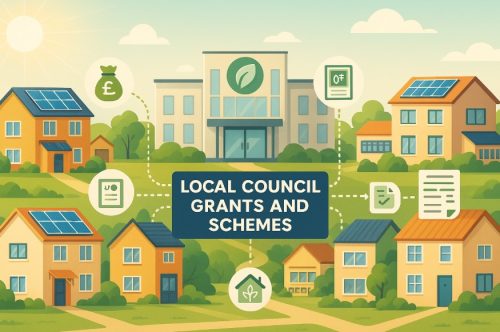
Local Council Grants and Schemes are financial incentives offered by individual councils across the UK to promote renewable energy and energy efficiency.
These schemes vary widely in their offerings, with many councils providing grants or low-interest loans for solar panel installations.
How Do Local Council Grants Work?
Local councils allocate funds to support energy-saving home improvements. These may include solar panel installations, insulation upgrades, and energy-efficient heating systems. The aim is to help households lower energy bills and reduce carbon emissions.
Eligibility for Local Council Grants
- Homeowners and tenants living within the council’s jurisdiction.
- Some grants are specifically aimed at low-income or fuel-poor households.
- Requirements differ by council but often include proof of income or energy efficiency ratings.
Application Process
To apply, visit your local council’s website or contact their energy efficiency department. Applications typically require documentation of property ownership, income status, and current energy efficiency measures. Funding is limited and usually allocated on a first-come, first-served basis.
9. Home Upgrade Grant (HUG)
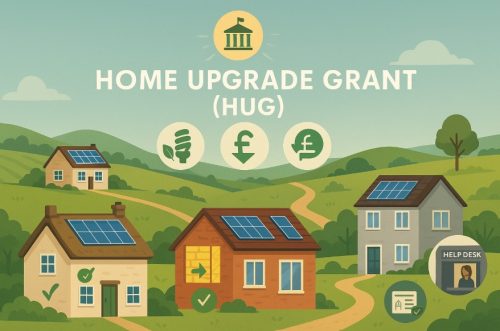
The Home Upgrade Grant (HUG) is a government initiative that focuses on improving the energy efficiency of low-income and off-grid households in England and Wales.
This grant is specifically designed for properties that are not connected to the gas grid, making renewable energy options like solar panels a priority.
How Does HUG Work?
HUG provides substantial financial aid up to £18,000, to cover the costs of solar panels, heat pumps, and other energy-efficient upgrades. The grant is aimed at improving energy efficiency in rural and low-income households, helping them reduce energy costs and carbon emissions.
Eligibility for Home Upgrade Grant
- Homeowners or tenants living in off-grid properties.
- Must meet low-income thresholds or receive government benefits.
- Properties with low EPC ratings (D, E, F, or G) are prioritised.
Application Process
Homeowners can apply for the HUG scheme through their local council or the UK government’s online portal.
The application process requires proof of income, property ownership, and energy performance certification. Once approved, funding is allocated for solar panel installations and other energy improvements.
10. VAT Reduction on Solar Panels
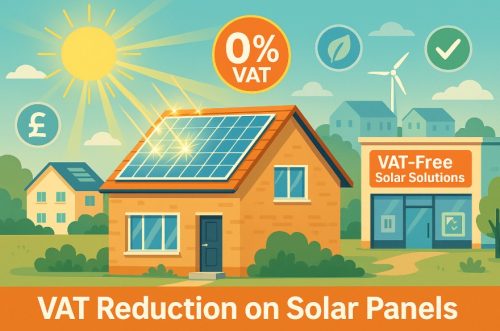
The VAT Reduction on Solar Panels is a government initiative that lowers the VAT rate on solar panel installations to 0% until April 2027. This reduction aims to make solar energy more affordable for homeowners across the UK.
How Does the VAT Reduction Work?
Previously, VAT on solar panels was set at 5%, but the government has now reduced it to 0%. This applies to both new installations and the addition of solar batteries.
It effectively lowers the overall cost of solar installations, saving homeowners around £1,900 on average.
Eligibility for VAT Reduction
- Available to all UK homeowners installing solar panels.
- No special requirements or applications are needed.
- Automatically applied at the point of sale by the installer.
Application Process
There is no application required. Homeowners simply need to work with a VAT-registered installer, and the discount is applied directly to the installation invoice.
Conclusion
Solar energy is an excellent way to reduce your carbon footprint and lower your energy bills. With various government grants and schemes available in the UK for 2025, the cost of installing solar panels has become much more accessible.
Programs like ECO4, the Green Homes Grant, and the Smart Export Guarantee (SEG) provide financial support and ongoing savings.
By understanding the eligibility criteria and taking advantage of these schemes, you can contribute to a greener future while enjoying long-term financial benefits. Now is the perfect time to explore your options and make the switch to solar energy.
FAQs About Government Grants for Solar Panels UK
Are solar panel grants available for rental properties in the UK?
Yes, solar panel grants are available for rental properties if the landlord agrees to the installation and meets the eligibility requirements for the specific scheme. Local authority grants and ECO4 are particularly accessible for rented homes.
How long does it take to receive funding from government solar schemes?
The approval process for government solar schemes can take anywhere from a few weeks to a few months, depending on the program and application completeness. Once approved, installation timelines vary based on availability and supplier schedules.
Do I need planning permission to install solar panels with grant support?
In most cases, planning permission is not required for solar panels unless the property is in a listed building or conservation area. Local councils can provide specific guidelines if additional permissions are needed.
Can I still get government grants if I use a private installer?
Yes, you can still receive government grants if you use a private installer, provided they are accredited and meet the standards required by the scheme, such as MCS certification.
Is there a deadline to apply for solar panel grants in 2025?
Most solar panel grants in 2025, such as the ECO4 scheme, are ongoing until at least 2026. However, it is advisable to apply early as funding availability can vary.
How much money can I save on energy bills with solar panel grants?
The amount you can save depends on the size of your solar panel system and energy consumption. On average, households save between £329 and £706 annually, with additional earnings from SEG payments.
Do government grants cover maintenance costs for solar panels?
Generally, government grants cover only the installation costs and not ongoing maintenance. However, some community energy schemes may include maintenance in their funding packages.