

Last Updated – 27-10-2026
PO Box 187 Havant has been associated with Lloyds Bank correspondence, including a debit card reported by a recipient in April 2020.
However, that report identifies postcode PO9 5TL, not PO9 9AQ, and there is insufficient verified evidence to confirm whether both addresses refer to the same mailing service or remain in use today.
If you have received a letter displaying this return address, particularly one addressed to somebody who does not live at your property, the important thing is to identify the sender safely and prevent further incorrect deliveries.
Is PO Box 187 Havant PO9 9AQ the Correct Postal Address?
There is an important discrepancy between the two postcodes associated with PO Box 187 Havant.
A historical entry on Who Wrote Me, published on 3 April 2020, identifies Lloyds Bank as the sender of a new debit card using PO Box 187, Havant, PO9 5TL.
However, the address PO Box 187, Havant, PO9 9AQ appears in other online references without equally clear supporting evidence.
| Address detail | PO9 5TL | PO9 9AQ |
| Location | Havant, Hampshire | Havant, Hampshire |
| PO Box number | 187 | 187 |
| Public evidence | Historical Lloyds debit-card report | Limited independent confirmation |
| Postcode sector | PO9 5 | PO9 9 |
| Current bank association | Not independently confirmed | Not independently confirmed |
| Verification needed | Royal Mail postcode check | Royal Mail postcode check |
The distinction matters because PO9 9 is identified in postal geography data as a non-geographic sector, potentially accommodating large organisations and specialist mailing arrangements.
Therefore, it would be incorrect to conclude that PO9 9AQ cannot exist simply because PO9 9 does not appear in ordinary residential postcode listings.
Before publishing either postcode as the verified address, check it using the Royal Mail Postcode Finder.

Royal Mail Postcode Finder showing the address-search facility used to verify PO Box 187 Havant and its postcode. Source: Royal Mail official website. Search both PO9 5TL and PO9 9AQ and capture the actual results; do not imply either has been confirmed if no result appears.
Who Uses PO Box 187 Havant and What Is It Used For?
The strongest historical evidence connects the address with Lloyds Bank debit-card correspondence.
The Who Wrote Me record identifies:
- Sender: Lloyds Bank
- Postal address: PO Box 187, Havant, PO9 5TL
- Mail carrier: UK Mail
- Contents: New debit card
- Date reported: 3 April 2020
This is a reader-submitted record, rather than an official Lloyds Bank confirmation of the PO Box’s ownership.
Banks commonly operate centralised mailing facilities for issuing cards, processing returned correspondence and handling customer communications.
Other Lloyds-related postal addresses have also been reported, including PO Box 204 Huddersfield and PO Box 8029 Kidderminster.
However, there is no reliable basis for stating that PO Box 187 specifically handles debt recovery, insurance claims, mortgage arrears or court notices.
Those activities should not be attributed to this address without documentary confirmation.
Is PO Box 187 Connected to Halifax or Bank of Scotland?
Lloyds Bank, Halifax and Bank of Scotland are part of Lloyds Banking Group.
The group allows personal customers to access certain everyday banking services across its participating branch network.
That relationship explains why someone investigating Lloyds correspondence may also encounter Halifax or Bank of Scotland.
Nevertheless, shared ownership does not establish that all three brands use PO Box 187 Havant.
Recipients should verify the particular brand shown on their correspondence rather than assuming the envelope originated from another group company.
What Should You Do If a Letter Arrives for Someone Who Does Not Live at Your Address?
One of the most significant problems associated with this PO Box is incorrectly addressed financial mail.
Comments on the historical Who Wrote Me entry describe correspondence arriving for former occupants, deceased previous owners and people who reportedly never lived at the property.
Some readers also mention receiving apparent bank cards and PIN-related letters.
These accounts are unverified individual experiences, not confirmed findings of fraud.
If you receive similar correspondence, follow these steps.
Step 1: Keep the Envelope Unopened
Do not deliberately open a letter addressed to somebody else.
Opening incorrectly delivered mail with the intention of causing another person detriment and without reasonable excuse can constitute an offence under the Postal Services Act 2000.
If you accidentally open an envelope before noticing the recipient’s name, stop reading its contents and explain the mistake when returning it.
Step 2: Mark the Letter for Return
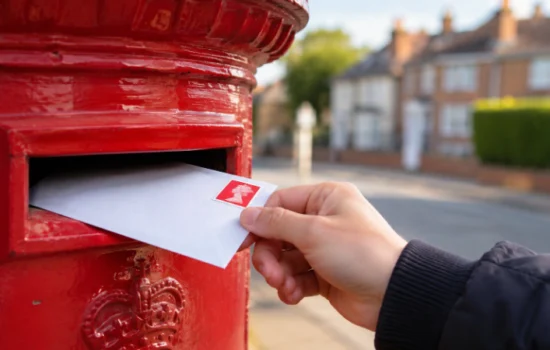
Royal Mail advises recipients of somebody else’s mail to cross out the delivery address and write:
“Not known at this address – Return to sender.”
Alternatively, use “No longer lives here” when the addressee is a former occupant.
Place the unopened envelope in a Royal Mail postbox. Normally, you do not need to purchase another stamp.

Royal Mail’s official instructions for dealing with somebody else’s mail, including returning an incorrectly addressed letter. Source: Royal Mail Help Centre, “I’ve received someone else’s mail”.
Step 3: Contact the Bank Independently
If the envelope suggests that it contains a bank card, security information or repeated financial correspondence, contact the relevant bank through its official customer service channel.
Explain that the addressee does not live at your property and ask the bank to investigate its address records.
The bank may be unable to discuss another customer’s account because of confidentiality requirements.
However, it can receive information about an apparent incorrect mailing address.
Step 4: Keep a Record of Repeated Deliveries
Record the delivery dates, sender details visible externally and whether items were returned.
Do not photograph or publish sensitive information.
If the same problem continues, request that the bank records team investigate the repeated incorrect deliveries.
Returning one envelope does not necessarily correct the sender’s customer database.
What If a Bank Card or PIN Arrives for a Complete Stranger?
Receiving an unexpected debit card or PIN envelope addressed to somebody who has never lived at your property can raise identity-fraud concerns.
However, one incorrectly addressed letter does not establish that fraud has occurred.
Possible explanations include outdated records, application errors, incorrect address entry or deliberate misuse.
If multiple items arrive in unfamiliar names:
- Leave the envelopes sealed.
- Contact the bank using an independently verified telephone number.
- Explain that the named individuals have never lived at your address.
- Ask the bank to refer the matter to its fraud or account-security team.
- Keep a record of the report and return the correspondence as instructed.
Never activate, test, photograph or attempt to use somebody else’s card.
Lloyds Bank explains that payment cards and PINs can be issued separately for security reasons. Consequently, the arrival of two envelopes may be consistent with genuine banking correspondence, but it does not establish who submitted the application.
If you suspect your own identity has been misused, examine your credit reports for unfamiliar accounts or searches.
What If the Letter Names a Deceased Person or Previous Tenant?
Letters for previous occupants do not automatically mean that a property is associated with outstanding debt.
If the recipient has moved away, mark the unopened correspondence as undeliverable.
Where the previous occupant has died, use “Addressee deceased – Return to sender” if you know that information to be accurate.
A deceased person’s executor or authorised representative can contact the bank’s bereavement department, where appropriate.
For unrelated householders, returning correspondence is generally preferable to attempting to manage the deceased person’s financial affairs.
What If Debt Collectors or Bailiffs Contact Your Property?
Receiving another person’s debt letter does not make you responsible for their debt.
If an enforcement agent contacts you, explain that you are not the debtor and request that their records be corrected.
Citizens Advice recommends supplying suitable evidence where needed, such as a recent council tax bill or tenancy-related documentation.
For a genuine enforcement notice, act promptly rather than simply ignoring it. Verify the agency independently and keep copies of correspondence.
How Can You Tell Whether a Letter From PO Box 187 Is Genuine?
A PO Box return address cannot independently prove a letter’s authenticity.
Fraudsters can print genuine company names, logos or return addresses on correspondence without controlling the organisation’s actual PO Box.
The following checks provide a more reliable assessment.
| What to check | More reassuring indication | Warning sign |
| Sender | Recognisable organisation confirmed independently | Company cannot be verified |
| Bank account | Correspondence matches recent activity | Unknown account or application |
| Payment request | Confirmed through the bank’s own channels | Urgent transfer to unfamiliar account |
| Telephone number | Matches official bank details | Different number presented as mandatory |
| Security information | No request to reveal confidential credentials | Requests for PINs or passwords |
| Website | Genuine bank domain | Lookalike website or suspicious QR code |
What Does a Suspicious Bank Letter Look Like?
Consider this fictional example:
“Your bank account will be suspended within 24 hours. Call the security department immediately, confirm your PIN and transfer your balance into a protected account.”
The principal warning signs are:
- Artificial urgency: A threat designed to prevent independent checks.
- Sensitive information request: Banks do not need customers to disclose their PIN.
- Unusual payment instructions: Moving money to another account is a recognised fraud warning.
- Unverified contact details: The telephone number may connect to criminals.
This is an illustrative example, not an actual letter from PO Box 187.
Liz Ziegler, Fraud Prevention Director at Lloyds, warned in a June 2026 Lloyds Banking Group statement:
“Scams are becoming more convincing, targeted and emotionally manipulative, making them harder to spot”
Her observation reinforces why verification should depend on independent banking channels rather than the appearance of an envelope.
Customers should also compare unexpected correspondence with their own banking app, recent statements and genuine account notifications.
How Can You Contact Lloyds, Halifax or Bank of Scotland About PO Box 187?
There is no independently verified customer helpline specifically assigned to PO Box 187 Havant.
Instead, contact the bank identified by the correspondence.
| Banking brand | General personal banking number | Official website |
| Lloyds Bank | 0345 300 0000 | lloydsbank.com |
| Halifax | 0345 720 3040 | halifax.co.uk |
| Bank of Scotland | 0345 721 3141 | bankofscotland.co.uk |
These numbers appear on the respective banks’ official contact pages. Check them again before calling, as services and opening hours can change.
For suspected fraud, use the dedicated fraud-reporting option on the appropriate bank’s website or app.
Do not use a telephone number printed on an unverified letter simply because it claims to be from Lloyds Banking Group.
How Can You Stop Incorrect Bank Letters Arriving Repeatedly?
Repeated returns sometimes fail because the company continues using an outdated address record.
Contact the bank and request an investigation into the incorrect correspondence.
The following wording can be adapted for a secure message, letter or customer service enquiry.
Subject: Incorrectly Addressed Banking Correspondence
Dear Customer Services,
I am receiving banking correspondence addressed to an individual who does not reside at my property.
The recipient’s name is [Name on envelope], and the delivery address is [Your address].
I have returned the correspondence marked “Not known at this address”, but further letters have continued to arrive.
Please investigate the incorrect address association, update your records where appropriate and take reasonable steps to prevent further correspondence being sent here.
Please confirm that my notification has been recorded.
Yours faithfully,
[Your name]The Information Commissioner’s Office explains that individuals can challenge inaccurate personal data held about them under the right to rectification.
Where the records concern somebody else, the organisation may need to investigate without disclosing that person’s private information.
Where Should You Report Suspicious Letters or Possible Fraud?
The appropriate reporting route depends on what has happened.
- Lloyds Banking Group: Contact the bank directly if correspondence appears fraudulent, a card has been issued unexpectedly or your account may be compromised.
- Report Fraud: Since 4 December 2025, Report Fraud has replaced Action Fraud for fraud and cybercrime reporting in England, Wales and Northern Ireland. Reports can be made through reportfraud.police.uk or by calling 0300 123 2040. In Scotland, contact Police Scotland on 101.
- Financial Conduct Authority: If a letter claims to be from an unfamiliar financial firm, use the FCA Firm Checker to check its authorisation, permissions and contact information.
- A legitimate entry on the FCA Register does not prove that every letter using a firm’s name is authentic.
- Royal Mail: Report repeated delivery problems or concerns about postal handling through Royal Mail’s customer support service.

FCA Firm Checker showing how consumers can verify a financial organisation’s authorisation and contact details. Source: Financial Conduct Authority.
Why Do Financial Institutions Use PO Boxes Instead of Branch Addresses?
Banks frequently use centralised addresses to manage high volumes of correspondence.
These arrangements may support card distribution, document processing, operational separation and returned-mail handling.
A PO Box does not necessarily represent a customer-facing branch.
For individuals or businesses interested in the service itself, the process is covered in how to set up a PO Box in the UK.
Royal Mail also operates Keepsafe, which temporarily holds eligible mail during an absence. That service is different from a PO Box or Redirection and is not intended to remove previous occupants from banks’ mailing databases.
Likewise, Royal Mail tracking information can help establish an item’s delivery progress where a tracking service applies, but it cannot reliably identify the actual business that produced a letter.
FAQs About PO Box 187 Havant
Who owns PO Box 187 Havant PO9 9AQ?
Lloyds Bank has been linked to PO Box 187 through a historical report using PO9 5TL. Current ownership or exclusive use of the PO9 9AQ version has not been independently established.
Is PO9 9AQ a valid postcode?
PO9 9 is described as a non-geographic postal sector, but that does not confirm the individual postcode PO9 9AQ. Check Royal Mail’s official address database before relying on it.
Is PO Box 187 Havant linked to Halifax?
Halifax and Lloyds Bank belong to Lloyds Banking Group. However, no sufficiently reliable evidence confirms Halifax specifically uses PO Box 187.
Why have I received a Lloyds letter when I am not a customer?
The letter might concern a previous resident, an incorrect address record or another banking customer. Contact Lloyds independently if the contents or repeated deliveries raise concerns.
Is it safe to open a letter addressed to someone else?
It is best not to open it. Return the sealed envelope through Royal Mail, particularly when it may contain confidential financial information.
What should I do if a debit card arrives for a stranger?
Do not activate or use it. Contact the issuing bank through official channels, explain the incorrect delivery and follow its instructions.
Will returning a letter stop future mail?
Not necessarily. Returning correspondence alerts the sender, but the organisation may need to correct its records separately.
Can somebody use my address to open a bank account?
An individual may enter an address without the occupier’s permission, but banks have identity-verification requirements. Unexpected banking correspondence does not by itself prove a successful fraudulent application.
Am I responsible for a former tenant’s bank debt?
No. Merely living at a property previously occupied by a debtor does not transfer that person’s debts to you.
What if the named recipient died years ago?
Return the envelope marked “Addressee deceased” if accurate. An authorised executor can separately notify the bank through its bereavement service.