

As businesses expand across markets and channels, the traditional payment gateway model shows its limits. Companies need more control over how transactions are processed, how providers are connected, and how performance can be optimised. This demand led to the emergence of a new approach: payment orchestration.
Today, payment architecture has moved far beyond single-provider integrations. Modern platforms rely on flexible orchestration layers that connect multiple payment service providers (PSPs), manage routing logic, and unify data across the payment stack.
Understanding this evolution helps businesses build a payment strategy that supports growth, resilience, and global scalability.
How Payment Gateways Work in Online Payments?
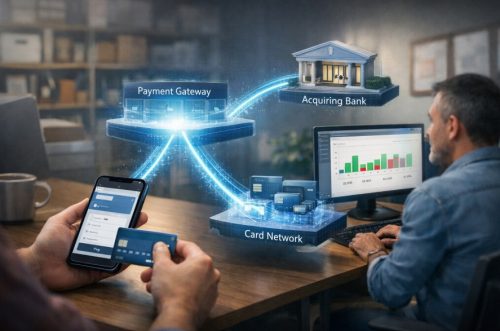
In the early days of e-commerce, online payment infrastructure followed a relatively straightforward model. Merchants integrated with a single payment gateway that served as an intermediary between their websites and the acquiring bank, which processed the transaction.
A payment gateway performed several essential tasks:
- Securely capture payment data
- Transmit it to the acquiring bank
- Return an approval or decline message to the merchant
This architecture simplified online payments and enabled businesses to start accepting card payments without building their own processing infrastructure.
However, as digital commerce expands globally, the demands placed on payment systems have increased. Businesses began accepting multiple currencies, integrating alternative payment methods (APMs), and working with several acquirers to improve approval rates. Each new requirement added complexity.
The traditional gateway model was not designed for this level of flexibility. Merchants often had to create separate integrations for each provider or region, resulting in fragmented systems that were difficult to maintain. Even relatively simple changes, such as adding a new payment provider, could require significant development effort.
As transaction volumes grew and payment ecosystems expanded, the limitations of gateway-based payment architecture became increasingly clear.
How Has the Evolution of Online Payment Architecture Transformed Modern Payment Systems?
Key Limitations of Single-Gateway Payment Architecture
Legacy payment architecture built around a single payment gateway often struggles to support the demands of modern commerce.
The main challenges of legacy architectures typically include:
- Vendor dependency: When a merchant relies on a single payment gateway or acquiring bank, that provider becomes the central point of the entire payment setup. If outages, regional restrictions, or weaker approval rates occur, the business has limited ability to respond.
- Integration complexity: As companies grow, they often need to connect multiple PSPs to support new markets, payment methods, or acquiring relationships. Without an orchestration layer, every new connection requires separate integration work, API maintenance, and operational setup.
- Fragmented operations: Multiple direct integrations usually mean multiple dashboards, reporting formats, and reconciliation workflows. This creates extra work for engineering, finance, and operations teams, while making it harder to maintain a unified view of performance.
- Difficulties scaling payments: Expanding into new regions often requires local providers, APMs, and market-specific compliance support. In a fragmented payment architecture, each new addition increases development effort and operational risk, slowing and making scaling payments more resource-intensive.
- Limited routing intelligence: Legacy systems rarely offer dynamic routing or failover logic. Transactions are often sent through a fixed provider, regardless of changing conditions such as issuer behaviour, regional performance, or temporary provider disruption.
These limitations have driven the industry toward more flexible and intelligent payment infrastructure models.
Payment Orchestration Explained: A New Approach to Payment Architecture
Payment orchestration emerged as a response to the growing complexity of digital payments. Rather than integrating with multiple providers individually, businesses can connect through a central orchestration layer that manages the entire payment ecosystem.
At its core, payment orchestration acts as a control layer between the merchant and the underlying payment providers. This layer connects multiple PSPs, acquirers, and payment methods through a single platform while allowing businesses to define how each transaction should be processed.
Using this approach, businesses connect once to the orchestration platform and access a network of payment services through that single integration, rather than maintaining separate integrations for each provider.
The orchestration layer also introduces intelligent transaction management. Businesses can configure routing rules that determine which provider processes a payment based on factors such as geography, currency, payment method, or historical approval rates. If a transaction fails, cascading logic can automatically retry it through an alternative provider.
These capabilities directly impact payment performance. By routing transactions through the most effective processing path, orchestration platforms help reduce decline rates and increase approval rates. Even small improvements in payment success rates can translate into significant revenue gains for high-volume merchants.
Payment orchestration also improves operational efficiency. Reporting, reconciliation, and monitoring can be unified across all connected providers, giving teams a single source of truth for payment performance.
As global commerce continues to expand, orchestration platforms have become an increasingly important component of modern payment architecture.
How Payment Orchestration Powers Modern Payment Infrastructure?

Payment orchestration has become a defining layer of modern payment infrastructure.
At the centre of this model is the orchestration layer: a control point that connects gateways, PSPs, acquirers, fraud tools, and APMs within a single framework.
Instead of building and maintaining separate integrations for each provider, businesses connect once and manage their entire payment ecosystem in a single environment. This shifts payments to a more unified, adaptable operating model.
Key Benefits of Payment Orchestration for Businesses
- Simpler integration management: With an orchestration layer, businesses avoid maintaining multiple direct connections to different PSPs and acquirers. One integration gives access to a broader payment ecosystem, reducing development effort and making the overall payment architecture easier to manage.
- Smarter transaction routing: Payment orchestration allows companies to define how transactions should be processed based on geography, currency, payment method, issuer behaviour, or provider performance. This makes routing more responsive and more closely aligned with business goals.
- Higher approval rates: By directing transactions through the most effective provider and applying cascading or failover logic when needed, orchestration helps reduce declines and improve payment success rates. For businesses processing high volumes, even a modest uplift can have a measurable commercial impact.
- Support for scaling payments: As companies expand into new markets, they often need local acquirers, region-specific compliance coverage, and new payment methods. A modern payment architecture makes scaling payments more practical by allowing these additions without rebuilding the entire payment stack each time.
- Broader payment method coverage: Modern payment infrastructure is no longer limited to card payments. Digital wallets, bank transfers, real-time payment rails, and local APMs all play an important role. An orchestration layer helps businesses bring these options into a single system without creating additional fragmentation.
- Unified visibility and control: One of the biggest advantages of orchestration is consolidated reporting. Rather than pulling data from multiple provider dashboards, teams can monitor transaction performance, approval rates, costs, and regional trends through a single view. This supports a stronger, more data-driven payment strategy.
- Greater operational resilience: A more flexible architecture reduces dependency on any single provider. If one PSP or acquirer underperforms or becomes unavailable, transactions can be rerouted through alternative channels, helping businesses maintain continuity.
- Support for platform and white-label models: For organisations launching branded payment services, a white-label payment gateway solution can complement orchestration-based infrastructure by providing the front-end payment experience while the underlying platform handles integrations and transaction logic.
This is why payment orchestration has become central to modern payment architecture. It gives businesses more control over how payments are processed, improves the ability to adapt across markets, and turns payment infrastructure into a strategic asset.
With platforms such as Corefy, payments stop being a fragmented ecosystem and become unified into a single operational environment.
What Payment Orchestration Means for Your Payment Strategy?
The shift from gateway-centric systems to orchestration-based payment architecture reflects a broader transformation in how businesses approach payments as part of their growth strategy.
With orchestration-based architecture, companies can design a flexible payment strategy that adapts to changing market conditions. They can connect new providers more quickly, optimise routing to improve approval rates, and support new payment methods without rebuilding their systems.
Also, orchestration helps reduce risk. By distributing transactions across multiple providers, businesses avoid dependency on a single gateway or acquirer. If one provider experiences disruptions, transactions can be rerouted through alternative channels.
As payment ecosystems continue to expand, orchestration-based payment architecture provides the flexibility and control businesses need to operate effectively in a global payments landscape.