


Vending is one of those businesses that looks simple from the outside and reveals its complexity once you’re in it. The basic model is straightforward: place a machine in a location, fill it with product, collect the revenue.
The reality involves site negotiations, margin management, machine maintenance, restocking logistics, and the ongoing work of finding and keeping the locations that make the economics work.
None of this is insurmountable. A vending business run intelligently can produce genuine passive income once the operational systems are established. But the path to that point requires more planning than the category’s apparent simplicity suggests.
Understanding the Economics Before You Start

The profitability of a vending business is determined by a small number of variables that interact in ways worth understanding before committing capital. Location is the primary driver of volume, and volume is the primary driver of everything else.
A machine in a high-footfall location with limited alternative options, a workplace with no nearby café, a gym, or a hospital waiting area, generates consistently more revenue than the same machine in a quieter location.
The difference between a good site and an average one can be the difference between a machine that covers its costs and one that contributes meaningfully to profit.
Product margin matters as much as volume. Each item sold needs to generate enough margin to cover the cost of the product, the cost of servicing the machine, any commission paid to the site owner, and a contribution to the machine’s capital cost.
Understanding the margin per item and the volume required to reach profitability is basic arithmetic that should be done before a machine is placed rather than after.
Site commission is the cost most new operators underestimate. Site owners who understand the value of their location will negotiate a percentage of revenue or a flat fee as the price of access.
Commission rates vary considerably depending on how desirable the site is and how much negotiating leverage the site owner has. High commission at a high-volume site can still produce acceptable margins. High commission at a moderate-volume site often doesn’t.
Choosing the Right Machines
The machine is the capital investment that sets the parameters for everything else. Choosing well means matching the machine type to the location, the product offering to the customer, and the investment level to the realistic revenue potential of the sites you’re targeting.
Coffee vending machines are among the highest-margin vending categories. A cup of hot beverage produced by a commercial vending machine at a cost of thirty to fifty pence, sold for £1.50 or more, generates a margin that confectionery or cold drinks don’t typically match.
For this reason, hot beverage machines are disproportionately attractive relative to their capital cost, and sites that support high beverage consumption, such as offices, healthcare settings, educational institutions, and transport hubs, are among the most sought-after in the vending industry.
The quality of the machine matters more in beverages than in most other vending categories, because customers have a direct sensory experience of the product and will avoid a machine that produces poor coffee.
A machine that grinds fresh beans, uses the correct water temperature, and produces a consistent result will retain customers in a way that a lower-quality machine won’t.
New machines carry a warranty and produce reliable output but require significant capital. Refurbished machines reduce the entry cost but carry maintenance risk that should be assessed carefully.
Leasing a machine, rather than purchasing, converts the capital cost into a monthly operational expense and typically includes maintenance and servicing, which removes a variable that can be difficult to manage in the early stages of a vending operation.
Finding and Securing Sites
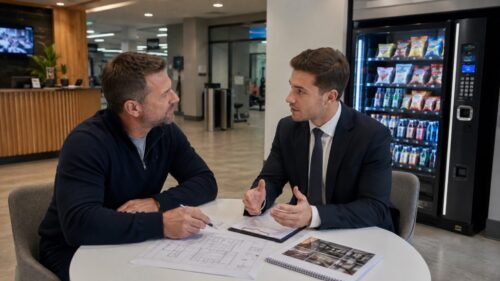
Site acquisition is the most time-intensive part of launching a vending business and the one that most determines the outcome. The sites available to a new operator are rarely the most desirable ones, which tend to be held by established operators with existing relationships.
Building a portfolio requires either finding sites that aren’t currently served, approaching businesses whose existing provision is inadequate, or offering something that differentiates from what’s already in place.
A cold approach to a business works better with a clear proposition, here’s the machine, here’s what it costs the site owner (often nothing), here’s what customers will get, and here’s the revenue share if you want one.
Site owners are deciding whether to give up floor space and take on a minor management relationship. Making that decision as easy as possible increases the conversion rate.
Contracts with site owners should specify the terms clearly: the length of the agreement, the commission arrangement, who is responsible for maintenance, and what happens if the machine underperforms. A verbal agreement creates ambiguity that becomes costly when something goes wrong.
What the First Year Actually Looks Like?
The first year of a vending business is characterised by learning rather than optimised profitability. Machines underperform at some sites and overperform at others.
Maintenance issues arise that weren’t anticipated. Restocking schedules need calibration as actual consumption patterns become clear. Some site relationships work, and some don’t.
Operators who approach the first year as a period of system development, building the operational processes that allow the business to scale, rather than expecting immediate profitability, are in a better position than those who judge the business on early revenue alone.
The vending businesses that reach genuine profitability typically have three things in common, a portfolio of sites with enough volume to cover fixed costs comfortably, operational systems that allow restocking and maintenance to be done efficiently, and a clear view of which sites are contributing positively and which should be replaced.
Getting to that point takes time and iteration. The businesses that get there are the ones that kept going long enough to learn what works.