


The main taxes a UK small business may pay are:
- Income Tax on the taxable profits of sole traders and business partners.
- Class 4 National Insurance on qualifying self-employed profits.
- Corporation Tax on the taxable profits of limited companies.
- VAT when taxable turnover exceeds the registration threshold, or after voluntary registration.
- Employer’s National Insurance when the business employs staff above relevant earnings thresholds.
- Dividend tax when company shareholders receive taxable dividends.
- Business rates when the business occupies qualifying non-domestic premises.
- Capital Gains Tax in certain cases where an individual sells business assets or disposes of a business.
Other liabilities may apply to particular sectors, products, transactions or business activities.
Which Taxes Apply to Each Business Structure?

The legal structure of a business is one of the main factors determining how its profits are taxed.
What Taxes Does a Sole Trader Pay?
A sole trader and the business are treated as the same legal person for tax purposes. The owner generally pays Income Tax and self-employed National Insurance through Self Assessment.
Tax is normally calculated on taxable profit, not total sales and not the amount the owner withdraws from the business.
Taxable profit is broadly calculated as:
Business income − allowable business expenses = taxable business profit
Personal withdrawals are not normally treated as business expenses. Taking less money out of the business does not, by itself, reduce a sole trader’s taxable profit.
Sole traders may therefore need to account for:
- Income Tax;
- Class 4 National Insurance;
- VAT, where registered;
- business rates, where applicable;
- PAYE and employer National Insurance, if they employ staff;
- Capital Gains Tax when selling certain business assets.
What Taxes Does a Partnership Pay?
In a conventional partnership, the partnership calculates its trading profit and reports it through a partnership tax return. Each individual partner then generally pays Income Tax and National Insurance on their allocated share of the taxable profit.
Each partner normally registers for Self Assessment, while the partnership itself must also be registered.
Partners may owe tax on their allocated share even if they leave some of the cash within the business. The partnership agreement and tax allocation should therefore be reviewed carefully.
Limited liability partnerships are normally taxed in a broadly similar way to conventional partnerships, although additional rules can apply.
What Taxes Does a Limited Company Pay?
A limited company is legally separate from its directors and shareholders. It normally pays Corporation Tax on taxable profits arising from:
- trading activities;
- investments;
- chargeable gains from selling assets.
The company may also have VAT, PAYE, employer National Insurance and business rates obligations.
Directors and shareholders can then face separate personal tax charges on salary, benefits, dividends, interest or other payments received from the company. This means company profits and the owner’s personal income must not be treated as the same thing.
Businesses can check the official Corporation Tax rates before estimating their company liability.
How Much Income Tax Does a Sole Trader Pay?
For the 2026/27 tax year, the standard Personal Allowance is generally £12,570. In England, Wales and Northern Ireland, taxable non-savings income is generally charged at:
- 20% basic rate: on the first £37,700 above the Personal Allowance;
- 40% higher rate: on taxable income from £37,701 to £125,140;
- 45% additional rate: on taxable income above £125,140.
The Personal Allowance is reduced by £1 for every £2 of adjusted net income above £100,000. It can be completely removed at sufficiently high income levels.
Scottish taxpayers use separate Scottish Income Tax bands for earnings, self-employment income and most pension income. For 2026/27, the Scottish rates range from 19% to 48%, depending on the relevant band.
A sole trader’s other income is combined with business profit when determining the Income Tax band. Employment income, rental income, pensions, savings and dividends can therefore affect the final calculation.
Example: Sole Trader With £40,000 Taxable Profit
Consider a sole trader in England with:
- £65,000 of business turnover;
- £25,000 of allowable expenses;
- £40,000 of taxable profit;
- no other income;
- a full £12,570 Personal Allowance.
The simplified calculation would be:
Income Tax
£40,000 − £12,570 = £27,430 taxable at 20%.
£27,430 × 20% = £5,486
Class 4 National Insurance
£40,000 − £12,570 = £27,430 subject to the 6% main Class 4 rate.
£27,430 × 6% = £1,645.80
The combined illustrative liability would therefore be approximately £7,131.80.
This example excludes student loan repayments, pension contributions, Capital Gains Tax, other income, tax reliefs, payments on account and adjustments. The Income Tax result would also differ for a Scottish taxpayer.
Does a Sole Trader Pay National Insurance?

A self-employed person with profits above £12,570 generally pays Class 4 National Insurance in 2026/27 at:
- 6% on profits from £12,570 to £50,270;
- 2% on profits above £50,270.
Where profits are at least £7,105, Class 2 contributions are normally treated as paid to protect the person’s National Insurance record, without an actual Class 2 payment being required.
Someone with profits below £7,105 may be able to make voluntary Class 2 contributions at £3.65 per week.
National Insurance should not be confused with Income Tax. Both charges can arise on the same taxable self-employed profit.
How Much Corporation Tax Does a Small Company Pay?
For the financial year beginning 1 April 2026:
- Companies with taxable profits of £50,000 or less generally pay the 19% small profits rate.
- Companies with taxable profits above £250,000 generally pay the 25% main rate.
- Companies with profits between those limits may receive marginal relief, creating a gradual increase in the effective rate.
The thresholds are proportionately reduced for short accounting periods and divided according to the number of associated companies. Investment income and other amounts can also affect the marginal relief calculation.
Example: Company With £60,000 Taxable Profit
Suppose a limited company has £60,000 of taxable profit, a 12-month accounting period and no associated companies or relevant distributions.
A simplified marginal relief calculation would produce Corporation Tax of approximately £12,150, equivalent to an effective rate of about 20.25%.
This is higher than simply applying 19% to all £60,000, but lower than applying the full 25% main rate without marginal relief.
The company may then retain its post-tax profits or distribute some of them. Any salary or dividends paid to the owner can create separate personal tax liabilities.
Do Company Directors Pay Tax on Salary and Dividends?

A director’s salary is normally subject to PAYE Income Tax and employee National Insurance in the same general way as employment income. The company may also pay employer National Insurance.
Dividends are paid from profits remaining after Corporation Tax and are not normally deductible when calculating the company’s taxable profit.
For 2026/27, an individual has a £500 dividend allowance. Taxable dividends above that allowance are charged at:
- 10.75% within the basic-rate band;
- 35.75% within the higher-rate band;
- 39.35% within the additional-rate band.
The applicable band is determined after combining the dividends with the shareholder’s other income.
A dividend is not automatically tax-free simply because it is paid by a small company. The company must also have sufficient distributable profits before declaring a lawful dividend.
When Does a Small Business Have to Register for VAT?
A business must normally register for VAT when its VAT-taxable turnover exceeds £90,000 over any rolling 12-month period.
It must also register when it expects taxable turnover to exceed £90,000 within the next 30 days alone. Registration can therefore be triggered by a large contract even where the business has not yet exceeded the threshold historically.
VAT-taxable turnover includes sales that are:
- standard-rated;
- reduced-rated;
- zero-rated.
It generally excludes exempt sales and transactions outside the scope of UK VAT, although the detailed classification rules can be complex.
A business can register voluntarily below the threshold. This may allow it to reclaim eligible input VAT, but it will also have to charge VAT where required, maintain appropriate records and submit returns.
Further details are available in the official VAT registration guidance.
What VAT Rate Does a Small Business Charge?
The main VAT rates are:
| VAT category | Rate | General application |
| Standard rate | 20% | Most taxable goods and services |
| Reduced rate | 5% | Certain qualifying goods and services |
| Zero rate | 0% | Qualifying zero-rated supplies |
Some supplies are exempt or outside the scope of VAT. Zero-rated and exempt supplies are not the same: both may result in no VAT being added to the customer’s price, but the business’s ability to reclaim input VAT can differ.
The correct treatment depends on exactly what the business sells, where the customer is located and whether any special place-of-supply rules apply.
Example: Approaching the VAT Threshold
A consultancy generates £8,000 of VAT-taxable turnover every month.
After 11 months, its rolling taxable turnover is £88,000. After month 12, it reaches £96,000 and passes the £90,000 registration threshold.
The owner should not wait until the end of the accounting year to check. The threshold is tested using a rolling 12-month period, so turnover should normally be reviewed at the end of every month.
What Payroll Taxes Does a Small Employer Pay?

A business that employs staff usually has to operate PAYE, deduct employee Income Tax and National Insurance, and report payroll information to HMRC through Real Time Information.
For most employees in 2026/27, employer Class 1 National Insurance is charged at 15% on relevant earnings above the annual Secondary Threshold of £5,000.
Different thresholds or zero-rate bands can apply to qualifying apprentices, employees under 21, veterans, Freeport employees and Investment Zone employees.
Example: Employer National Insurance on a £30,000 Salary
For a standard employee earning £30,000 annually:
£30,000 − £5,000 = £25,000
£25,000 × 15% = £3,750 employer National Insurance
This is a simplified annual illustration. Actual payroll calculations are normally made for each pay period and can be affected by the employee’s National Insurance category.
Eligible businesses may reduce their employer National Insurance through the Employment Allowance, worth up to £10,500 per tax year.
However, eligibility conditions apply, and some single-director companies cannot claim where the director is the only employee liable for employer National Insurance.
Electronic PAYE payments are generally due by the 22nd of the following tax month. Employers that qualify to pay quarterly normally use the 22nd following the end of the relevant quarter.
Does a Small Business Pay Business Rates?
A business may pay business rates when it uses non-domestic property, such as:
- an office;
- a shop;
- a warehouse;
- a factory;
- a pub or restaurant;
- a holiday rental that meets the relevant conditions.
The rules and relief systems differ across England, Scotland, Wales and Northern Ireland.
In England, Small Business Rate Relief may provide 100% relief where a business occupies one property with a rateable value of £12,000 or less. Relief gradually reduces between £12,001 and £15,000.
For 2026/27, an eligible English property below £51,000 that does not receive full relief may use the 43.2p small business multiplier. Different multipliers apply to qualifying retail, hospitality and leisure premises and to higher-value properties.
Businesses should check their rateable value and relief entitlement with the relevant council or rating authority rather than assuming that being “small” automatically removes the charge.
Can Capital Gains Tax Apply to a Small Business?
Capital Gains Tax can arise when an individual sole trader or partner sells certain business assets, such as land, buildings, goodwill or the whole business.
Company shareholders may also face Capital Gains Tax when selling shares.
From 6 April 2026, the standard individual Capital Gains Tax rates are generally 18% and 24%, depending on the person’s taxable income and the nature of the gain. Where a disposal qualifies for Business Asset Disposal Relief, the qualifying rate is 18%.
Business Asset Disposal Relief is subject to detailed ownership, employment, trading and minimum-period conditions. It also has a £1 million lifetime limit.
Selling a business should therefore be planned carefully, ideally before contracts become unconditional.
Does Making Tax Digital Affect Small Businesses in 2026?
Making Tax Digital for Income Tax began applying from 6 April 2026 to certain sole traders and landlords whose qualifying self-employment and property income exceeded £50,000 in the 2024/25 tax year.
The planned timetable is:
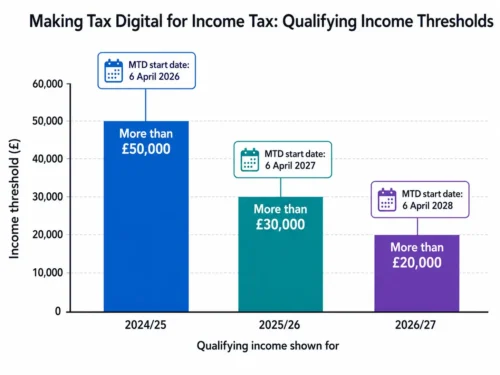
| Qualifying income shown for | Income threshold | MTD start date |
| 2024/25 | More than £50,000 | 6 April 2026 |
| 2025/26 | More than £30,000 | 6 April 2027 |
| 2026/27 | More than £20,000 | 6 April 2028 |
Those within the rules must use compatible software, maintain digital records and meet the reporting requirements. Exemptions may be available in limited circumstances, including certain forms of digital exclusion.
Qualifying income is generally based on gross self-employment and property income rather than taxable profit after expenses. Businesses should therefore not use their final profit figure when checking the threshold.
When Are Small Business Taxes Due?

Tax deadlines depend on the tax and business structure.
Self Assessment Deadlines
A new sole trader or partner normally registers for Self Assessment by 5 October following the end of the tax year in which trading began.
The standard deadlines are generally:
- 31 October for a paper tax return;
- 31 January for an online tax return;
- 31 January for the balancing payment and first payment on account;
- 31 July for the second payment on account.
Payments on account normally arise where the Self Assessment liability is more than £1,000 and less than 80% of the liability was collected at source.
Corporation Tax Deadlines
For most small companies:
- Corporation Tax is normally due nine months and one day after the accounting period ends.
- The Company Tax Return is normally due 12 months after the accounting period ends.
These are separate deadlines. The payment is generally due before the return.
VAT Deadlines
A VAT Return and the related payment are usually due one calendar month and seven days after the end of the VAT accounting period. Different deadlines can apply to businesses using annual accounting or payments on account.
How Can a Small Business Estimate Its Tax Liability?
A small business can create a more reliable tax estimate by following five steps:
- Confirm the legal structure. Establish whether the business is a sole trader, partnership or limited company.
- Calculate taxable profit. Separate turnover from profit and identify genuinely allowable expenses.
- Check VAT turnover separately. VAT registration is based on taxable turnover rather than accounting profit.
- Include employment and property costs. Add PAYE, employer National Insurance, pension duties and business rates where relevant.
- Create a deadline-based cash-flow forecast. Account for Self Assessment payments on account, VAT quarters and Corporation Tax deadlines.
Maintaining a separate tax reserve can reduce the risk of spending money that will later be due to HMRC. The amount required should be based on a realistic calculation rather than a universal percentage.
For wider UK business planning and operational information, readers can also explore www.topbusinessblog.co.uk.
Which Business Expenses Can Reduce Taxable Profit?
A business can generally deduct expenses incurred wholly and exclusively for its trade, subject to the rules applying to each cost.
Potentially allowable expenses may include:
- business insurance;
- accountancy fees;
- employee wages;
- qualifying travel costs;
- advertising and marketing;
- office costs;
- stock and raw materials;
- qualifying software and subscriptions;
- certain premises and utility costs.
Personal expenditure is not normally deductible. Where an expense has both business and private use, only the identifiable business proportion may be allowable.
Some purchases are treated under capital allowance rules rather than deducted as an ordinary day-to-day expense. VAT recovery also follows separate rules from Income Tax or Corporation Tax deductibility.
Final Takeaway
The taxes paid by a UK small business depend primarily on its structure and activities.
A sole trader will commonly pay Income Tax and Class 4 National Insurance on taxable profits.
A limited company generally pays Corporation Tax, while its owners may separately pay tax on salaries, benefits or dividends. VAT, payroll taxes, business rates and Capital Gains Tax may apply in addition.
For 2026/27, the most important figures include the £90,000 VAT registration threshold, Corporation Tax rates ranging from 19% to 25%, the £12,570 Personal Allowance, Class 4 National Insurance rates of 6% and 2%, and employer National Insurance charged at 15% above the standard £5,000 Secondary Threshold.
Accurate bookkeeping, regular turnover checks and a calendar of filing and payment deadlines can help a business identify liabilities early.
Where ownership arrangements, associated companies, international sales, property, large asset purchases or business disposals are involved, professional advice may be appropriate.
Frequently Asked Questions
How Much Can a Small Business Earn Before Paying Tax?
There is no universal tax-free business turnover limit. A sole trader may benefit from a £12,570 Personal Allowance, but it is shared with other taxable income. A company’s first pound of taxable profit can potentially be subject to Corporation Tax.
Does a Small Business Pay Tax in Its First Year?
It may do. Tax normally depends on taxable profits and other relevant liabilities rather than how long the business has traded. Payment may not be due until after the first accounting period, but the liability can arise from the beginning of trading.
Does a Small Business Pay Tax on Profit or Turnover?
Income Tax and Corporation Tax are generally charged on taxable profit. VAT registration and Making Tax Digital thresholds can depend on qualifying turnover or gross income instead.
Does Every Limited Company Have to Register for VAT?
No. A limited company generally registers when its VAT-taxable turnover exceeds the compulsory threshold or when it chooses to register voluntarily.
Can a VAT-Registered Business Reclaim All the VAT It Pays?
Not always. Input VAT must normally relate to taxable business activities and meet the evidence requirements. Restrictions apply to private use, exempt activities, entertainment, certain vehicles and other expenditure.
Are Business Rates the Same as Corporation Tax?
No. Corporation Tax is charged on a company’s taxable profits. Business rates are property-based charges connected with qualifying non-domestic premises.
Can a Company Director Take Money Out Without Paying Tax?
Not automatically. Salary, dividends, benefits, expense reimbursements and director’s loans have different legal and tax treatments. Incorrect withdrawals can create additional tax and company-law problems.
What Happens If a Small Business Cannot Pay HMRC?
The business should contact HMRC as early as possible. A Time to Pay arrangement may be available depending on the amount owed, filing position, payment history and ability to meet an agreed schedule. Interest may continue to accrue.
Note: This article has been reviewed against official HM Revenue & Customs and GOV.UK guidance.